


Page 68 - JURNAL PENYELIDIKAN AKADEMIK
P. 68
J u r n a l   P e n y e l i d i k a n   A k a d e m i k   I P G M   J i l i d   5 / 2 0 2 0  | 61


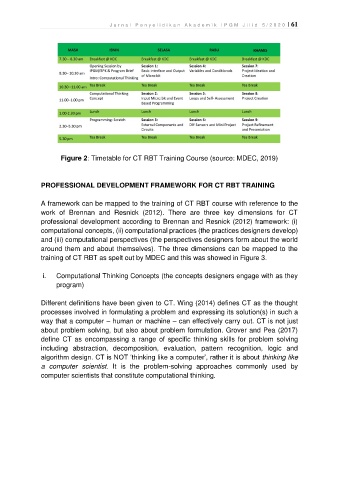
                      Figure 2: Timetable for CT RBT Training Course (source: MDEC, 2019)


               PROFESSIONAL DEVELOPMENT FRAMEWORK FOR CT RBT TRAINING

               A framework can be mapped to the training of CT RBT course with reference to the
               work  of  Brennan  and  Resnick  (2012).  There  are  three  key  dimensions  for  CT
               professional development according to Brennan and Resnick (2012) framework: (i)
               computational concepts, (ii) computational practices (the practices designers develop)
               and (iii) computational perspectives (the perspectives designers form about the world
               around them and about themselves). The three dimensions can be mapped to the
               training of CT RBT as spelt out by MDEC and this was showed in Figure 3.

                i.   Computational Thinking Concepts (the concepts designers engage with as they
                     program)

               Different definitions have been given to CT. Wing (2014) defines CT as the thought
               processes involved in formulating a problem and expressing its solution(s) in such a
               way that a computer – human or machine – can effectively carry out. CT is not just
               about problem solving, but also about problem formulation. Grover and Pea (2017)
               define  CT  as  encompassing  a  range  of  specific  thinking  skills  for  problem  solving
               including  abstraction,  decomposition,  evaluation,  pattern  recognition,  logic  and
               algorithm design. CT is NOT ‘thinking like a computer’, rather it is about thinking like
               a  computer  scientist.  It  is  the  problem-solving  approaches  commonly  used  by
               computer scientists that constitute computational thinking.

