


Page 71 - JURNAL PENYELIDIKAN AKADEMIK
P. 71
J u r n a l   P e n y e l i d i k a n   A k a d e m i k   I P G M   J i l i d   5 / 2 0 2 0  | 64


               e.  Logical Reasoning

               Logical  reasoning  involves  analysing  situations  to  make  a  decision  or  reach  a
               conclusion  about  a  situation.  An  example  of  logical  and  analytical  thinking  might
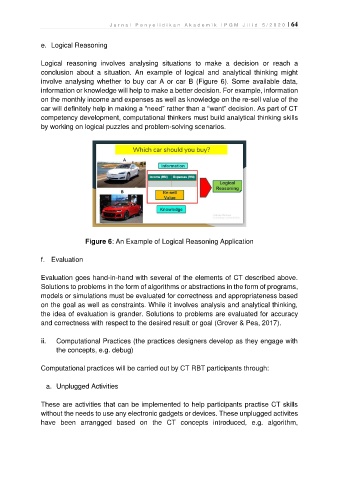
               involve  analysing  whether  to  buy  car  A  or car  B  (Figure  6).  Some  available  data,
               information or knowledge will help to make a better decision. For example, information
               on the monthly income and expenses as well as knowledge on the re-sell value of the
               car will definitely help in making a “need” rather than a “want” decision. As part of CT
               competency development, computational thinkers must build analytical thinking skills
               by working on logical puzzles and problem-solving scenarios.


                               Figure 6: An Example of Logical Reasoning Application

               f.  Evaluation

               Evaluation goes hand-in-hand with several of the elements of CT described above.
               Solutions to problems in the form of algorithms or abstractions in the form of programs,
               models or simulations must be evaluated for correctness and appropriateness based
               on the goal as well as constraints. While it involves analysis and analytical thinking,
               the idea of evaluation is grander. Solutions to problems are evaluated for accuracy
               and correctness with respect to the desired result or goal (Grover & Pea, 2017).

               ii.   Computational Practices (the practices designers develop as they engage with
                     the concepts, e.g. debug)

               Computational practices will be carried out by CT RBT participants through:

                 a.  Unplugged Activities

               These are activities that can be implemented to help participants practise CT skills
               without the needs to use any electronic gadgets or devices. These unplugged activites
               have  been  arrangged  based  on  the  CT  concepts  introduced,  e.g.  algorithm,

