


Page 72 - JURNAL PENYELIDIKAN AKADEMIK
P. 72
J u r n a l   P e n y e l i d i k a n   A k a d e m i k   I P G M   J i l i d   5 / 2 0 2 0  | 65


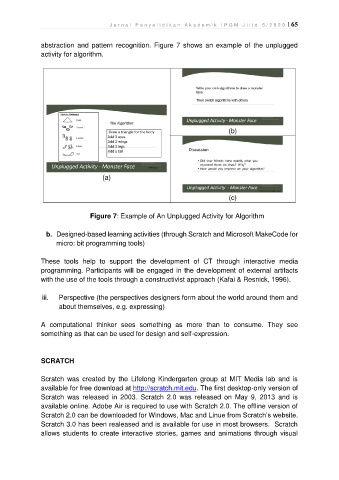
               abstraction  and  pattern  recognition.  Figure  7  shows  an  example of  the unplugged
               activity for algorithm.


                                                                                 (b)


                                     (a)


                                                                                 (c)

                                 Figure 7: Example of An Unplugged Activity for Algorithm

                 b.  Designed-based learning activities (through Scratch and Microsoft MakeCode for
                     micro: bit programming tools)

               These  tools  help  to  support  the  development  of  CT  through  interactive  media
               programming. Participants will be engaged in the development of external artifacts
               with the use of the tools through a constructivist approach (Kafai & Resnick, 1996).

                iii.   Perspective (the perspectives designers form about the world around them and
                      about themselves, e.g. expressing)

               A  computational  thinker  sees  something  as  more  than  to  consume.  They  see
               something as that can be used for design and self-expression.


               SCRATCH

               Scratch  was  created  by  the  Lifelong  Kindergarten  group  at  MIT  Media  lab  and  is
               available for free download at http://scratch.mit.edu. The first desktop-only version of
               Scratch  was  released  in  2003.  Scratch  2.0  was  released  on  May  9,  2013  and  is
               available online. Adobe Air is required to use with Scratch 2.0. The offline version of
               Scratch 2.0 can be downloaded for Windows, Mac and Linue from Scratch’s website.
               Scratch 3.0 has been realeased and is available for use in most browsers.  Scratch
               allows students to create interactive stories, games and animations through visual

