


Page 102 - Hall et al (2015) Principles of Critical Care-McGraw-Hill
P. 102
70      PART 1: An Overview of the Approach to and Organization of Critical Care


                 Mode of Transport:  The chosen mode of transport for interhospital   atmospheric pressure, partial pressure of oxygen, and relative humidity.
                                                                                                                          27
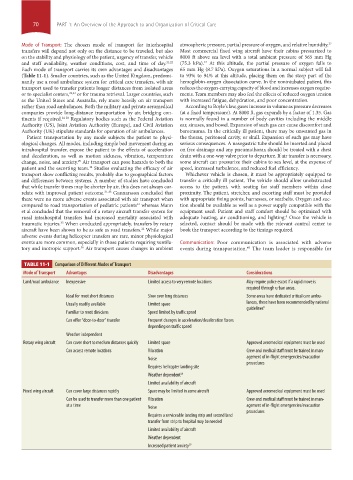
                 transfers will depend not only on the distance to be traveled, but also    Most commercial fixed wing aircraft have their cabins pressurized to
                 on the stability and physiology of the patient, urgency of transfer, vehicle   8000  ft  above sea level  with a  total  ambient  pressure  of  565  mm Hg
                 and staff availability, weather conditions, cost, and time of day. 21,22    (75.3  kPa).  At this altitude, the partial pressure of oxygen falls to
                                                                               37
                 Each mode of transport carries its own advantages and disadvantages   65 mm Hg (8.7 kPa). Oxygen saturations in a normal subject will fall
                 (Table 11-1). Smaller countries, such as the United Kingdom, predomi-  to 93% to 94% at this altitude, placing them on the steep part of the
                 nantly use a road ambulance system for critical care transfers, with air   hemoglobin- oxygen dissociation curve. In the nonintubated patient, this
                 transport used to transfer patients longer distances from isolated areas   reduces the oxygen-carrying capacity of blood and increases oxygen require-
                 or to specialist centers, 22,23  or for trauma retrieval. Larger countries, such   ments. Team members may also feel the effects of reduced oxygen tension
                 as the United States and Australia, rely more heavily on air transport   with increased fatigue, dehydration, and poor concentration.
                 rather than road ambulances. Both the military and private aeromedical   According to Boyle’s law, gases increase in volume as pressure decreases
                 companies provide long-distance transportation by air, bridging con-  (at a fixed temperature). At 8000 ft, gas expands by a factor of 1.35. Gas
                 tinents if required. 24-28  Regulatory bodies such as the Federal Aviation   is normally found in a number of body cavities including the middle
                 Authority (US), Joint Aviation Authority (Europe), and Civil Aviation   ear, sinuses, and bowel. Expansion of such gas can cause discomfort and
                 Authority (UK) stipulate standards for operation of air ambulances.  barotrauma. In the critically ill patient, there may be unwanted gas in
                   Patient transportation by any mode subjects the patient to physi-  the thorax, peritoneal cavity, or skull. Expansion of such gas may have
                 ological changes. All modes, including simple bed movement during an   serious consequences. A nasogastric tube should be inserted and placed
                 intrahospital transfer, expose the patient to the effects of acceleration   on free drainage and any pneumothorax should be treated with a chest
                 and deceleration, as well as motion sickness, vibration, temperature   drain with a one-way valve prior to departure. If air transfer is necessary,
                 change, noise, and anxiety.  Air transport can pose hazards to both the   some aircraft can pressurize their cabins to sea level, at the expense of
                                    29
                 patient and the escorting team.  Studies evaluating the efficacy of air   speed, increased turbulence, and reduced fuel efficiency.
                                        30
                 transport show conflicting results, probably due to geographical factors   Whichever vehicle is chosen, it must be appropriately equipped to
                 and differences between systems. A number of studies have concluded   transfer a critically ill patient. The vehicle should allow unobstructed
                 that while transfer times may be shorter by air, this does not always cor-  access to the patient, with seating for staff members within close
                 relate with improved patient outcome. 31-33  Gunnarsson concluded that     proximity. The patient, stretcher, and escorting staff must be provided
                 there were no more adverse events associated with air transport when   with appropriate fixing points, harnesses, or seatbelts. Oxygen and suc-
                 compared to road transportation of pediatric patients  whereas Mann   tion should be available as well as a power supply compatible with the
                                                         34
                 et al concluded that the removal of a rotary aircraft transfer system for   equipment used. Patient and staff comfort should be optimized with
                                                                                                           8
                 rural intrahospital transfers had increased mortality associated with   adequate heating, air conditioning, and lighting.  Once the vehicle is
                 traumatic injuries.  When conducted appropriately, transfers by rotary   selected, contact should be made with the relevant control center to
                               35
                 aircraft have been shown to be as safe as road transfers.  While major   book the transport according to the timings required.
                                                          22
                 adverse events during helicopter transfers are rare, minor physiological
                 events are more common, especially in those patients requiring ventila-  Communication:  Poor communication is associated with adverse
                 tory and inotropic support.  Air transport causes changes in ambient   events during transportation.  The team leader is responsible for
                                     36
                                                                                              40
                   TABLE 11-1    Comparison of Different Modes of Transport
                  Mode of Transport  Advantages             Disadvantages                     Considerations
                  Land/road ambulance  Inexpensive          Limited access to very remote locations  May require police escort if a rapid move is
                                                                                              required through urban areas.
                                Ideal for most short distances  Slow over long distances      Some areas have dedicated critical care ambu-
                                Usually readily available   Limited space                     lances, these have been recommended by national
                                                                                                    8
                                Familiar to most clinicians  Speed limited by traffic speed   guidelines
                                Can offer “door-to-door” transfer  Frequent changes in acceleration/deceleration forces
                                                            depending on traffic speed
                                Weather independent
                  Rotary wing aircraft  Can cover short to medium distances quickly  Limited space  Approved aeromedical equipment must be used
                                Can access remote locations  Vibration                        Crew and medical staff must be trained in man-
                                                            Noise                             agement of in-flight emergencies/evacuation
                                                            Requires helicopter landing site  procedures
                                                            Weather dependent 38
                                                            Limited availability of aircraft
                  Fixed wing aircraft  Can cover large distances rapidly  Space may be limited in some aircraft  Approved aeromedical equipment must be used
                                Can be used to transfer more than one patient   Vibration     Crew and medical staff must be trained in man-
                                at a time                   Noise                             agement of in-flight emergencies/evacuation
                                                                                              procedures
                                                            Requires a serviceable landing strip and second land
                                                            transfer from strip to hospital may be needed
                                                            Limited availability of aircraft
                                                            Weather dependent
                                                            Increased patient anxiety 39


            Section01.indd   70                                                                                        1/22/2015   9:37:11 AM

