


Page 103 - Hall et al (2015) Principles of Critical Care-McGraw-Hill
P. 103
CHAPTER 11: Transportation of the Critically Ill Patient  71


                    ensuring  there  has  been  clear  communication  with  all  relevant       TABLE 11-2    Preparing the Patient
                    parties.
                                                                                                Respiratory
                      • Patient: If feasible, consent for the transfer should be obtained from
                      the patient following a discussion of risks and benefits.  The patient   Check
                                                              9
                      should be kept informed of the progress of their transfer at all times.  Endotracheal tube placement is correct and secure—consider filling cuff with saline for air
                      • Patient’s next of kin: An explanation of the risks and benefits of the   transportation 27
                      transfer as well as the contact details for the receiving unit should be   Laryngeal masks should be replaced with endotracheal tubes
                      provided, particularly when this involves a transfer of responsibility   Oxygen requirement
                      of care.                                            Ventilation mode and parameters
                      • Transferring specialist: The decision to transfer the patient lies with   Recent chest radiograph for evidence of reversible pathology such as pneumothorax
                      the specialist with overall responsibility for the patient’s care.  Any
                                                                   9
                      other specialists involved in the patient’s care must be made aware of   Recent arterial blood gas and trends
                      the transfer and timings. A comprehensive summary of the patient’s   Monitoring
                      condition should accompany them.                    Oxygen saturations
                      • Receiving specialist: The final decision to accept the patient lies   Capnography
                      with the receiving critical care specialist.  Once the patient has been
                                                   8
                      accepted by the receiving specialist the following information should   Endotracheal tube cuff pressure
                      be confirmed to them:                               Respiratory rate
                         ◦ Reason for transfer                            Blood gas analysis for prolonged transfers
                         ◦ Patient name, age, sex                         Stethoscope
                         ◦ Medical history
                         ◦ Details of current clinical condition          Potential events
                         ◦ Details of current therapy                     Intubation/reintubation during transfer
                         ◦ Change in therapy to be undertaken for transfer  Airway obstruction
                         ◦ Infection risk
                         ◦ State of family communication                  Respiratory depression
                         ◦ Mode of transfer                               Increased oxygen requirement
                         ◦ Time frame of transfer                         Vomiting and aspiration of stomach contents
                         ◦ Contact details for referring team             Pneumothorax
                      • Other specialties involved: Handover should be provided between   Drugs
                      all the teams involved in the patient’s care at the discharging unit and
                      the receiving unit, including details of nursing care.  Intubating/anesthetic drugs—induction agent, muscle relaxant
                      • Critical care network: Depending on the location, there may be   Nebulized/inhaled bronchodilators
                      central coordination of critical care beds, thus transfers should   Oxygen
                      usually  be  arranged  with  the  approval  of  the  critical  care  network   Equipment
                      administrator. 8,41,42
                      • Ambulance control/aeromedical control center.     Airway adjuncts: Oropharyngeal airways, nasopharyngeal airways
                                                                          Emergency surgical airway kit with capability to ventilate via it
                      • Hospital porters/orderlies.
                                                                          Stethoscope
                     This can be delegated to another team member if required. All com-  Water-soluble lubricant
                    munication should be documented clearly, with copies kept by the
                      discharging and receiving units.                    Nasal cannulae
                                                                          Face masks with reservoir bags and oxygen tubing
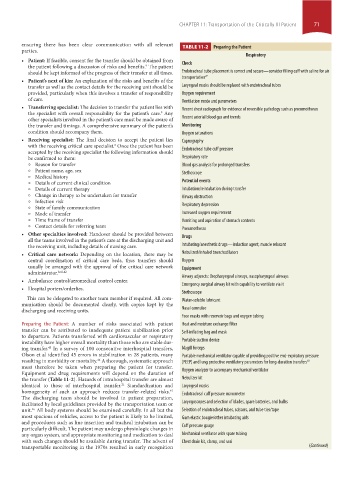
                    Preparing the Patient:  A number of risks associated with patient   Heat and moisture exchange filter
                    transfer can be attributed to inadequate patient stabilization prior   Self-inflating bag and mask
                    to departure. Patients transferred with cardiovascular or respiratory
                    instability have higher overall mortality than those who are stable dur-  Portable suction device
                    ing transfer.  In a survey of 100 consecutive interhospital transfers,    Magill forceps
                             43
                    Olson et al identified 45 errors in stabilization in 28 patients, many     Portable mechanical ventilator capable of providing positive end-expiratory pressure
                    resulting in morbidity or mortality.  A thorough, systematic approach   (PEEP) and lung protective ventilatory parameters for long-duration transfers 50
                                             44
                    must therefore be taken when preparing the patient for transfer.
                    Equipment and drug requirements will depend on the duration of   Oxygen analyzer to accompany mechanical ventilator
                    the transfer (Table 11-2). Hazards of intrahospital transfer are almost   Nebulizer kit
                    identical to those of interhospital transfer.  Standardization and   Laryngeal masks
                                                      21
                    homogeneity of such an approach reduces transfer-related risks.    Endotracheal cuff pressure manometer
                                                                      45
                    The discharging team should be involved in patient preparation,
                    facilitated by local guidelines provided by the transportation team or   Laryngoscopes and selection of blades, spare batteries, and bulbs
                    unit.  All body systems should be examined carefully. In all but the   Selection of endotracheal tubes, scissors, and tube ties/tape
                       46
                    most spacious of vehicles, access to the patient is likely to be limited,   Gum elastic bougie/other intubating aids
                    and procedures such as line insertion and tracheal intubation can be
                    particularly difficult. The patient may undergo physiologic changes in   Cuff pressure gauge
                    any organ system, and appropriate monitoring and medication to deal   Mechanical ventilator with spare tubing
                    with such changes should be available during transfer. The advent of   Chest drain kit, clamp, and seal
                    transportable monitoring in the 1970s resulted in early recognition                               (Continued)


            Section01.indd   71                                                                                        1/22/2015   9:37:11 AM

