


Page 106 - Hall et al (2015) Principles of Critical Care-McGraw-Hill
P. 106
74      PART 1: An Overview of the Approach to and Organization of Critical Care


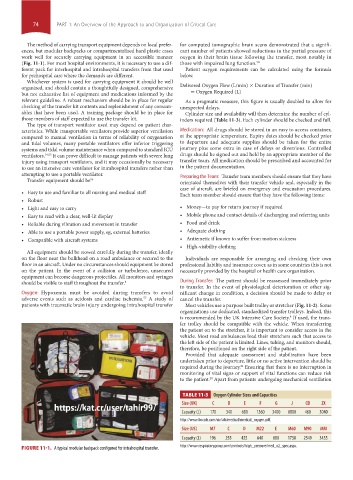
                   The method of carrying transport equipment depends on local prefer-  for computed tomographic brain scans demonstrated that a signifi-
                 ences, but modular backpacks or compartmentalized hard plastic cases   cant number of patients showed reductions in the partial pressure of
                 work  well  for  securely  carrying  equipment  in  an  accessible  manner   oxygen in their brain tissue following the transfer, most notably in
                 (Fig. 11-1). For most hospital environments, it is necessary to use a dif-  those with impaired lung function. 58
                 ferent pack for interhospital and intrahospital transfers from that used   Patient oxygen requirements can be calculated using the formula
                 for prehospital care where the demands are different.  below.
                   Whichever system is used for carrying equipment it should be well
                 organized, and should contain a thoughtfully designed, comprehensive   Delivered Oxygen Flow (L/min) × Duration of Transfer (min)
                 but not exhaustive list of equipment and medications informed by the      = Oxygen Required (L)
                 relevant guideline. A robust mechanism should be in place for regular   As a pragmatic measure, this figure is usually doubled to allow for
                 checking of the transfer kit contents and replenishment of any consum-  unexpected delays.
                 ables that have been used. A training package should be in place for   Cylinder size and availability will then determine the number of cyl-
                 those members of staff expected to use the transfer kit.  inders required (Table 11-3). Each cylinder should be checked and full.
                   The type of transport ventilator used may depend on patient char-
                 acteristics. While transportable ventilators provide superior ventilation   Medication:  All drugs should be stored in an easy to access container,
                 compared to manual ventilation in terms of reliability of oxygenation   at the appropriate temperature. Expiry dates should be checked prior
                 and tidal volumes, many portable ventilators offer inferior triggering   to departure and adequate supplies should be taken for the entire
                 systems and tidal volume maintenance when compared to standard ICU   journey plus some extra in case of delays or diversions. Controlled
                 ventilators. 54,55  It can prove difficult to manage patients with severe lung   drugs should be signed out and held by an appropriate member of the
                 injury using transport ventilators, and it may occasionally be necessary   transfer team. All medication should be prescribed and accounted for
                 to use an intensive care ventilator for intrahospital transfers rather than   in the patient documentation.
                 attempting to use a portable ventilator.              Preparing the Team:  Transfer team members should ensure that they have
                   Transfer equipment should be 56                     orientated themselves with their transfer vehicle and, especially in the
                                                                       case of aircraft, are briefed on emergency and evacuation procedures.
                    • Easy to use and familiar to all nursing and medical staff  Each team member should ensure that they have the following items:
                    • Robust
                    • Light and easy to carry                             • Money—to pay for return journey if required
                    • Easy to read with a clear, well-lit display         • Mobile phone and contact details of discharging and referring units
                    • Reliable during vibration and movement in transfer    • Food and drink
                    • Able to use a portable power supply, eg, external batteries    • Adequate clothing
                    • Compatible with aircraft systems                    • Antiemetic if known to suffer from motion sickness
                                                                          • High-visibility clothing
                   All equipment should be stowed carefully during the transfer, ideally
                 on the floor near the bulkhead on a road ambulance or secured to the   Individuals are responsible for arranging and checking their own
                 floor in an aircraft. Under no circumstances should equipment be stored   professional liability and insurance cover, as in some countries this is not
                 on the patient. In the event of a collision or turbulence, unsecured   necessarily provided by the hospital or health care organization.
                 equipment can become dangerous projectiles. All monitors and syringes
                 should be visible to staff throughout the transfer. 8  During Transfer:  The patient should be reassessed immediately prior
                                                                       to transfer. In the event of physiological deterioration or other sig-
                 Oxygen:  Hypoxemia must be avoided during transfers to avoid   nificant change in condition, a decision should be made to delay or
                 adverse  events  such  as  acidosis  and  cardiac  ischemia.   A  study  of   cancel the transfer.
                                                           57
                 patients with traumatic brain injury undergoing intrahospital transfer   Most vehicles use a purpose built trolley or stretcher (Fig. 11-2). Some
                                                                       organizations use dedicated, standardized transfer trolleys. Indeed, this
                                                                       is recommended by the UK Intensive Care Society.  If used, the trans-
                                                                                                             8
                                                                       fer  trolley  should  be  compatible  with  the  vehicle.  When  transferring
                                                                       the patient on to the stretcher, it is important to consider access in the
                                                                       vehicle. Most road ambulances load their stretchers such that access to
                                                                       the left side of the patient is limited. Lines, tubing, and monitors should,
                                                                       therefore, be positioned on the right side of the patient.
                                                                         Provided that adequate assessment and stabilization have been
                                                                       undertaken prior to departure, little or no active intervention should be
                                                                       required during the journey.  Ensuring that there is no interruption in
                                                                                            21
                                                                       monitoring of vital signs or support of vital functions can reduce risk
                                                                       to the patient.  Apart from patients undergoing mechanical ventilation
                                                                                 20
                                                                         TABLE 11-3    Oxygen Cylinder Sizes and Capacities
                                                                        Size (UK)  C   D     E    F     G    J    CD   ZX
                                                                        Capacity (L)  170  340  680  1360  3400  6800  460  3040
                                                                       http://www.bocsds.com/uk/sds/medical/medical_oxygen.pdf.
                                                                        Size (US)  M7  C     D   M22    E   M60  M90   MM
                                                                        Capacity (L)  196  255  425  640  680  1738  2549  3455
                 FIGURE 11-1.  A typical modular backpack configured for intrahospital transfer.  http://www.respiratorygroup.com/products/high_pressure/med_o2_spec.aspx.


            Section01.indd   74                                                                                        1/22/2015   9:37:14 AM

