


Page 107 - Hall et al (2015) Principles of Critical Care-McGraw-Hill
P. 107
CHAPTER 11: Transportation of the Critically Ill Patient  75


                                                                          Patient Documentation:  As well as documentation to be completed
                                                                          during the transfer, copies of notes, referral letters, and digital or film
                                                                          imaging should accompany the patient.
                                                                          Transfer Documentation:  Recording of observations of vital signs that
                                                                          would usually be recorded on the intensive care unit should be contin-
                                                                          ued during transfers, at a frequency guided by the degree of stability
                                                                          of the patient.
                                                                           Particular note should be made of observations that are likely to
                                                                          deteriorate during the transfer such as hemodynamic stability and pain
                                                                          scores.  As well as the usual physiological data collection, transfer tools
                                                                              51
                                                                          have been developed integrating descriptions of monitoring and special
                                                                          equipment, checklists, and event descriptions. Such tools may not only
                                                                          improve patient safety but also allow efficient follow-up and surveillance
                                                                          of transport-related incidents. 62
                                                                              ■
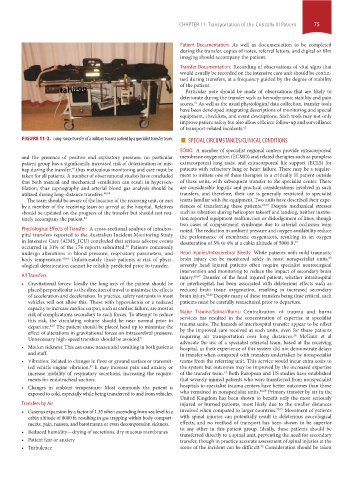
                    FIGURE 11-2.  Long-range transfer of a military trauma patient by a specialist transfer team.  SPECIAL CIRCUMSTANCES/CLINICAL CONDITIONS

                                                                          ECMO:  A number of specialist regional centers provide extracorporeal
                    and the  presence of  positive  end expiratory pressure, no particular   membrane oxygenation (ECMO) and related therapies such as pumpless
                    patient group has a significantly increased risk of deterioration or mis-  extracorporeal lung assist and extracorporeal life support (ECLS) for
                    hap during the transfer,  thus meticulous monitoring and care must be   patients with refractory lung or heart failure. There may be a require-
                                     48
                    taken for all patients. A number of observational studies have concluded   ment to initiate one of these therapies in a critically ill patient outside
                    that both manual and mechanical ventilation can result in hyperven-  of these units, with subsequent transfer to the specialist center. There
                    tilation, thus  capnography and  arterial  blood  gas analysis  should  be   are considerable logistic and practical considerations involved in such
                    utilized during long-distance transfers. 48,59        transfers, and therefore, their use is generally restricted to specialist
                     The team should be aware of the location of the receiving unit, or met   teams familiar with the equipment. Two units have described their expe-
                    by a member of the receiving team on arrival at the hospital. Relatives   riences of transferring these patients. 63,64  Despite mechanical stresses
                    should be updated on the progress of the transfer but should not rou-  such as vibration during helicopter takeoff and landing, neither institu-
                    tinely accompany the patient. 21                      tion reported equipment malfunction or dislodgement of lines, though
                                                                          two  cases of  compartment syndrome  due to  arterial occlusion were
                    Physiological Effects of Transfer:  A cross-sectional analysis of intrahos-  noted. The reduction in ambient pressure and oxygen availability reduce
                    pital transfers reported to the Australian Incident Monitoring Study   the  performance  of  membrane  oxygenators,  resulting  in  an  oxygen
                    in Intensive Care (AIMS_ICU) concluded that serious adverse events   desaturation of 3% to 4% at a cabin altitude of 5000 ft. 63
                    occurred in 31% of the 176 reports submitted.  Patients commonly
                                                       40
                    undergo alterations in blood pressure, respiratory parameters, and   Head Injuries/Intracerebral Bleeds:  While patients with mild traumatic
                                                                                                                            65
                    body temperature. 60,61  Unfortunately those patients at risk of physi-  brain  injury  can  be  monitored  safely  in  most  nonspecialist  units,
                    ological deterioration cannot be reliably predicted prior to transfer.  severely head injured patients often require specialist neurosurgical
                                                                          intervention and monitoring to reduce the impact of secondary brain
                    All Transfers                                         injury. 66,67  Transfer of the head injured patient, whether intrahospital
                      • Gravitational  forces:  Ideally  the  long  axis  of  the  patient  should  be  or interhospital, has been associated with deleterious effects such as
                      placed perpendicular to the direction of travel to minimize the effects   reduced brain tissue  oxygenation, resulting in  increased secondary
                      of acceleration and deceleration. In practice, safety restraints in most  brain injury. 58,68  Despite many of these transfers being time critical, such
                      vehicles will not allow this. Those with hypovolemia or a reduced  patients must be carefully resuscitated prior to departure.
                      capacity to increase cardiac output, such as cardiac failure, are most at
                      risk of complications secondary to such forces. To attempt to reduce  Major Trauma/Spinal/Burns:  Centralization of trauma and burns
                      this  risk,  the  circulating  volume  should  be  near  normal  prior  to  services has resulted in the concentration of expertise at specialist
                      departure.  The patient should be placed head up to minimize the  trauma units. The hazards of interhospital transfer appear to be offset
                             8,27
                      effect of alterations in gravitational forces on intracerebral pressure.  by the improved care received at such units, even for those patients
                                                                                                                26
                      Unnecessary high-speed transfers should be avoided. 8  requiring  air  transportation over  long  distances.   McGinn et al
                                                                          advocate the use of a specialist retrieval team, based at the receiving
                      • Motion sickness: This can cause nausea and vomiting in both patients   hospital, as their experience of this system did not demonstrate delays
                      and staff.                                          in transfer when compared with transfers undertaken by nonspecialist
                      • Vibration: Related to changes in floor or ground surface or transmit-  teams from the referring unit. This service would incur extra costs to
                      ted vehicle engine vibration.  It may increase pain and anxiety or  the system but outcomes may be improved by the increased expertise
                                           45
                      increase mobility of respiratory secretions, increasing the require-  of the transfer team.  Both European and US studies have established
                                                                                         15
                      ments for endotracheal suction.                     that severely injured patients who were transferred from nonspecialist
                      • Changes in ambient temperature: Most commonly the patient is  hospitals to specialist trauma centers have better outcomes than those
                      exposed to cold, especially while being transferred to and from vehicles.  who remained in nonspecialist units. 66,69  Primary transfer by air in the
                                                                          United Kingdom has been shown to benefit only the most seriously
                    Transfers by Air                                      injured or burned patients, most likely due to the smaller distances
                      • Gaseous expansion by a factor of 1.35 when ascending from sea level to a   involved when compared to larger countries. 70,71  Movement of patients
                      cabin altitude of 8000 ft, resulting in gas trapping within body compart-  with spinal injuries can potentially result in deleterious neurological
                      ments, pain, nausea, and barotrauma or even decompression sickness.  effects, and no method of transport has been shown to be superior
                      • Reduced humidity—drying of secretions, dry mucous membranes  to  any  other  in  this  patient  group.  Ideally,  these  patients  should  be
                                                                          transferred directly to a spinal unit, preventing the need for secondary
                      • Patient fear or anxiety                           transfer, though in practice accurate assessment of spinal injuries at the
                      • Turbulence                                        scene of the incident can be difficult.  Consideration should be taken
                                                                                                     72


            Section01.indd   75                                                                                        1/22/2015   9:37:15 AM

