


Page 108 - Hall et al (2015) Principles of Critical Care-McGraw-Hill
P. 108
76      PART 1: An Overview of the Approach to and Organization of Critical Care


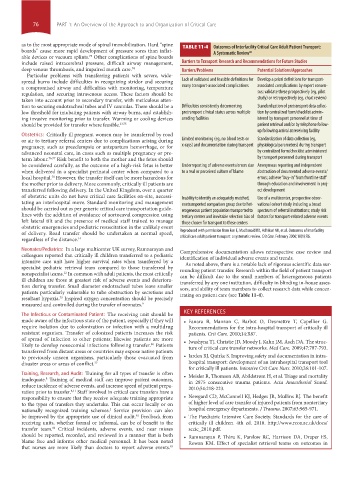
                 as to the most appropriate mode of spinal immobilization. Hard “spine     TABLE 11-4     Outcomes of Interfacility Critical Care Adult Patient Transport:
                 boards” cause more rapid development of pressure sores than inflat-  A Systematic Review 84
                 able devices or vacuum splints.  Other complications of spine boards
                                        73
                 include raised intracerebral pressure, difficult airway management,   Barriers to Transport Research and Recommendations for Future Studies
                 deep venous thrombosis, and impaired mouth care. 74    Barriers/Problems         Potential Solutions/Approaches
                   Particular problems with transferring patients with severe, wide-
                 spread burns include difficulties in recognizing stridor and securing   Lack of validated and feasible definitions for  Develop a priori definitions for transport-
                 a  compromised  airway  and  difficulties  with  monitoring,  temperature   many transport-associated complications  associated complications by expert consen-
                 regulation, and securing intravenous access. These factors should be             sus;  validate these prospectively (eg, pilot
                 taken into account prior to secondary transfer, with meticulous atten-           study) or retrospectively (eg, chart review)
                 tion to securing endotracheal tubes and IV cannulas. There should be a   Difficulties consistently documenting   Standardization of pretransport data collec-
                 low threshold for intubating patients with airway burns, and establish-  pretransport clinical status across multiple   tion by centralized form/checklist admin-
                 ing invasive monitoring prior to transfer. Warming or cooling devices   sending facilities  istered by transport personnel at time of
                 should be provided for transfer where feasible. 23,75                            patient retrieval and/or by telephone follow-
                                                                                                  up following arrival at receiving facility
                 Obstetrics:  Critically ill pregnant women may be transferred by road
                 or air to tertiary referral centers due to complications arising during   Limited monitoring (eg, no blood tests or   Standardization of data collection (eg,
                 pregnancy, such as preeclampsia or antepartum hemorrhage, or for   x-rays) and documentation during transport  physiological parameters) during transport
                 advanced neonatal care, in cases such as multiple pregnancy or pre-              by centralized form/checklist administered
                 term labour. 76,77  Risk benefit to both the mother and the fetus should         by transport  personnel during transport
                 be considered carefully, as the outcome of a high-risk fetus is better   Underreporting of adverse events/errors due  Anonymous reporting and independent
                 when delivered in a specialist perinatal center when compared to a   to a real or perceived culture of blame  abstraction of documented adverse events/
                 local hospital.  However, the transfer itself can be more hazardous for          errors; achieve “buy-in” from frontline staff
                            78
                 the mother prior to delivery. More commonly, critically ill patients are         through education and involvement in proj-
                 transferred following delivery. In the United Kingdom, over a quarter            ect development
                 of obstetric units do not have critical care facilities on-site, necessi-  Inability to identify an adequately matched,   Use of a multicenter, prospective obser-
                 tating an interhospital move. Standard monitoring and management   nontransported comparison group due to het- vational cohort study including a broad
                 should be carried out as per generic critical care transportation guide-  erogeneous patient population transported to  spectrum of referral institutions; study risk
                 lines with the addition of avoidance of aortocaval compression using   tertiary centers and inevitable selection bias of  factors for transport-related adverse events
                 left lateral tilt and the presence of medical staff trained to manage   those chosen for transport to these centers
                 obstetric emergencies and pediatric resuscitation in the unlikely event
                 of delivery. Road transfer should be undertaken at normal speed,   Reproduced with permission from Fan E, MacDonald RD, Adhikari NK, et al. Outcomes of interfacility
                 regardless of the distance. 14                        critical care adult patient transport: a systematic review. Crit Care. February 2006;10(1):R6.
                 Neonates/Pediatrics:  In a large multicenter UK survey, Ramnarayan and   Comprehensive documentation allows retrospective case review and
                 colleagues reported that critically ill children transferred to a pediatric   identification of individual adverse events and trends.
                 intensive care unit have higher survival rates when transferred by a   As noted above, there is a notable lack of rigorous scientific data sur-
                 specialist  pediatric  retrieval  team  compared  to  those  transferred  by   rounding patient transfer. Research within the field of patient transport
                 nonspecialist teams.  In common with adult patients, the most critically   can be difficult due to the small numbers of heterogeneous patients
                                12
                 ill children are those at greatest risk of adverse events and deteriora-  transferred by any one institution, difficulty in blinding in-house asses-
                 tion during transfer. Small diameter endotracheal tubes leave smaller   sors, and ability of team members to collect research data while concen-
                 patients particularly vulnerable to tube obstruction by secretions and   trating on patient care (see Table 11-4).
                 resultant hypoxia.  Inspired oxygen concentration should be precisely
                              79
                 measured and controlled during the transfer of neonates. 9
                 The Infectious or Contaminated Patient:  The receiving unit should be   KEY REFERENCES
                 made aware of the infectious state of the patient, especially if they will     • Fanara B, Manzon C, Barbot O, Desmettre T, Capellier G.
                 require isolation due to colonization or infection with a multidrug   Recommendations for the intra-hospital transport of critically ill
                 resistant organism. Transfer of colonized patients increases the risk   patients. Crit Care. 2010;14:R87.
                 of spread of infection to other patients; likewise patients are more     • Iwashyna TJ, Christie JD, Moody J, Kahn JM, Asch DA. The struc-
                 likely to develop nosocomial infections following transfer.  Patients   ture of critical care transfer networks. Med Care. 2009;47:787-793.
                                                             80
                 transferred from distant areas or countries may expose native patients
                 to previously  unseen organisms, particularly those evacuated from     • Jarden RJ, Quirke S. Improving safety and documentation in intra-
                 disaster areas or areas of conflict. 27                  hospital transport: development of an intrahospital transport tool
                                                                          for critically ill patients. Intensive Crit Care Nurs. 2010;26:101-107.
                 Training, Research, and Audit:  Training for all types of transfer is often     • Meisler R, Thomsen AB, Abildstrøm H, et al. Triage and mortality
                 inadequate.   Training  of medical  staff  can  improve  patient  outcomes,   in 2875 consecutive trauma patients.  Acta Anaesthesiol Scand.
                         8
                 reduce incidence of adverse events, and increase speed of patient prepa-  2010;54:218-223.
                 ration prior to transfer.  Staff involved in critical care transfers have a
                                  8,11
                 responsibility to ensure that they receive adequate training appropriate     • Newgard CD, McConnell KJ, Hedges JR, Mullins RJ. The benefit
                 to the types of transfers they undertake. This can occur locally or on   of higher level of care transfer of injured patients from nontertiary
                 nationally recognized training schemes.  Service provision can also   hospital emergency departments. J Trauma. 2007;63:965-971.
                                               2
                 be improved by the appropriate use of clinical audit.  Feedback from     • The Paediatric Intensive Care Society. Standards for the care of
                                                        81
                 receiving units, whether formal or informal, can be of benefit to the   critically ill children. 4th ed. 2010.  http://www.rcoa.ac.uk/docs/
                 transfer team.  Critical incidents, adverse events, and near misses   sccic_2010.pdf.
                            82
                 should be reported, recorded, and reviewed in a manner that is both     • Ramnarayan P, Thiru K, Parslow RC, Harrison DA, Draper ES,
                 blame free and informs other medical personnel. It has been noted   Rowan KM. Effect of specialist retrieval teams on outcomes in
                 that nurses are more likely than doctors to report adverse events.
                                                                    83


            Section01.indd   76                                                                                        1/22/2015   9:37:16 AM

