


Page 290 - Hall et al (2015) Principles of Critical Care-McGraw-Hill
P. 290
194     PART 2: General Management of the Patient


                                                                       in systolic Ppa by the change in alveolar pressure (plateau pressure—
                        Pra or Ppw                                     PEEP) during a controlled tidal breath, with the change in Ppa reflecting
                                                                                    40
                     20                                                the change in Ppl.  Next, PEEP is multiplied by the transmission ratio to
                                                                       estimate end-expiratory Ppl. Finally, transmural pressure is calculated by
                                                                       subtracting Ppl from the Pra or Ppw.  Even though this method appears
                                                                                                 40
                     10
                                                                                                          40
                   Pressure  Ppl                                       to yield a valid estimate of transmural pressure,  it is unclear whether
                                                                       it contributes significantly to patient management. In clinical decision
                                                                       making, use of the Ppw or Pra should not focus excessively on its abso-
                      0
                                                                       lute value. It is often more important to assess how a change in the Ppw
                                                                       or Pra correlates with clinically relevant clinical end points (eg, blood
                    −10                                                pressure, cardiac output, oxygenation, urine output) after manipulation
                                                                       of intravascular volume, and this can be assessed without correcting for
                                                                       the effect of PEEP.
                                                                         The effect of PEEP on transmural pressure described above is relevant
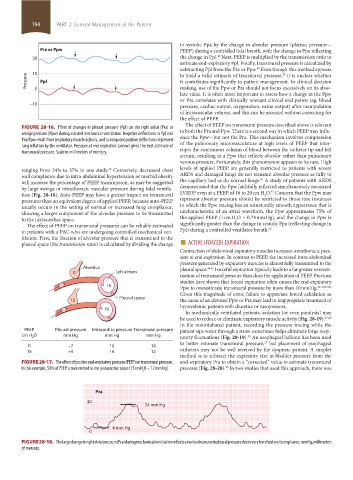
                 FIGURE 28-16.  Effect of changes in pleural pressure (Ppl) on the right atrial (Pra) or   to both the Pra and Ppw. There is a second way in which PEEP may influ-
                 wedge pressure (Ppw) during assisted mechanical ventilation. Negative deflections in Ppl and
                 Pra/Ppw result from inspiratory muscle activity, and subsequent positive deflections represent   ence the Ppw—but not the Pra. This mechanism involves compression
                                                                       of the pulmonary microvasculature at high levels of PEEP that inter-
                 lung inflation by the ventilator. Pressure at end expiration (arrow) gives the best estimate of
                 transmural pressure. Scale in millimeters of mercury.  rupts the continuous column of blood between the catheter tip and left
                                                                       atrium, resulting in a Ppw that reflects alveolar rather than pulmonary
                                                                       venous pressure. Fortunately, this phenomenon appears to be rare. High
                 ranging from 24% to 37% in one study.  Conversely, decreased chest   levels of applied PEEP are generally restricted to patients with severe
                                               39
                 wall compliance due to intra-abdominal hypertension or morbid obesity   ARDS and damaged lungs do not transmit alveolar pressure as fully to
                                                                                                  41
                 will increase the percentage of PEEP transmission, as may be suggested   the capillary bed as do normal lungs.  A study of patients with ARDS
                 by large swings in intrathoracic vascular pressure during tidal ventila-  demonstrated that the Ppw faithfully reflected simultaneously measured
                                                                                                      42
                 tion (Fig. 28-18). Auto-PEEP may have a greater impact on transmural   LVEDP even at a PEEP of 16 to 20 cm H O.  Concern that the Ppw may
                                                                                                    2
                 pressures than an equivalent degree of applied PEEP, because auto-PEEP   represent alveolar pressure should be restricted to those rare instances
                 usually occurs in the setting of normal or increased lung compliance,   in which the Ppw tracing has an unnaturally smooth appearance that is
                 allowing a larger component of the alveolar pressure to be transmitted   uncharacteristic of an atrial waveform, the Ppw approximates 75% of
                 to the juxtacardiac space.                            the applied PEEP (1 cm H O ~ 0.74 mm Hg), and the change in Ppw is
                                                                                          2
                   The effect of PEEP on transmural pressures can be reliably estimated   significantly greater than the change in systolic Ppa (reflecting change in
                 in patients with a PAC who are undergoing controlled mechanical ven-  Ppl) during a controlled ventilator breath. 43
                 pleural space (the transmission ratio) is calculated by dividing the change   ■  ACTIVE (FORCED) EXPIRATION
                 tilation. First, the fraction of alveolar pressure that is transmitted to the
                                                                       Contraction of abdominal expiratory muscles increases intrathoracic pres-
                                                                       sure at end expiration. In contrast to PEEP, the increased intra-abdominal
                                                                       pressure generated by expiratory muscles is almost fully transmitted to the
                                      Alveolus                         pleural space. 44,45  Forceful expiration typically leads to a far greater overesti-
                                   0             Left atrium
                                                                       mation of transmural pressure than does the application of PEEP. Previous
                                                                       studies have shown that forced expiration often causes the end-expiratory
                                              16                       Ppw to overestimate transmural pressure by more than 10 mm Hg. 24-26,45,46
                                               −2                      Given this magnitude of error, failure to appreciate forced exhalation as
                                                   Pleural space
                                  15                                   the cause of an elevated Ppw or Pra may lead to inappropriate treatment of
                                                                       hypovolemic patients with diuretics or vasopressors.
                                             16
                                                                         In mechanically ventilated patients, sedation (or even paralysis) may
                                               +4                      be used to reduce or eliminate expiratory muscle activity (Fig. 28-19). 25,26
                                                                       In the nonintubated patient, recording the pressure tracing while the
                  PEEP       Pleural pressure  Intracardiac pressure  Transmural pressure  patient sips water through a straw sometimes helps eliminate large respi-
                 cm H O        mm Hg          mm Hg         mm Hg      ratory fluctuations (Fig. 28-19).  An esophageal balloon has been used
                                                                                              45
                     2
                                                                       to better estimate transmural pressure,  but placement of esophageal
                                                                                                    24
                   0             −2            16            18        catheters may not be well received by the dyspneic patient. A simpler
                   15            +4            16            12
                                                                       method is to subtract the expiratory rise in bladder pressure from the
                 FIGURE 28-17.  The effect of positive end-expiratory pressure (PEEP) on transmural pressure.   end-expiratory Pra to obtain a “corrected” value to estimate transmural
                                                                                       45
                 In this example, 50% of PEEP is transmitted to the juxtacardiac space (15 cm H O ~ 12 mm Hg).  pressure (Fig. 28-20).  In two studies that used this approach, there was
                                                          2
                                          Pra
                                       30
                                                           24 mm Hg


                                                4 mm Hg
                                        0
                 FIGURE 28-18.  The large change in right atrial pressure (Pra) during mechanical ventilation reflects a marked increase in pleural pressure due to very low chest wall compliance. mm Hg, millimeters
                 of mercury.


            section02.indd   194                                                                                       1/13/2015   2:05:36 PM

