


Page 289 - Hall et al (2015) Principles of Critical Care-McGraw-Hill
P. 289
CHAPTER 28: Interpretation of Hemodynamic Waveforms  193


                                                                          is located in a vessel whose capillary bed supplies an area of markedly
                                                                          reduced alveolar ventilation. 20,38  Second, an initial 15 to 20 mL of “dead
                                                                          space”  blood  should  be  withdrawn  and  discarded  before  the  sample
                                                                          for analysis is obtained, to reduce the likelihood of obtaining a false-
                                                                          negative result when the inflated catheter has truly wedged.  Finally, a
                                                                                                                     38
                                       BALLOON                            false-positive result (ie, high O  saturation in aspirated blood when the
                                                                                                2
                                       INFLATED                           catheter is not wedged) can occur if the sample is aspirated too quickly.
                         Ppa                                              It is recommended that the sample be aspirated at a rate no faster than
                             – 60 –                                       3 mL/min. 38
                                                Partial Ppw
                             – 40 –                                       RESPIRATORY INFLUENCES: TRANSMURAL PRESSURE
                                                                28
                             – 20 –                                       The Pra and Ppw are used as surrogates for RV and LV filling pressure,
                                                                          respectively. However, it is  transmural (intravascular minus pleural)
                                                                          pressure that represents the distending pressure for cardiac filling.
                             – 0 –
                                                                          During normal breathing, pleural pressure (Ppl) is slightly negative at
                                                                          end-expiration and intrathoracic vascular pressures measured at this
                                                                          point in respiratory cycle provide the best estimate of transmural pres-
                                                                          sure (Fig. 28-16). Either a strip recording or the cursor method should
                                                                          be used to define the end-expiratory pressure.
                                                                           One error is the assumption that during mechanical ventilation the
                                                                          lowest point in the pressure tracing reflects end expiration. While this
                                       BALLOON                            is true during controlled ventilation, inspiratory efforts that trigger
                                       INFLATED                           mechanical breaths produce a nadir in the pressure tracing (Fig. 28-16).
                         Ppa                                              Identification of end expiration in the Ppw tracing is aided by the knowl-
                             – 60 –                                       edge that expiration is usually longer than inspiration, two exceptions
                                                                          being marked tachypnea and inverse-ratio ventilation. Identification of
                             – 40 –                  Ppw                  end expiration from the pressure tracing should not be difficult when
                                                                          interpreted  in  relationship  to the patient’s  ventilatory  pattern. When
                                                                          confusion occurs, a simultaneous airway pressure tracing may be used.
                             – 20 –             A C  V                     The Pra and Ppw will overestimate transmural pressure if intrathoracic
                                                         12               pressure is positive at end expiration. This can occur from an increase in
                                                 X X’ Y
                             – 0 –                                        end-expiratory lung volume due to applied positive end-expiratory pres-
                                                                          sure (PEEP) or auto-PEEP, or from increased intra-abdominal pressure
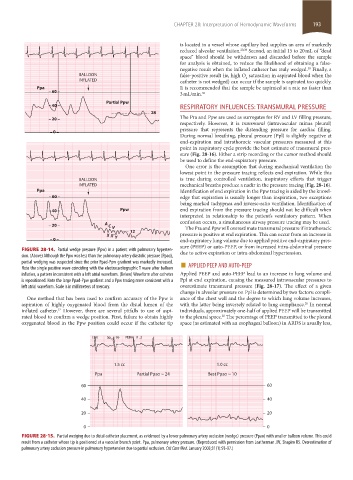
                    FIGURE 28-14.  Partial wedge pressure (Ppw) in a patient with pulmonary hyperten-  due to active expiration or intra-abdominal hypertension.
                    sion. (Above) Although the Ppw was less than the pulmonary artery diastolic pressure (Ppad),
                    partial wedging was suspected since the prior Ppad-Ppw gradient was markedly increased.     ■
                    Note the single positive wave coinciding with the electrocardiographic T wave after balloon   APPLIED PEEP AND AUTO-PEEP
                    inflation, a pattern inconsistent with a left atrial waveform. (Below) Waveform after catheter   Applied PEEP and auto-PEEP lead to an increase in lung volume and
                    is repositioned. Note the large Ppad-Ppw gradient and a Ppw tracing more consistent with a   Ppl at end expiration, causing the measured intravascular pressures to
                    left atrial waveform. Scale is in millimeters of mercury.  overestimate transmural pressure (Fig. 28-17). The effect of a given
                                                                          change in alveolar pressure on Ppl is determined by two factors: compli-
                     One method that has been used to confirm accuracy of the Ppw is   ance of the chest wall and the degree to which lung volume increases,
                    aspiration of highly oxygenated blood from the distal lumen of the   with the latter being inversely related to lung compliance.  In normal
                                                                                                                    20
                    inflated catheter.  However, there are several pitfalls to use of aspi-  individuals, approximately one-half of applied PEEP will be transmitted
                                37
                    rated blood to confirm a wedge position. First, failure to obtain highly   to the pleural space.  The percentage of PEEP transmitted to the pleural
                                                                                        20
                    oxygenated blood in the Ppw position could occur if the catheter tip   space (as estimated with an esophageal balloon) in ARDS is usually less,
                                            (34)  Sp  96  PERH 0 . 2
                                                  O 2


                                                   1.5 cc                             1.0 cc
                                             Ppa           Partial Ppao ~ 24       Best Ppao ~ 10
                                        60                                                             60

                                        40                                                             40

                                        20                                                             20

                                         0                                                             0
                    FIGURE 28-15.  Partial wedging due to distal catheter placement, as evidenced by a lower pulmonary artery occlusion (wedge) pressure (Ppao) with smaller balloon volume. This could
                    result from a catheter whose tip is positioned at a vascular branch point. Ppa, pulmonary artery pressure. (Reproduced with permission from Leatherman JW, Shapiro RS. Overestimation of
                    pulmonary artery occlusion pressure in pulmonary hypertension due to partial occlusion. Crit Care Med. January 2003;31(1):93-97.)


            section02.indd   193                                                                                       1/13/2015   2:05:34 PM

