


Page 375 - Hall et al (2015) Principles of Critical Care-McGraw-Hill
P. 375
CHAPTER 32: Assessing the Circulation: Oximetry, Indicator Dilution, and Pulse Contour Analysis  245


                    pressure measurement when discriminating patients with and without   increased by muscle contraction, the De O 2  slope increases, whereas in the
                                             values  >85% suggest resuscitation   setting of altered blood flow distribution the rate of global O  delivery
                    cardiovascular insufficiency. St O 2                                                              2
                                                         values <60% reflect                                  slope is dependent on
                    adequacy whereas in trauma patients persistent St O 2  is decreased. Sepsis decreases the De O 2 . The Re O 2
                    a poor outcome.  Although this poor discrimination is disappointing,    how low St O 2  is at the time of release, being less steep if St O 2  is above 40%
                                24
                    these data are reasonable and expected because a primary goal of   than if the recovery starts at 30%, suggesting that the magnitude of the
                                             as constant as possible by combined   ischemic signal determines maximal local vasodilation. This dynamic
                    autoregulation is to maintain St O 2
                    increased local flow to match increased metabolic demand and decrease   technique has been used to assess circulatory sufficiency in patients with
                                                                  remains   trauma, sepsis and during weaning from mechanical ventilation. 26-28
                    local metabolic rate if flow decreases such that baseline St O 2

                    within the normal range until shock is quite advanced. Importantly, St O 2
                    covaries best with local venous O  saturation. Thus, measuring local
                                             2
                       noninvasively is a potentially  valuable tool  in the  assessment  of   Tissue O  saturation (St O 2 ) varies little until severe tissue hypoperfusion occurs.
                                                                                2
                    St O 2
                    compartment syndromes. 19,23,27                        St O 2  coupled to a VOT allows one to diagnose circulatory stress before hypotension develops.
                     However, the addition of a dynamic vascular occlusion test (VOT)
                    that induces a controlled local ischemic challenge with subsequent
                    release has been shown to markedly improve and expand the predictive  CARDIAC OUTPUT
                              to identify tissue hypoperfusion.  The VOT measures the
                                                     28
                    ability of St O 2                                                             to meet the body’s metabolic demand
                    effect of total vascular occlusion-induced tissue ischemia and release on   Shock reflects an inadequate D O 2  . Indeed, except for
                                    is measured on the thenar eminence because the   and cardiac output is a primary determinant of D O 2
                    downstream St O 2 . St O 2                                                                        that occurs
                    subcutaneous tissue thickness is small and similar across subjects and   extreme hypoxemia and anemia, most of the increase in D O 2
                                                                          with resuscitation and normal biological adaptation is due to increasing
                    the thenar muscles are easily subjected to isolated ischemic challenge by   cardiac output. Since cardiac  output  should vary  to match metabolic
                    simple forearm sphygmomanometer inflation similar to that done when    varies with demand), there is no “normal” cardiac out-
                    measuring systemic blood pressure.                    demands (ie, D O 2
                                                                          put. Cardiac output is merely adequate or inadequate to meet the meta-
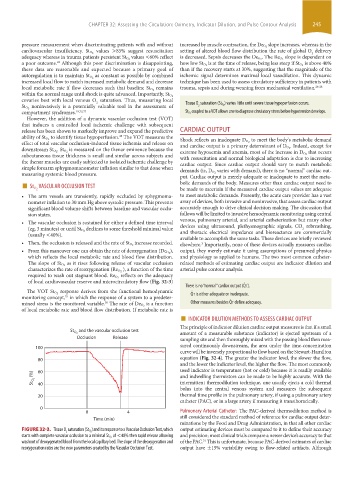
                        ■  St O  VASCULAR OCCLUSION TEST                  bolic demands of the body. Measures other than cardiac output need to
                                                                          be made to ascertain if the measured cardiac output values are adequate
                         2
                      • The arm vessels are transiently, rapidly occluded by sphygmoma-  to meet metabolic demands. Presently, the acute care provider has a vast
                      nometer inflation to 30 mm Hg above systolic pressure. This prevents   array of devices, both invasive and noninvasive, that assess cardiac output
                      significant blood volume shifts between baseline and vascular occlu-  accurately enough to drive clinical decision making. The discussion that
                      sion states.                                        follows will be limited to invasive hemodynamic monitoring using central
                      • The vascular occlusion is sustained for either a defined time interval   venous, pulmonary arterial, and arterial catheterization but many other
                                          declines to some threshold minimal value   devices using ultrasound, plethysmographic signals, CO  rebreathing,
                                                                                                                   2
                      (eg, 3 minutes) or until St O 2                     and thoracic electrical impedance and bioreactance are commercially
                      (usually <40%).                                     available to accomplish the same tasks. These devices are briefly reviewed
                                                           increase recorded.
                                                                                 3
                      • Then, the occlusion is released and the rate of St O 2  elsewhere.  Importantly, none of these devices actually measures cardiac
                                                                      ),     output, they merely estimate it using assumptions of presumed physics
                      • From this maneuver one can obtain the rate of deoxygenation (De O 2
                      which reflects the local metabolic rate and blood flow  distribution.   and physiology as applied to humans. The two most common catheter-
                                   as it rises following release of vascular occlusion   related methods of estimating cardiac output are indicator dilution and
                      The slope of St O 2
                                                       ), a function of the time   arterial pulse contour analysis.
                      characterizes the rate of reoxygenation (Re O 2
                                                      reflects on the adequacy
                      required to wash out stagnant blood. Re O 2
                      of local cardiovascular reserve and microcirculatory flow (Fig. 32-3)
                                                                           There is no “normal” cardiac output (Q ˙ t).
                                  response derives from the functional hemodynamic
                     The VOT  St O 2                                         Q ˙ t is either adequate or inadequate.
                    monitoring concept,  in which the response of a system to a predeter-
                                  29
                                                30            is a function   Other measures besides Q ˙ t define adequacy.
                    mined stress is the monitored variable.  The rate of De O 2
                    of local metabolic rate and blood flow distribution. If metabolic rate is
                                                                              ■  INDICATOR DILUTION METHODS TO ASSESS CARDIAC OUTPUT
                                                                          The principle of indicator dilution cardiac output measures is that if a small
                                    St  and the vascular occlusion test
                                     O 2                                  amount of a measurable substance (indicator) is ejected upstream of a
                                      Occlusion    Release                sampling site and then thoroughly mixed with the passing blood then mea-
                                                                          sured continuously downstream, the area under the time-concentration
                        100
                                                                          curve will be inversely proportional to flow based on the Stewart-Hamilton
                         80                                               equation (Fig. 32-4). The greater the indicator level, the slower the flow,
                                                                          and the lower the indicator level, the higher the flow. The most commonly
                                                                          used indicator is temperature (hot or cold) because it is readily available
                       St O 2   (%)  60                                   and indwelling thermistors can be made to be highly accurate. With the
                                                                          intermittent thermodilution technique, one usually ejects a cold thermal
                         40
                                                                          bolus into the central venous system and measures the subsequent
                         20                                               thermal time profile in the pulmonary artery, if using a pulmonary artery
                                                                          catheter (PAC), or in a large artery if measuring it transthoracically.
                          0                                               Pulmonary Arterial Catheter:  The PAC-derived thermodilution method is
                                         0              4
                                            Time (min)                    still considered the standard method of reference for cardiac output deter-
                                                                          minations by the Food and Drug Administration, in that all other cardiac
                                           ) and its response to a Vascular Occlusion Test, which   output estimating devices must be compared to it to define their accuracy
                    FIGURE 32-3.  Tissue O  saturation (St O 2
                                   2
                                                   of <40% then rapid release allowing   and precision; most clinical trials compare a newer device’s accuracy to that
                    starts with complete vascular occlusion to a minimal St O 2
                                                                                 31
                    washout of deoxygenated blood from the local capillary bed. The slope of the deoxygenation and   of the PAC.  This is unfortunate, because PAC-derived estimates of cardiac
                    reoxygenation rates are the new parameters created by the Vascular Occlusion Test.  output  have  ±15%  variability  owing  to  flow-related  artifacts.  Although
            section03.indd   245                                                                                       1/23/2015   2:06:49 PM

