


Page 370 - Hall et al (2015) Principles of Critical Care-McGraw-Hill
P. 370
240     PART 3: Cardiovascular Disorders


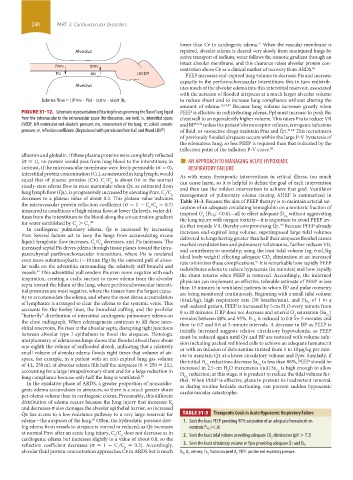
                                                                       lower than Cp in cardiogenic edema.  When the vascular membrane is
                                                                                                  77
                                    Alveolus                           repaired, alveolar edema is cleared very slowly from noninjured lungs by
                                                                       active transport of sodium; water follows the osmotic gradient through an
                                                                       intact alveolar membrane, and this clearance raises alveolar protein con-
                             Pmv         mv
                                                                       centration above Cp as a clinical marker of recovery from ARDS. 86
                             Pis          is            LVEDP            PEEP increases end-expired lung volume to decrease Pis and increase
                                                                       capacity in the peribronchovascular interstitium; this in turn redistrib-
                                    Alveolus
                                                                       utes much of the alveolar edema into this interstitial reservoir, associated
                                                                       with the aeration of flooded airspaces at a much larger alveolar volume
                        Edema flow = [ (Pmv - Pis) - ( mv -  is)  ]K f  to reduce shunt and to increase lung compliance without altering the
                                                                       amount of edema. 13,14,87  Because lung volume increases greatly when
                 FIGURE 31-12.  Schematic representation of Starling forces governing the flux of lung liquid   PEEP is effective in redistributing edema, Ppl must increase to push the
                 from the intravascular to the extravascular space (for discussion, see text). is, interstitial space;   chest wall to an equivalently higher volume. This raises Pra to reduce VR
                 LVEDP, left ventricular end-diastolic pressure; mv, microvessels of the lung; π, colloid osmotic   and BP 5,6,26  unless the patient’s baroreceptor reflexes, iatrogenic infusions
                                                                 30
                 pressure; σ, reflection coefficient. (Reproduced with permission from Hall and Wood LDH )  of fluid, or vasoactive drugs maintain Pms and Q ˙ t. 31,88  This recruitment
                                                                       of previously flooded airspaces occurs within the large P-V hysteresis of
                                                                       the edematous lung, so less PEEP is required than that indicated by the
                                                                       inflection point of the inflation P-V curve. 89
                 albumin and globulin. If these plasma proteins were completely reflected     ■
                 (σ = 1), no protein would pass from lung blood to the interstitium; in   AN APPROACH TO MANAGING ACUTE HYPOXEMIC
                 contrast, if the microvascular membrane were freely permeable (σ = 0),   RESPIRATORY FAILURE
                 interstitial protein concentration (Cl), as measured in lung lymph, would   As with many therapeutic interventions in critical illness, too much
                 equal that of plasma proteins (Cp). C /C  is about 0.6 in the normal   can cause harm, so it is helpful to define the goal of each intervention
                                                p
                                             l
                 steady-state edema flow in most mammals; when Q ˙ e, as estimated from   and then use the mildest intervention to achieve that goal. Ventilator
                 lung lymph flow (Q ˙ l), is progressively increased by elevating Pmv, C /C     management  of  pulmonary  edema  causing  AHRF  is  summarized  in
                                                                    p
                                                                  l
                 decreases to a plateau value of about 0.3. This plateau value indicates   Table 31-3. Because the aim of PEEP therapy is to maintain arterial sat-
                 the microvascular protein reflection coefficient (σ = 1 − C /C  = 0.7)     uration of an adequate circulating hemoglobin on a nontoxic fraction of
                                                               p
                                                             l
                 measured in conditions of high edema flow; at lower Q ˙ e levels, water dif-  ; <0.6)—all to effect adequate D  without aggravating
                 fuses from the interstitium to the blood along the concentration gradient   inspired O  (Fi O 2  O 2
                                                                               2
                                                                       the lung injury with oxygen toxicity—it is important to avoid PEEP lev-
                 for water established by C  > C . 84                  els that impede VR, thereby compromising Q ˙ t.  Because PEEP already
                                                                                                         90
                                    p
                                        L
                   In cardiogenic pulmonary edema,  Q ˙ e  is increased by increasing   increases end-expired lung volume, superimposed large tidal volumes
                 Pmv. Several factors act to keep the lungs from accumulating excess   delivered to lungs having greater than half their airspaces flooded causes
                 liquid: lymphatic flow increases, C /C  decreases, and Pis increases. The   marked overdistention and pulmonary volutrauma, further reduces VR,
                                          l
                                            p
                   incre ased septal Pis drives edema through tissue planes toward the intra-  and contributes to mortality; using the least tidal volume (eg, 6 mL/kg
                 parenchymal peribronchovascular interstitium, where Pis is rendered   ideal body weight) effecting adequate CO  elimination at an increased
                 even more subatmospheric (−10 mm Hg) by the outward pull of alveo-  rate minimizes these complications.  It is remarkable how rapidly PEEP
                                                                                                      2
                                                                                                 91
                 lar walls on the adventitia surrounding the relatively stiff bronchi and    redistributes edema to reduce hypoxemia (in minutes) and how rapidly
                 vessels.  This adventitial pull renders Pis even more negative with each   the shunt returns when PEEP is removed. Accordingly, the informed
                      84
                 inspiration, creating a cyclic suction to move edema from the alveolar   physician can implement an effective, tolerable estimate of PEEP in less
                 septa toward the hilum of the lung, where peribronchovascular intersti-  than 15 minutes in ventilated patients in whom BP and pulse oximetry
                 tial pressures are most negative, where the tissues have the largest capac-  are being monitored continuously. Beginning with a small tidal volume
                 ity to accommodate the edema, and where the most dense accumulation                                of 1 in a
                 of lymphatics is arranged to clear the edema to the systemic veins. This   (6 mL/kg), high respiratory  rate (30 breaths/min),  and Fi O 2
                                                                       well-sedated patient, PEEP is increased by 5 cm H O every minute from
                 accounts for the Kerley lines, the bronchial cuffing, and the perihilar   0 to 20 minutes. If BP does not decrease and arterial O  saturation (Sa )
                                                                                                           2
                 “butterfly” distribution of interstitial cardiogenic pulmonary edema on          is reduced to 0.8 for 5 minutes and
                                                                                                              2
                                                                                                                         O 2
                 the chest radiograph. When edemagenesis continues to fill these inter-  remains between 88% and 95%, Fi O 2
                                                                       then to 0.7 and 0.6 at 5-minute intervals. A decrease in BP as PEEP is
                 stitial reservoirs, Pis rises at the alveolar septa, disrupting tight junctions   initially  increased suggests  relative  circulatory  hypovolemia,  so PEEP
                 between alveolar type I epithelium to flood the airspaces. Histologic   must be reduced again until Q ˙ t and BP are restored with volume infu-
                 morphometry of edematous lungs shows that flooded alveoli have about   sion including packed red blood cells to achieve an adequate hematocrit
                 one-eighth the volume of unflooded alveoli, indicating that a relatively   or with an infusion of dobutamine titrated from 1 to 10 µg/kg per min-
                 small volume of alveolar edema floods eight times that volume of air-  ute to maintain Q ˙ t at a lower circulatory volume and Ppw. Similarly, if
                 space, for example, in a patient with an end-expired lung gas volume   the initial Fi  reductions decrease Sa  to less than 88%, PEEP should be
                 of 4 L, 250 mL of alveolar edema fills half the airspaces (8 × 250 = 2 L),   increased in 2.5-cm H O increments until Sa  is high enough to allow
                                                                                                  O 2
                                                                                O 2
                 accounting for a large intrapulmonary shunt and for a large reduction in   Fi  reduction; at this stage, it is prudent to reduce the tidal volume fur-
                                                                                       2
                                                                                                        O 2
                 lung compliance because only half the lung is ventilated. 28  ther. When PEEP is effective, plans to prevent its inadvertent removal,
                                                                         O 2
                   In the exudative phase of ARDS, a greater proportion of noncardio-  as during routine bedside suctioning, can prevent sudden hypoxemic
                 genic edema accumulates in airspaces, so there is a much greater shunt   cardiovascular catastrophe.
                 per edema volume than in cardiogenic edema. Presumably, this different
                 distribution of edema occurs because the lung injury that increases K   f
                 and decreases σ also damages the alveolar epithelial barrier, so increased
                 Q ˙ e has access to a low-resistance pathway to a very large reservoir for     TABLE 31-3    Therapeutic Goals in Acute Hypoxemic Respiratory Failure
                 edema—the airspaces of the lung.  Often, the hydrostatic pressure driv-    1.  Seek the least PEEP providing 90% saturation of an adequate hematocrit on
                                         85
                 ing edema from vessels to airspace is normal or reduced; as Q ˙ e increases   nontoxic Fi O 2  (<.6)
                 at normal Pmv after an acute lung injury, C /C  does not decrease as in     2.  Seek the least tidal volume providing adequate CO  elimination (pH > 7.2)
                                                   p
                                                 l
                 cardiogenic edema but increases slightly to a value of about 0.8, so the             2
                                                                                                            ˙
                 reflection coefficient decreases (σ  = 1  - C /C   = 0.2). Accordingly,     3.  Seek the least circulatory volume or Ppw providing adequate Q t and D O 2
                                                    p
                                                  l
                 alveolar fluid protein concentration approaches Cp in ARDS but is much    fraction inspired O ; PEEP, positive end-expiratory pressure.
                                                                                          2
                                                                         , O2, delivery; FiO 2
                                                                       DO 2
            section03.indd   240                                                                                       1/23/2015   2:06:46 PM

