


Page 371 - Hall et al (2015) Principles of Critical Care-McGraw-Hill
P. 371
CHAPTER 31: The Pathophysiology of the Circulation in Critical Illness  241


                     Cardiovascular management of cardiogenic and noncardiogenic   management of fluid therapy.  There were no differences in com-
                                                                                                40
                    edema aims to reduce edema formation and accumulation without   plications between the two groups and no further beneficial effects
                    inducing inadequate Q ˙ t or D  (see Table 31-3), thereby decreasing the   were  observed  after 5  days. These  results  favoring  conservative  fluid
                                         O 2
                    duration and complications of intensive care.  Cardiogenic edema is   management likely underestimated the observed outcome, as random
                                                     88
                    caused by high Pmv, often related to acute or acute-on-chronic LV dys-    assignment to treatment groups did not start until 43 hours after admis-
                    function that increases LVEDP. Reducing the central blood volume by   sion to the ICU. Support for underestimation comes from several case
                    venodilating agents (eg, morphine, furosemide, or nitroglycerin) reduces   reports  demonstrating  improvement  with  Ppw  reduction  within  the
                    LVEDP and edemagenesis, but excess preload reduction will adversely   first  24  hours  after  ICU  admission. 30,31,37-39,88   These  considerations
                    reduce Q ˙ t from a poorly functioning ventricle that often requires a   encourage early and aggressive reduction of circulating volume and
                    higher LVEDP (16-30 mm Hg) than normal (8-12 mm Hg). Where    Ppw with care to avoid hypoperfusion (ie, patients in shock are not
                    indicated, vasoactive drugs to enhance systolic function (eg, dobuta mine,   eligible for this strategy). This approach constantly seeks the least Ppw
                    milrinone, nitroglycerin) or reduce afterload (eg, fenoldopam, nicar-  associated with an adequate Q ˙ t and D  during the early stage of edema
                                                                                                     O 2
                    dipine, or nitroprusside) and measures to correct diastolic dysfunction    formation in ARDS. Of course, this is only symptomatic treatment; as
                    (eg, prolong filling time, maintain coordinated atrial contraction, or   yet there are no specific therapies for the acute lung injury that correct
                    correct myocardial hypoxia and ischemia) act to reduce the LVEDP   an increased K  and a reduced σ. The aim is to minimize the edema con-
                                                                                    f
                    required for adequate Q ˙ t and thus reduce cardiogenic edema formation   sequences of vascular injury and thereby shorten duration of ventilation
                    by the Starling equation. Increasing π  by colloid infusion also reduces   and care in the intensive care unit. 37-39
                                               mv
                    edema formation, provided Pmv is not increased; an albumin infusion
                    that raises π  from 15 to 20 mm Hg and Pmv from 25 to 30 mm Hg causes
                            mv
                    more Q ˙ e because σ = 0.7. Colloid infusion is even less helpful in reduc-
                    ing noncardiogenic edema, where σ is much reduced. In one study of oleic   KEY REFERENCES
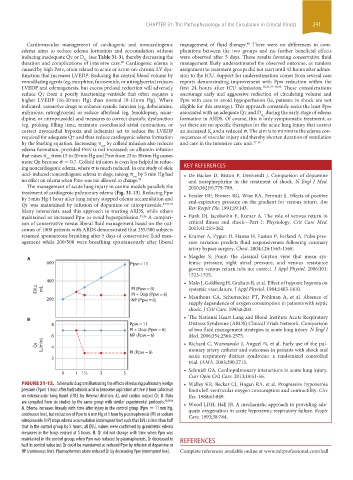
                    acid–induced noncardiogenic edema in dogs, raising π  by 5 mm Hg had     • De Backer D, Biston P, Devriendt J. Comparison of dopamine
                                                          mv
                    no effect on edema when Pmv was not allowed to change. 78  and norepinephrine in the treatment of shock.  N Engl J Med.
                     The management of acute lung injury in canine models parallels the   2010;362(9):779-789.
                    treatment of cardiogenic pulmonary edema (Fig. 31-13). Reducing Ppw
                    by 5 mm Hg 1 hour after lung injury stopped edema accumulation and     • Fessler HE, Brower RG, Wise RA, Permutt S. Effects of positive
                                                                             end-expiratory pressure on the gradient for venous return.  Am
                    Q ˙ t was maintained by infusion of dopamine or nitroprussside. 87,92,93
                    Many intensivists used this approach in treating ARDS, while others   Rev Respir Dis. 1991;19:143.
                    maintained or increased Ppw to avoid hyperperfusion. 35,36  A compari-    • Funk DJ, Jacobsohn E, Kumar A. The role of venous return in
                    son of conservative versus liberal fluid management based on the out-  critical illness and shock—Part I: Physiology.  Crit Care Med.
                    comes of 1000 patients with ARDS demonstrated that 255/500 subjects    2013;41:255-262.
                    resumed spontaneous breathing after 5 days of conservative fluid man-    • Kramer A, Zygun D, Hawes H, Easton P, Ferland A. Pulse pres-
                    agement while 200/500 were breathing spontaneously after liberal    sure variation predicts fluid responsiveness following coronary
                                                                             artery bypass surgery. Chest. 2004;126:1563-1568.
                                                                              • Magder S,  Point: the classical Guyton view that mean sys-
                      A
                            600                          Ppw = 11            temic pressure, right atrial pressure, and venous resistance
                                                                               govern venous return is/is not correct. J Appl Physiol. 2006;101:
                                                                             1523-1525.
                            400                                               • Malo J, Goldberg H, Graham R, et al. Effect of hypoxic hypoxia on
                         EVLL  mL                        PI (Ppw = 6)        systemic vasculature. J Appl Physiol. 1984;1403-1410.
                                                         PI + Dop (Ppw = 6)    • Manthous  CA,  Schumacker  PT,  Pohlman  A,  et  al.  Absence  of
                            200                          NP (Ppw = 6)
                                                                             supply dependence of oxygen consumption in patients with septic
                                                                             shock. J Crit Care. 1993;8:203.
                                                                              • The National Heart Lung and Blood Institute Acute Respiratory
                      B
                              8                         Ppw = 11             Distress Syndrome (ARDS) Clinical Trials Network. Comparison
                                                        PI + Dop (Ppw = 6)   of two fluid management strategies in acute lung injury. N Engl J
                              6                         NP (Ppw = 6)         Med. 2006;354:2564-2575.
                         QT  (L/min)                                          • Richard C, Warszawski J, Anguel N, et al. Early use of the pul-
                        .     4                         PI (Ppw = 6)         monary artery catheter and outcomes in patients with shock and
                              2                                              acute respiratory distress syndrome: a randomized  controlled
                                                                             trial. JAMA. 2003;290:2713.
                                                                              • Schmidt GA. Cardiopulmonary interactions in acute lung injury.
                                 0    1 1½    3       5
                                                                             Curr Opin Crit Care. 2013;19:51-56.
                    FIGURE 31-13.  Schematic diagram illustrating the effects of reducing pulmonary wedge     • Walley KR, Becker CJ, Hogan RA, et al. Progressive hypoxemia
                    pressure (Ppw) 1 hour after hydrochloric acid or kerosene aspiration at time 0 hour (abscissa)   limits left ventricular oxygen consumption and contractility. Circ
                                                                 ˙
                    on extravascular lung liquid (EVLL by thermal dilution; A), and cardiac output Qt; B. Data   Res. 1988;63:849.
                    are compiled from six studies by the same group with similar experimental protocols. 85,89,90      • Wood LDH, Hall JB. A mechanistic approach to providing ade-
                    A. Edema increases linearly with time after injury in the control group (Ppw = 11 mm Hg,   quate oxygenation in acute hypoxemic respiratory failure. Respir
                    continuous line), but reduction of Ppw to 6 mm Hg at 1 hour by plasmapheresis (Pl) or sodium   Care. 1993;38:784.
                    nitroprusside (NP) stops edema accumulation (interrupted line) such that EVLL is less than half
                    that in the control group by 5 hours; all EVLL values were confirmed by gravimetric edema
                    measures in the lungs excised at 5 hours. B. Qt did not change with time when Ppw was
                                              ˙
                                                               ˙
                    maintained in the control group; when Ppw was reduced by plasmapheresis, Qt decreased to   REFERENCES
                                  ˙
                    half its control value but Qt could be maintained at reduced Ppw by infusion of dopamine or
                    NP (continuous line). Plasmapheresis alone reduced Qt by decreasing Ppw (interrupted line).  Complete references available online at www.mhprofessional.com/hall
                                                ˙


            section03.indd   241                                                                                       1/23/2015   2:06:47 PM

