


Page 373 - Hall et al (2015) Principles of Critical Care-McGraw-Hill
P. 373
CHAPTER 32: Assessing the Circulation: Oximetry, Indicator Dilution, and Pulse Contour Analysis  243


                                   Hemoglobin absorption spectrum                       Normal hemoglobin-oxygen dissociation
                                                                                               curve relative to P
                           Red                              Infrared           100                        O 2
                          660 nm                            940 nm
                                                                                                                 Arterial
                                                                                               Mixed venous
                                                                 MetHb         Saturation (%)  75  Capillary
                                                                                50
                     Absorption                                  OxyHb          25


                                                               DeOxyHb           0       25      50      75     100
                                                                                                 P (mm Hg)
                                         COHb                                                     O 2
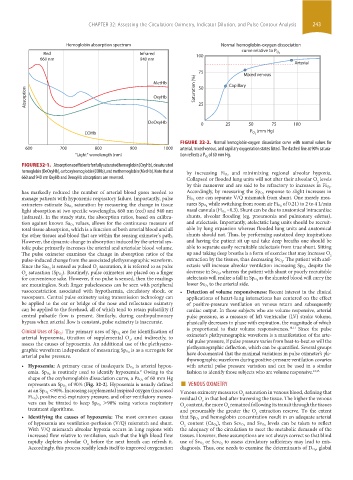
                                                                          FIGURE 32-2.  Normal hemoglobin-oxygen dissociation curve with normal values for
                     600         700         800        900         1000  arterial, mixed venous, and capillary oxygenation states listed. The dashed line at 90% satura-
                                      “Light” wavelength (nm)             tion reflects a P O 2  of 60 mm Hg.
                    FIGURE 32-1.  Absorption coefficients for fully saturated hemoglobin (OxyHb), desaturated
                    hemoglobin (DeOxyHb), carboxyhemoglobin (COHb), and methemoglobin (MetHb). Note that at      and minimizing regional alveolar hypoxia.
                    660 and 940 nm OxyHb and DeoxyHb absorptions are reversed.  by increasing Fi O 2
                                                                            Collapsed or flooded lung units will not alter their alveolar O  levels
                                                                                                                        2
                                                                            by this maneuver and are said to be refractory to increases in Fi O 2 .
                    has markedly  reduced the number of arterial blood gases  needed to   Accordingly, by measuring the Sp O 2  response to slight increases in
                    manage patients with hypoxemic respiratory failure. Importantly, pulse   Fi O 2  one can separate V/Q mismatch from shunt. One merely mea-
                                      saturation by measuring the change in tissue                           of 0.21) to 2 to 4 L/min
                    oximeters estimate Sa O 2                               sures Sp O 2  while switching from room air Fi O 2
                    light absorption at two specific wavelengths, 660 nm (red) and 940 nm   nasal cannula (Fi O 2  ~0.3). Shunt can be due to anatomical intracardiac
                    (infrared). In the steady state, the absorption ratios, based on calibra-  shunts, alveolar flooding (eg, pneumonia and pulmonary edema),
                                      values, allows for the continuous measure of   and atelectasis. Importantly, atelectatic lung units should be recruit-
                    tion against known Sa O 2
                    total tissue absorption, which is a function of both arterial blood and all   able by lung expansion whereas flooded lung units and anatomical
                    the other tissues and blood that are within the sensing oximeter’s path.   shunts should not. Thus, by performing sustained deep inspirations
                    However, the dynamic change in absorption induced by the arterial sys-  and having the patient sit up and take deep breaths one should be
                    tolic pulse primarily increases the arterial and arteriolar blood volume.   able to separate easily recruitable atelectasis from true shunt. Sitting
                    The pulse oximeter examines the change in absorption ratios of the   up and taking deep breaths is a form of exercise that may increase O
                                                                                                                             2
                    pulse-induced change from the associated plethysmographic waveform.   extraction by the tissues, thus decreasing Sv O 2 . The patient with atel-
                              is sensed as pulsed O  saturation, it is referred to as pulse                           despite the
                    Since the Sa O 2         2                              ectasis will increase alveolar ventilation increasing Sp O 2
                                  ). Routinely, pulse oximeters are placed on a finger   , whereas the patient with shunt or poorly recruitable
                    O  saturation (Sp O 2                                   decrease in Sv O 2
                     2
                    for convenience sake. However, if no pulse is sensed, then the readings   atelectasis will realize a fall in Sp O 2  as the shunted blood will carry the
                    are meaningless. Such finger pulselessness can be seen with peripheral   lower Sv O 2  to the arterial side.
                    vasoconstriction  associated  with  hypothermia,  circulatory  shock,  or     • Detection of volume responsiveness: Recent interest in the clinical
                    vasospasm. Central pulse oximetry using transmission technology can     applications of heart-lung interactions has centered on the effect
                    be applied to the ear or bridge of the nose and reflectance oximetry     of positive-pressure ventilation on venous return and subsequently
                    can be applied to the forehead, all of which tend to retain pulsatility if    cardiac output. In those subjects who are volume responsive, arterial
                    central  pulsatile flow is present. Similarly, during cardiopulmonary   pulse pressure, as a measure of left ventricular (LV) stroke volume,
                    bypass when arterial flow is constant, pulse oximetry is inaccurate.  phasically decreases in phase with expiration, the magnitude of which
                                                                            is  proportional  to  their  volume  responsiveness. 10,11   Since  the  pulse
                                                      are for identification of
                    Clinical Uses of Sp O 2 :  The primary uses of Sp O 2   oximeter’s plethysmographic waveform is a manifestation of the arte-
                    arterial hypoxemia, titration of supplemental O , and indirectly, to
                                                        2
                    assess the causes of hypoxemia. An additional use of the plethysmo-  rial pulse pressure, if pulse pressure varies from beat-to-beat so will the
                                                         is as a surrogate for   plethysmographic deflection, which can be quantified. Several groups
                    graphic waveform independent of measuring Sp O 2        have documented that the maximal variations in pulse oximeter’s ple-
                    arterial pulse pressure.
                                                                            thysmographic waveform during positive-pressure ventilation covaries
                                                           is arterial hypox-  with arterial pulse pressure variation and can be used in a similar
                      • Hypoxemia: A primary cause of inadequate D O 2
                              is  routinely used to identify hypoxemia.  Owing to the   fashion to identify those subjects who are volume responsive. 12,13
                                                            9
                      emia.  Sp O 2
                                                              of 60 mm Hg
                      shape of the oxyhemoglobin dissociation curve, a Pa O 2    ■
                                    of 90% (Fig. 32-2). Hypoxemia is usually defined   VENOUS OXIMETRY
                      represents an Sp O 2
                              <90%. Increasing supplemental inspired oxygen (increased
                      as an Sp O 2                                        Venous oximetry measures O  saturation in venous blood, defining that
                        ), positive end-expiratory pressure, and other ventilatory maneu-      2
                      Fi O 2                                              residual O  in that bed after traversing the tissue. The higher the venous
                                                 >90% using various respiratory   2
                      vers can be titrated to keep Sp O 2                 O  content, the more O  remained following its transit through the tissues
                                                                           2
                                                                                          2
                      treatment algorithms.                               and presumably the greater the O  extraction reserve. To the extent
                                                                                                   2
                      • Identifying  the  causes  of  hypoxemia:  The  most  common  causes   that Sp O 2  and hemoglobin concentration result in an adequate arterial
                      of hypoxemia are ventilation-perfusion (V/Q) mismatch and shunt.   O  content (Ca O 2 ), then Scv O 2  and Sv O 2  levels can be taken to reflect
                                                                           2
                      With V/Q mismatch alveolar hypoxia occurs in lung regions with   the adequacy of the circulation to meet the metabolic demands of the
                      increased flow relative to ventilation, such that the high blood flow   tissues. However, these assumptions are not always correct so that blind
                      rapidly depletes alveolar O  before the next breath can refresh it.   use of Sv O 2  or Scv O 2  to assess circulatory sufficiency may lead to mis-
                                          2
                      Accordingly, this process readily lends itself to improved oxygenation   diagnosis. Thus, one needs to examine the determinants of D O 2 , global
            section03.indd   243                                                                                       1/23/2015   2:06:48 PM

