


Page 376 - Hall et al (2015) Principles of Critical Care-McGraw-Hill
P. 376
246     PART 3: Cardiovascular Disorders


                                                                                                          33
                      Bolus thermodilution curves sampled in the pulmonary and femoral  variable with the phase of the ventilatory cycle,  a minimum of three
                       arteries after injection of  cold saline into the superior vena cava  bolus measures need to be taken at random to the ventilatory cycle and
                                                                       averaged to derive the mean cardiac output. This limitation is minimized
                           Pulmonary artery thermodilution curve
                                                                       but not eliminated by having the measure of indicator across the entire
                                                                       thoracic compartment, as described below. Second, the reported car-
                                                                       diac output values are, by definition, for a single time interval and thus
                                                                       do not report continuous cardiac output measures. If cardiovascular
                                 Trans cardiopulmonary thermodilution curve
                                                                       conditions are changing rapidly, many bolus thermodilution measures
                                                                       need to be done over the course of care or the information will not be
                    − T (ºC)                                           useful. Importantly, measures of stroke volume and cardiac output,
                                                                       when coupled with other measured hemodynamic variables, allow for
                                                                       the calculation of various important hemodynamic parameters, like LV
                                                                                                      .
                                                                       stroke work and both systemic D O 2  and V O 2
                                                                         In an attempt to both reduce the work load from cardiac output
                                                                       measures and provide continuous measures of cardiac output by ther-
                                                                       modilution (CCO), the PAC was modified were made to incorporate a
                                          Time (s)                     thermal filament (Vigilance, Edwards Life Sciences, Irvine, CA) or ther-
                                                                       mal coil (OptiQ™, ICU Medical, San Clemente, CA) that warms blood in
                    Injection of thermal indicator                     the superior vena cava as opposed to cooling it. To avoid other thermal
                                                                       artifacts  the  Vigilance  uses  a  random  thermal  (heat)  signal  using  an
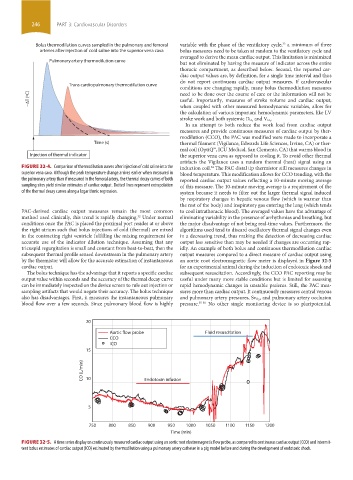
                 FIGURE 32-4.  Comparison of thermodilution curves after injection of cold saline into the   induction coil.  The PAC distal tip thermistor still measures changes in
                                                                                  34
                 superior vena cava. Although the peak temperature change arrives earlier when measured in   blood temperature. This modification allows for CCO trending, with the
                 the pulmonary artery than if measured in the femoral artery, the thermal decay curves of both   reported cardiac output values reflecting a 10-minute moving average
                 sampling sites yield similar estimates of cardiac output. Dotted lines represent extrapolation   of this measure. The 10-minute moving average is a requirement of the
                 of the thermal decay curves along a logarithmic regression.  system because it needs to filter out the larger thermal signal induced
                                                                       by respiratory changes in hepatic venous flow (which is warmer than
                                                                       the rest of the body) and inspiratory gas entering the lung (which tends
                 PAC-derived cardiac output measures remain the most  common   to cool intrathoracic blood). The averaged values have the advantage of
                 method used clinically, this trend is rapidly changing.  Under normal   eliminating variability in the presence of arrhythmias and breathing, but
                                                         32
                 conditions once the PAC is placed the proximal port resides at or above   the major disadvantage of not being real-time values. Furthermore, the
                 the right atrium such that bolus injections of cold (thermal) are mixed   algorithms used tend to discard oscillatory thermal signal changes even
                 in the contracting right ventricle fulfilling the mixing requirement for   in a decreasing trend, thus making the detection of decreasing cardiac
                 accurate use of the indicator dilution technique. Assuming that any   output less sensitive than may be needed if changes are occurring rap-
                 tricuspid regurgitation is small and constant from beat-to-beat, then the   idly. An example of both bolus and continuous thermodilution cardiac
                 subsequent thermal profile sensed downstream in the pulmonary artery   output measures compared to a direct measure of cardiac output using
                 by the thermistor will allow for the accurate estimation of instantaneous   an aortic root electromagnetic flow meter is displayed in Figure 32-5
                 cardiac output.                                       for an experimental animal during the induction of endotoxic shock and
                   The bolus technique has the advantage that it reports a specific cardiac   subsequent resuscitation. Accordingly, the CCO PAC reporting may be
                 output value within seconds and the accuracy of the thermal decay curve   useful under many more stable conditions but is limited for assessing
                 can be immediately inspected on the device screen to rule out injection or   rapid hemodynamic changes in unstable patients. Still, the PAC mea-
                 sampling artifacts that would negate their accuracy. The bolus technique   sures more than cardiac output. It continuously measures central venous
                 also has disadvantages. First, it measures the instantaneous pulmonary   and pulmonary artery pressures, Sv O 2 , and pulmonary artery occlusion
                 blood flow over a few seconds. Since pulmonary blood flow is highly   pressure. 35-38  No other single monitoring device is so pluripotential.


                                       20

                                               Aortic flow probe                Fluid resuscitation
                                               CCO
                                               ICO
                                       15

                                      CO (L/min)  10       Endotoxin infusion


                                        5


                                        750    800    850   900    950   1000   1050   1100  1150   1200
                                                                    Time (min)
                 FIGURE 32-5.  A time series display on continuously measured cardiac output using an aortic root electromagnetic flow probe, as compared to continuous cardiac output (CCO) and intermit-
                 tent bolus estimates of cardiac output (ICO) estimated by thermodilution using a pulmonary artery catheter in a pig model before and during the development of endotoxic shock.


            section03.indd   246                                                                                       1/23/2015   2:06:51 PM

