


Page 377 - Hall et al (2015) Principles of Critical Care-McGraw-Hill
P. 377
CHAPTER 32: Assessing the Circulation: Oximetry, Indicator Dilution, and Pulse Contour Analysis  247


                    Regrettably, the documentation that PAC use improves outcomes is   estimate of lung water, has not been shown to aid in reducing time on
                      generally  lacking, 34,39  even though such evidence is also lacking for   the ventilator in patients with acute lung injury. Given that it is difficult
                               7  and arterial pressure monitoring. However, given the   to document the benefit from all the physiological data coming from a
                    the use of Sp O 2
                      present climate in critical care medicine, it is highly doubtful that such a   PAC in critically ill patients, this lack of proven benefit of these newer
                    study will now be undertaken. 32                      measures is not surprising.
                    tion, several devices use the transthoracic approach to calibrate their   ■  ARTERIAL PULSE CONTOUR ANALYSIS AND CARDIAC OUTPUT
                    Transpulmonary Indicator Dilution:  In an attempt to avoid PAC inser-
                    cardiac output monitoring devices and also provide an independent   The primary determinants of the arterial pulse pressure are LV stroke
                    reference cardiac output value. Since these devices measure indicator   volume  and central  arterial compliance. Compliance  is a  function  of
                    dilution over a larger capacitor than the PAC, they tend to see less   size, age, sex, and physiological inputs, like sympathetic tone, hypogly-
                    respiratory variations in their measures, but do not eliminate them.    cemia, temperature, and autonomic responsiveness of the vasculature.
                                                                      40
                    The PiCCO™ (Pulsion Medical Systems, Munich, Germany) and the   Many of  these  determinants  of vascular compliance  can be  assumed
                    VolumeView (Edwards Life Sciences) systems use cold bolus injec-  based on autopsy studies.  Hamilton and Remington  explored this
                                                                                             42
                                                                                                                  43
                    tions into a central vein with thermal sampling in a large peripheral   interaction over 50 years ago developing the overall approach used by
                    artery.  At  least  for  the  PiCCO  device,  this  serves  to  calibrate  the   most of the companies who attempt to report cardiac output from the
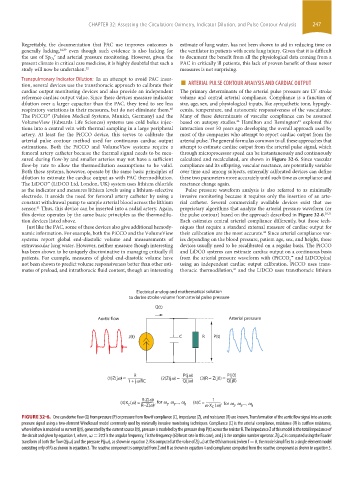
                    arterial  pulse  contour  method  used  for  continuous  cardiac  output   arterial pulse. The general formulas common to all these approaches that
                    estimations. Both the PiCCO and VolumeView systems require a   attempt to estimate cardiac output from the arterial pulse signal, which
                    femoral artery catheter because the thermal signal needs to be mea-  through microprocessor speed can be instantaneously and continuously
                    sured during flow-by and smaller arteries may not have a sufficient   calculated and recalculated, are shown in Figure 32-6. Since vascular
                    flow-by  rate  to  allow  the  thermodilution  assumptions  to  be  valid.   compliance and its offspring, vascular reactance, are potentially variable
                    Both these systems, however, operate by the same basic principles of   over time and among subjects, externally calibrated devices can define
                    dilution to estimate the cardiac output as with PAC thermodilution.   these two parameters more accurately until such time as compliance and
                    The LiDCO™ (LiDCO Ltd, London, UK) system uses lithium chloride   reactance change again.
                    as the indicator and measures lithium levels using a lithium-selective   Pulse pressure waveform analysis is also referred to as minimally
                    electrode. It avoids the need for femoral artery catheter by using a   invasive monitoring because it requires only the insertion of an arte-
                    constant withdrawal pump to sample arterial blood across the lithium   rial catheter. Several commercially available devices exist that use
                    sensor.  Thus, this device can be inserted into a radial artery. Again,   proprietary algorithms that analyze the arterial pressure waveform (or
                         41
                    this device operates by the same basic principles as the thermodilu-  the pulse contour) based on the approach described in Figure 32-6. 29,31
                    tion devices listed above.                            Each estimates central arterial compliance differently, but those tech-
                     Just like the PAC, some of these devices also give additional hemody-  niques that require a standard external measure of cardiac output for
                    namic information. For example, both the PiCCO and the VolumeView   their calibration are the most accurate.  Since arterial compliance var-
                                                                                                      44
                    systems report global end-diastolic volume and measurements of   ies depending on the blood pressure, patient age, sex, and height, these
                    extravascular lung water. However, neither measure though interesting   devices usually need to be recalibrated on a regular basis. The PiCCO
                    has been shown to be uniquely discriminative in managing critically ill   and LiDCO systems can estimate cardiac output on a continuous basis
                    patients.  For example,  measures  of  global  end-diastolic  volume  have   from the arterial pressure waveform with (PiCCO ™ and LiDCOplus)
                                                                                                               2
                    not been shown to predict volume responsiveness better than other esti-  using an independent cardiac output calibration. PiCCO uses trans-
                    mates of preload, and intrathoracic fluid content, though an interesting   thoracic thermodilution,  and the LiDCO uses transthoracic lithium
                                                                                            45

                                                           Electrical analog and mathematical solution
                                                        to derive stroke volume from arterial pulse pressure
                                                                 Q(t)

                                              Aortic flow                                 Arterial pressure


                                                        J(t)             C       R   P(t)


                                                          R                P(jw)          P(j0)
                                                 (1)Z(jw) =        (2)Z(jw) =   (3)R = Z(j0) =
                                                        1 + jw RC         Q(jw)          Q(j0)

                                                             R·Z(w)                  1
                                                     (4)X (w) =  R−Z(w)’  for w , w ,..., w 8  (5)C =  w·X C  (w)’  for w , w ,..., w 8
                                                                     2
                                                                       3
                                                        C
                                                                                            2
                                                                                              3
                    FIGURE 32-6.  One can derive flow (Q) from pressure (P) or pressure from flow if compliance (C), impedance (Z), and resistance (R) are known. Transformation of the aortic flow signal into an aortic
                    pressure signal using a two-element Windkessel model commonly used by minimally invasive monitoring techniques. Compliance (C) is the arterial compliance, resistance (R) is outflow resistance,
                    where inflow is modeled as current Q(t), generated by the current source J(t), pressure is modeled by the pressure drop P(t) across the resistor R. The impedance Z of this model is the total impedance of
                    the circuit and given by equation 1, where, ω = 2πf is the angular frequency, f is the frequency (60/heart rate in this case), and j is the complex number operator. Z(jω) is computed using the Fourier
                    transform of both the flow Q(jω) and the pressure P(jω), as shown in equation 2. R is computed at the value of Z(jω) at the 0th harmonic (when f = 0, the model simplifies to a single element model
                    consisting only of R) as shown in equation 3. The reactive component is computed from Z and R as shown in equation 4 and compliance computed from the reactive component as shown in equation 5.


            section03.indd   247                                                                                       1/23/2015   2:06:51 PM

