


Page 450 - Hall et al (2015) Principles of Critical Care-McGraw-Hill
P. 450
320     PART 3: Cardiovascular Disorders


                                         A                             B


                                                             650                           650
                                        40                        40     27                      27
                                                 40       650                  27        650
                                https://kat.cr/user/tahir99/

                                                      63                             45
                                                                                                                     in a patient
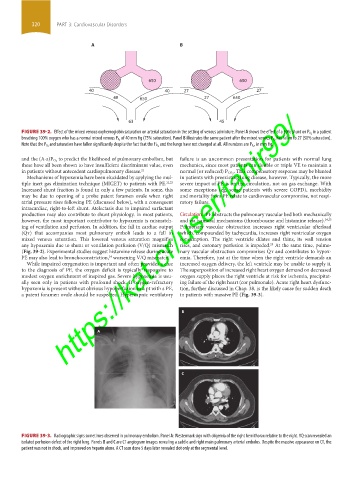
                 FIGURE 39-2.  Effect of the mixed venous oxyhemoglobin saturation on arterial saturation in the setting of venous admixture. Panel A shows the effect of a 50% shunt on P O 2
                                                                                                         has fallen to 27 (50% saturation).
                 breathing 100% oxygen who has a normal mixed venous P O 2  of 40 mm Hg (75% saturation). Panel B illustrates the same patient after the mixed venous P O 2
                                                                                                 , in mm Hg.
                 Note that the P O 2  and saturation have fallen significantly despite the fact that the Fi O 2  and the lungs have not changed at all. All numbers are P O 2
                              to predict the likelihood of pulmonary embolism, but   failure is  an uncommon  presentation for patients with  normal lung
                 and the (A-a)P O 2
                 these have all been shown to have insufficient discriminant value, even   mechanics, since most patients can double or triple VE to maintain a
                 in patients without antecedent cardiopulmonary disease. 21  normal (or reduced) P CO 2 . This compensatory response may be blunted
                   Mechanisms of hypoxemia have been elucidated by applying the mul-  in patients with preexisting lung disease, however. Typically, the more
                 tiple inert gas elimination technique (MIGET) to patients with PE. 22,23    severe impact of PE is on the circulation, not on gas exchange. With
                 Increased shunt fraction is found in only a few patients. In some, this   some exceptions (eg, some patients with severe COPD), morbidity
                 may be due to opening of a probe patent foramen ovale when right   and mortality from PE relate to cardiovascular compromise, not respi-
                 atrial pressure rises following PE (discussed below), with a consequent   ratory failure.
                 intracardiac, right-to-left shunt. Atelectasis due to impaired surfactant
                 production may also contribute to shunt physiology. In most patients,   Circulation:  PE obstructs the pulmonary vascular bed both mechanically
                 however, the most important contributor to hypoxemia is mismatch-  and via humoral mechanisms (thromboxane and histamine release). 24,25
                 ing of ventilation and perfusion. In addition, the fall in cardiac  output   Pulmonary vascular obstruction increases right   ventricular afterload
                 (Q ˙ t)  that  accompanies  most  pulmonary  emboli  leads  to  a  fall  in   which, compounded by tachycardia, increases right ventricular oxygen
                 mixed  venous saturation. This lowered venous saturation magnifies   consumption. The right ventricle dilates and thins, its wall tension
                 any  hypoxemia due to shunt or ventilation  perfusion (V/Q) mismatch   rises, and coronary perfusion is impeded.  At the same time, pulmo-
                                                                                                      25
                 (Fig. 39-2). Experimental studies suggest histamine release during acute   nary vascular obstruction compromises Q ˙ t and contributes to hypox-
                 PE may also lead to bronchoconstriction,  worsening V/Q mismatch.  emia. Therefore, just at the time when the right ventricle demands an
                                               24
                   While impaired oxygenation is important and often provides a clue   increased oxygen delivery, the left ventricle may be unable to supply it.
                 to  the  diagnosis  of  PE,  the  oxygen  deficit  is  typically  responsive  to   The superposition of increased right heart oxygen demand on decreased
                 modest oxygen enrichment of inspired gas. Severe hypoxemia is usu-  oxygen supply places the right ventricle at risk for ischemia, precipitat-
                 ally seen only in patients with profound shock. If oxygen-refractory   ing failure of the right heart (cor pulmonale). Acute right heart dysfunc-
                 hypoxemia is present without obvious hypoperfusion in a pt with a PE,   tion, further discussed in Chap. 38, is the likely cause for sudden death
                 a patent foramen ovale should be suspected. Hypercapnic ventilatory   in patients with massive PE (Fig. 39-3).


                                                                        B


                                           A


                                                                        C


                 FIGURE 39-3.  Radiographic signs sometimes observed in pulmonary embolism. Panel A: Westermark sign with oligemia of the right hemithorax relative to the right. VQ scan revealed an
                 isolated perfusion defect of the right lung. Panels B and C are CT angiogram images revealing a saddle and right main pulmonary arterial embolus. Despite the massive appearance on CT, the
                 patient was not in shock, and improved on heparin alone. A CT scan done 5 days later revealed clot only at the segmental level.


            section03.indd   320                                                                                       1/23/2015   2:07:32 PM

