


Page 452 - Hall et al (2015) Principles of Critical Care-McGraw-Hill
P. 452
322     PART 3: Cardiovascular Disorders


                                                       . This can be dem-  for the evaluation of critically ill patients—non-invasiveness, potential
                 until a new steady state is reached at a higher Pa CO 2
                 onstrated numerically by the alveolar dead-space fraction (AVDSf)   to elucidate competing diagnoses (such as myocardial infarction or
                 as follows:                                           pericardial disease), and rapid availability, echocardiography is insen-
                                                                       sitive, and should not be used to exclude PE. In prospective trials of
                                AVDSf = (Pa CO 2  – P ET CO  )/Pa CO 2  unselected patients, sensitivities of between 29% and 52% are reported
                                                 2
                   When combined with a negative D-dimer value, as will be discussed   for various echocardiographic criteria of right ventricular strain or
                 shortly, an AVDSf of less than 0.15 has been shown to exclude PE in   dysfunction or tricuspid regurgitation. 35,36  Many patients with PE have
                 hospitalized patients with a sensitivity of 97.8% and a negative predictive   normal echocardiograms.
                 value of 98%.  In calculating the AVDSf, however, one must take care   When echocardiography exhibits right ventricular dysfunction, it reli-
                           16
                 to ensure a properly calibrated blood gas analyzer, as even small changes   ably predicts an increased risk of mortality from pulmonary embolism.
                        measurements  will  cause  large  differences  in AVDSf. Strong   One study examined 126 patients with PE with echocardiography on
                                https://kat.cr/user/tahir99/
                 in  Pa CO 2
                                                                is noted   the day of diagnosis, and found moderate  RV dysfunction  to impart
                 consideration of PE is warranted whenever a rising arterial P CO 2
                 in the setting of relatively constant CO  production.  a sixfold increased risk of in-hospital death compared to normal RV
                                             2                         function.  Even in patients assessed to be hemodynamically stable at
                                                                              37
                 Pulmonary Artery Catheter:  The most obvious clues from the pulmonary   presentation, right ventricular dysfunction portends a worse prognosis;
                 artery catheter (PAC) are the elevations in right atrial, right ventricu-  one study found that 10% of such patients develop shock and 5% died in
                 lar, and Pa pressures and concomitant fall in Q ˙ t that occur with PE.   the hospital, compared to a 0% mortality amongst patients with normal
                 Concomitant with reduced Q ˙ t, one observes widening of the  arterial (A)   RV function.  In another series of hemodynamically stable patients,
                                                                                 38
                 to venous (V) oxygen content difference (Fick principle) and a decre-  recurrent embolism was strongly associated with baseline echocar-
                                                     ) or the central venous
                                                                                                                   39
                 ment in the mixed venous oxygen saturation (Sv O 2    diographic abnormalities in right ventricular wall motion.  A word
                 oxygen saturation. A final clue from the PAC may lie in the difference   of   caution is prudent, however, in that the classic echocardiographic
                 between the Pa diastolic pressure and the pulmonary artery occlusion   findings of PE are nonspecific, being common to a number of causes of
                 pressure (Paop), though rising pericardial constraint may blunt a fall in   acute right ventricular pressure overload such as the acute respira-
                 Paop.  Normally, flow through the pulmonary circulation is pulsatile,   tory distress syndrome, other  forms of  severe  hypoxemia, or status
                     26
                 so that by the end of diastole, there is no more flow from the Pa to left     asthmaticus (see Chaps. 52 and 55).
                 atrium. Without flow, there can be no pressure gradient from the Pa to
                 left atrium. Thus the end-diastolic Pa pressure and the Paop are nearly
                 equal. When there is obstruction of the pulmonary vascular bed, how-  DIAGNOSIS
                 remains. A discrepancy between the Pa diastolic pressure and Paop may   ■  SPECIAL PROBLEMS IN THE ICU
                 ever, flow is not completed by the end of diastole and a pressure gradient
                 provide a clue to Pa obstruction. 31                  The typical critically ill patient is unable to complain of the usual symp-
                   Unfortunately, such pulmonary arterial changes are both nonspecific   toms of PE, has numerous explanations for tachycardia and tachypnea,
                 and insensitive, so that only rarely do such changes indicate PE. For   is hemodynamically unstable, and is a poor candidate for transport for
                 example, cardiac dysfunction (systolic or diastolic) causes a rise in right   radiographic studies. For that reason, it is important to have a clear
                 heart pressures and a fall in Q ˙ t, any cause of low Q ˙ t will result in a   sense of the probability of PE in any given patient. Such a judgment is
                   widened A-V oxygen content difference; and any cause of acute lung   complex, and validated algorithms for determining prior probability in
                 injury or global hypoxic vasoconstriction may raise the Pa diastolic to   critically ill patients are not available. The clinician must synthesize the
                 Paop gradient. A further layer of complexity is added by observations   patient’s risk factors and cardiopulmonary physiology to arrive at a risk
                 that in randomized trials, PAC use results in a small but significant   determination.  In  the  following  sections,  the  contribution  of  various
                 increase in the risk of PE compared to central venous catheters. 32,33    tests in evaluating suspected PE is discussed. An approach to diagnosis
                 Given the limitation of the PAC as a diagnostic tool and the risk of actu-  is summarized in Figure 39-5.
                 Echocardiography:  Intensivist-performed, goal-directed echocardiog-  ■  RISK FACTORS
                 ally causing PE, it cannot be advocated for the diagnosis of PE.
                 raphy occasionally points to PE as the cause of cardiopulmonary   Since the symptoms, signs, and laboratory findings of PE are usu-
                 failure (Chap. 29). Similarly, a formal study requested for evaluation   ally nonspecific, to wait for a patient with classic, unmistakable clues
                 of a low flow state may unexpectedly reveal findings strongly sugges-  before pursuing a diagnosis risks missing the majority of patients with
                         34
                 tive of PE.  These include a dilated, thin-walled, poorly contracting   this potentially lethal disease. However, since nonspecific indicators of
                 right ventricle, bowing of the interventricular septum to the left, or   potential PE are ubiquitous, indiscriminant pursuit of the diagnosis is
                 McConnell’s sign. Very rarely, echocardiography may demonstrate a   prohibitively costly and dangerous. Most patients with PE have identifi-
                 thrombus in the right atrium or right ventricle (Table 39-2), clinching   able risk factors (Table 39-3). Absence of risk factors for VTE should
                 the diagnosis of PE. While its attractions include portability—especially    lead  the  physician  to  seek  alternative  explanations  for  the  patient’s
                                                                         findings. On the other hand, when numerous risk factors are present,
                                                                       the diagnosis should be more seriously considered.
                                                                         Given the nonspecific presentation of most patients with PE, a clinical
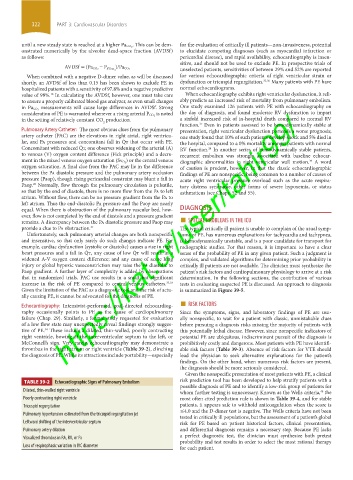
                   TABLE 39-2    Echocardiographic Signs of Pulmonary Embolism  risk prediction tool has been developed to help stratify patients with a
                                                                       possible diagnosis of PE and to identify a low-risk group of patients for
                  Dilated, thin-walled right ventricle                 whom further testing is unnecessary. Known as the Wells criteria,  the
                                                                                                                       40
                  Poorly contracting right ventricle                   most often cited prediction rule is shown in Table 39-4, and for stable
                  Tricuspid regurgitation                              patients, it appears safe to withhold anticoagulation when the score is
                                                                       ≤4.0 and the D-dimer test is negative. The Wells criteria have not been
                  Pulmonary hypertension estimated from the tricuspid regurgitation jet
                                                                       tested in critically ill populations, but the assessment of a patient’s global
                  Leftward shifting of the interventricular septum     risk for PE based on patient historical factors, clinical presentation,
                  Pulmonary artery dilation                            and differential diagnosis remains a necessary step. Because PE lacks
                                                                       a perfect diagnostic test, the clinician must synthesize both pretest
                  Visualized thrombus in RA, RV, or Pa
                                                                         probability and test results in order to select the most rational therapy
                  Loss of respirophasic variation in IVC diameter
                                                                       for each patient.


            section03.indd   322                                                                                       1/23/2015   2:07:33 PM

