


Page 453 - Hall et al (2015) Principles of Critical Care-McGraw-Hill
P. 453
CHAPTER 39: Pulmonary Embolic Disorders: Thrombus, Air, and Fat  323


                                                                            Treat; PPV only 60%
                                                                                 +
                                                                Stop
                                                              NPV 96%
                                                                            –
                                                                               Helical CT                  Treat

                                                               –                NO                –
                                                 Low                  +        Abnormal  YES             +
                                                              D-Dimer                           LE Duplex
                                                                                leg exam
                                  https://kat.cr/user/tahir99/


                                   Pretest    Intermediate             –         STOP
                                  probability                 Helical CT        NPV 89%

                                                               +

                                                            Treat; PPV > 92%                              STOP
                                                                              +            Treat
                                                                         ECHO RV
                                                               +         Strain*
                                                                               –
                                                                   NPV 60%        +                  +
                                                High †               –                  –                –
                                                              Helical CT     LE Duplex           PA Gram

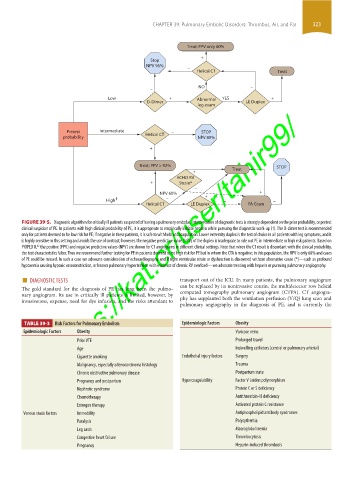
                    FIGURE 39-5.  Diagnostic algorithm for critically ill patients suspected of having a pulmonary embolus. Interpretation of diagnostic tests is strongly dependent on the prior probability, or pretest
                    clinical suspicion of PE. In patients with high clinical probability of PE, it is appropriate to empirically initiate heparin while pursuing the diagnostic work-up (†). The D-dimer test is recommended
                    only for patients deemed to be low risk for PE; if negative in these patients, it is safe to withhold anticoagulation. Lower extremity duplex is the test of choice in all patients with leg symptoms, and it
                    is highly sensitive in this setting and avoids the use of contrast; however, the negative predictive value (NPV) of the duplex is inadequate to rule out PE in intermediate or high risk patients. Based on
                         42
                    PIOPED II,  the positive (PPV) and negative predictive values (NPV) are shown for CT angiograms in different clinical settings. Note that when the CT result is discordant with the clinical probability,
                    the test characteristics falter. Thus we recommend further testing for PE in patients deemed to be high risk for PE but in whom the CTA is negative; in this population, the NPV is only 60% and cases
                    of PE could be missed. In such a case we advocate consideration of echocardiography and if right ventricular strain or dysfunction is discovered without alternative cause (*)—such as profound
                    hypoxemia causing hypoxic vasoconstriction, or known pulmonary hypertension with evidence of chronic RV overload—we advocate treating with heparin or pursuing pulmonary angiography.
                        ■  DIAGNOSTIC TESTS                               transport out of the ICU. In many patients, the pulmonary angiogram

                    The gold standard for the diagnosis of PE has long been the pulmo-  can be replaced by its noninvasive cousin, the multidetector row helical
                    nary angiogram. Its use in critically ill patients is limited, however, by   computed tomography pulmonary angiogram (CTPA). CT angiogra-
                                                                          phy has supplanted both the ventilation perfusion (V/Q) lung scan and
                    invasiveness, expense, need for dye infusion, and the risks attendant to
                                                                          pulmonary angiography in the diagnosis of PE, and is currently the

                      TABLE 39-3    Risk Factors for Pulmonary Embolism   Epidemiologic Factors  Obesity
                    Epidemiologic Factors  Obesity                                           Varicose veins
                                       Prior VTE                                             Prolonged travel
                                       Age                                                   Indwelling catheters (central or pulmonary arterial)
                                       Cigarette smoking                  Endothelial injury factors  Surgery
                                       Malignancy, especially adenocarcinoma histology       Trauma
                                       Chronic obstructive pulmonary disease                 Postpartum state
                                       Pregnancy and postpartum           Hypercoagulability  Factor V Leiden polymorphism
                                       Nephrotic syndrome                                    Protein C or S deficiency
                                       Chemotherapy                                          Antithrombin-III deficiency
                                       Estrogen therapy                                      Activated protein C resistance
                    Venous stasis factors  Immobility                                        Antiphospholipid antibody syndromes
                                       Paralysis                                             Polycythemia
                                       Leg casts                                             Macroglobulinemia
                                       Congestive heart failure                              Thrombocytosis
                                       Pregnancy                                             Heparin-induced thrombosis


            section03.indd   323                                                                                       1/23/2015   2:07:34 PM

