


Page 470 - Hall et al (2015) Principles of Critical Care-McGraw-Hill
P. 470
340     PART 3: Cardiovascular Disorders


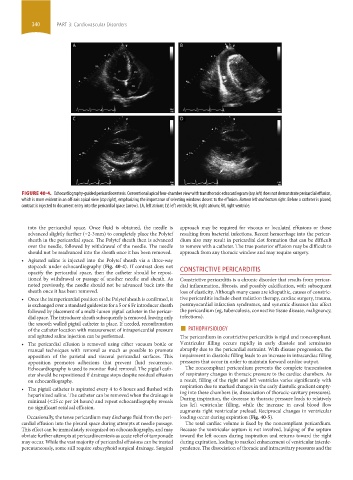
                 FIGURE 40-4.  Echocardiography-guided pericardiocentesis. Conventional apical four-chamber view with transthoracic echocardiogram (top left) does not demonstrate pericardial effusion,
                 which is more evident in an off-axis apical view (top right), emphasizing the importance of selecting windows closest to the effusion. Bottom left and bottom right. Before a catheter is placed,
                 contrast is injected to document entry into the pericardial space (arrow). LA, left atrium; LV, left ventricle; RA, right atrium; RV, right ventricle.


                   into  the  pericardial  space.  Once  fluid  is  obtained,  the  needle  is   approach may be required for viscous or loculated effusions or those
                   advanced slightly further (~2-3 mm) to completely place the Polytef   resulting from bacterial infections. Recent hemorrhage into the pericar-
                   sheath in the pericardial space. The Polytef sheath then is advanced   dium also may result in pericardial clot formation that can be difficult
                   over the needle, followed by withdrawal of the needle. The needle   to remove with a catheter. The true posterior effusion may be difficult to
                   should not be readvanced into the sheath once it has been removed.  approach from any thoracic window and may require surgery.
                    • Agitated  saline  is  injected  into  the  Polytef  sheath  via  a  three-way
                   stopcock under echocardiography (Fig. 40-4). If contrast does not
                   opacify the pericardial space, then the catheter should be reposi-  CONSTRICTIVE PERICARDITIS
                   tioned by withdrawal or passage of another needle and sheath. As   Constrictive pericarditis is a chronic disorder that results from pericar-
                   noted previously, the needle should not be advanced back into the   dial inflammation, fibrosis, and possibly calcification, with subsequent
                   sheath once it has been removed.                    loss of elasticity. Although many cases are idiopathic, causes of constric-
                    • Once the intrapericardial position of the Polytef sheath is confirmed, it   tive pericarditis include chest radiation therapy, cardiac surgery, trauma,
                   is exchanged over a standard guidewire for a 5 or 6 Fr introducer sheath     postmyocardial infarction syndromes, and systemic diseases that affect
                   followed by placement of a multi-lumen pigtail catheter in the pericar-  the pericardium (eg, tuberculosis, connective tissue disease, malignancy,
                   dial space. The introducer sheath subsequently is removed, leaving only   infections).
                   of the catheter location with measurement of intrapericardial pressure   ■  PATHOPHYSIOLOGY
                   the smooth walled pigtail catheter in place. If needed, reconfirmation
                   and agitated saline injection can be performed.     The pericardium in constrictive pericarditis is rigid and  noncompliant.
                    • The pericardial effusion is removed using either vacuum bottle or   Ventricular filling occurs rapidly in early diastole and terminates
                   manual techniques with removal as much as possible to   promote     abruptly due to the pericardial restraint. With disease progression, the
                   apposition of the parietal and visceral pericardial surfaces. This   impairment in diastolic filling leads to an increase in intracardiac filling
                   apposition promotes adhesions that prevent fluid recurrence.   pressures that occur in order to maintain forward cardiac output.
                   Echocardiography is used to monitor fluid removal. The pigtail cath-  The noncompliant pericardium prevents the complete transmission
                   eter should be repositioned if drainage stops despite residual effusion   of respiratory changes in thoracic pressure to the cardiac chambers. As
                   on echocardiography.                                a result, filling of the right and left ventricles varies significantly with
                    • The pigtail catheter is aspirated every 4 to 6 hours and flushed with   respiration due to marked changes in the early diastolic gradient empty-
                   heparinized saline. The catheter can be removed when the drainage is   ing into these chambers (ie, dissociation of thoracic-cavitary pressures).
                   minimal (<25 cc per 24 hours) and repeat echocardiography reveals   During inspiration, the decrease in thoracic pressure leads to relatively
                   no significant residual effusion.                   less  left  ventricular  filling,  while  the  increase in  caval  blood  flow
                                                                         augments right ventricular preload. Reciprocal changes in ventricular
                   Occasionally, the tense pericardium may discharge fluid from the peri-  loading occur during expiration (Fig. 40-5).
                 cardial effusion into the pleural space during attempts at needle passage.   The total cardiac volume is fixed by the noncompliant pericardium.
                 This effect can be immediately recognized on echocardiography, and may   Because the ventricular septum is not involved, bulging of the septum
                 obviate further attempts at pericardiocentesis as acute relief of tamponade   toward the left occurs during inspiration and returns toward the right
                 may occur. While the vast majority of pericardial effusions can be treated   during expiration, leading to marked enhancement of ventricular interde-
                 percutaneously, some still require subxyphoid surgical drainage. Surgical   pendence. The dissociation of thoracic and intracavitary pressures and the


            section03.indd   340                                                                                       1/23/2015   2:07:43 PM

