


Page 476 - Hall et al (2015) Principles of Critical Care-McGraw-Hill
P. 476
346     PART 3: Cardiovascular Disorders


                 of left ventricular dysfunction (EF <50%), and need for bypass or tho-
                 racic aortic surgery are the class I indications for aortic valve replace-  A    B
                 ment.
                   Patients with critical noncardiac disease and severe AS pose a signifi-  Pre deployment
                 cant challenge in management. Due to fixed obstruction, the increased
                 cardiac output required for tissue perfusion in sepsis or profound   Pacing
                 anemia may not be adequate. The need for urgent noncardiac surgery   catheter   Deployed valve
                 in patients with severe AS puts a patient at a very high risk for cardiac                     TEE
                 complications, including myocardial infarction, congestive heart failure,                     probe
                 and death. 15
                   Treatment of critically ill patients with decompensated severe AS is
                 complex, and consists of stabilizing measures (typically undertaken in    C       D
                 the intensive care settings) followed when possible by mechanical
                 interventions on the stenotic valve. Medical measures aim at maintain-  LV pressure
                 ing cardiac output and coronary perfusion pressure. All medications   100           100
                 have the potential for acute decompensation, and close monitoring is   Aortic
                 required. Diuretics are frequently used, but dosing should be cautious.   pressure     Aortic
                                                                                                        pressure
                 We favor an initial small intravenous bolus followed by continuous
                 furosemide infusion, as it allows rapid achievement of a steady state,
                 and leads to less hemodynamic instability caused by the vasodilating                0     LV pressure
                 effect of intermittent dosing. The intensity of diuretic regimen can be   0
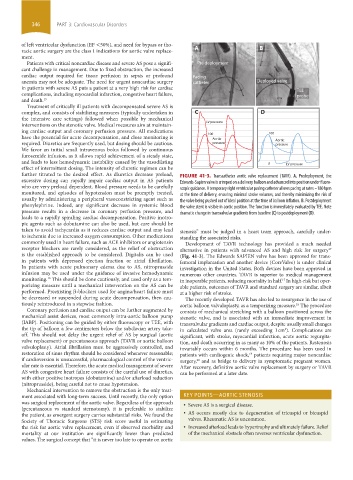
                 further  titrated to the  desired effect.  As  diuretics decrease  preload,   FIGURE 41-3.  Transcatheter aortic valve replacement (TAVR).  A. Predeployment, the
                 excessive  dosing  can rapidly  impair cardiac  output  in AS patients   Edwards-Sapien valve is crimped on a delivery balloon and advanced into position under fluoro-
                 who are very preload dependent. Blood pressure needs to be carefully   scopic guidance. A temporary right ventricular pacing catheter allows pacing at rates ~180 bpm
                 monitored, and   episodes of hypotension must be promptly treated,   at the time of delivery, ensuring minimal stroke volumes, and thereby minimizing the risk of
                 usually by administering a peripheral vasoconstricting agent such as   the valve being pushed out of ideal position at the time of balloon inflation. B. Postdeployment
                 phenylephrine.  Indeed,  any  significant  decrease  in  systemic  blood   the valve stent is visible in aortic position. The function is immediately evaluated by TEE. Note
                 pressure results in a decrease in coronary perfusion pressure, and   dramatic change in transvalvular gradients from baseline (C) to postdeployment (D).
                 leads to a rapidly spiraling cardiac decompensation. Positive inotro-
                 pic agents such as dobutamine can also be used, but care should be
                 taken to avoid tachycardia as it reduces cardiac output and may lead     stenosis” must be judged in a heart team approach, carefully under-
                 to ischemia due to increased oxygen consumption. Other medications   standing the associated risks.
                 commonly used in heart failure, such as ACE inhibitors or angiotensin   Development of TAVR technology has provided a much needed
                 receptor blockers are rarely considered, as the relief of obstruction   alternative in patients with advanced AS and high risk for surgery
                                                                                                                          17
                 is the established approach to be considered. Digitalis can be used   (Fig. 41-3). The Edwards SAPIEN valve has been approved for trans-
                 in patients with depressed ejection fraction or atrial fibrillation.   femoral implantation and another device (CoreValve) is under clinical
                 In patients with acute pulmonary edema due to AS, nitroprusside   investigation in the United States. Both devices have been approved in
                 infusion may be used under the guidance of invasive hemodynamic   numerous other countries. TAVR is superior to medical management
                 monitoring.  This should be done cautiously, and used only as a tem-  in inoperable patients, reducing mortality in half.  In high-risk but oper-
                          16
                                                                                                          17
                 porizing measure until a mechanical intervention on the AS can be   able patients, outcomes of TAVR and standard surgery are similar, albeit
                 performed. Preexisting β-blockers used for angina/heart failure must   at a higher risk of stroke.
                 be decreased or suspended during acute decompensation, then cau-  The recently developed TAVR has also led to resurgence in the use of
                 tiously reintroduced in a stepwise fashion.           aortic balloon valvuloplasty, as a temporizing measure.  The procedure
                                                                                                               18
                   Coronary perfusion and cardiac output can be further augmented by   consists of mechanical stretching with a balloon positioned across the
                 mechanical assist devices, most commonly intra-aortic balloon pump   stenotic valve, and is associated with an immediate improvement in
                 (IABP). Positioning can be guided by either fluoroscopy or TEE, with   transvalvular gradients and cardiac output, despite usually small changes
                 the tip of balloon a few centimeters below the subclavian artery take-  in calculated valve area (rarely exceeding 1 cm ). Complications are
                                                                                                           2
                 off. This should not delay the urgent relief of AS by surgical (aortic   significant, with stroke, myocardial infarction, acute aortic regurgita-
                 valve replacement) or percutaneous approach (TAVR or aortic balloon   tion, and death occurring in as many as 10% of the patients. Restenosis
                 valvuloplasty).  Atrial  fibrillation  must  be  aggressively  controlled,  and   invariably occurs within 6 months. The procedure has been used in
                   restoration of sinus rhythm should be considered whenever reasonable;   patients with cardiogenic shock,  patients requiring major noncardiac
                                                                                               19
                 if cardioversion is unsuccessful, pharmacological control of the ventric-  surgery,  and as bridge to delivery in symptomatic pregnant women.
                                                                             20
                 ular rate is essential. Therefore, the acute medical management of severe   After recovery, definitive aortic valve replacement by surgery or TAVR
                 AS with congestive heart failure consists of the careful use of diuretics,   can be performed at a later date.
                 with either positive inotropes (dobutamine) and/or afterload reduction
                 (nitroprusside), being careful not to cause hypotension.
                   Mechanical intervention to remove the obstruction is the only treat-
                 ment associated with long-term success. Until recently, the only option   KEY POINTS—AORTIC STENOSIS
                 was surgical replacement of the aortic valve. Regardless of the approach     • Severe AS is a surgical disease.
                 (percutaneous vs standard sternotomy), it is preferable to stabilize
                 the patient, as emergent surgery carries substantial risks. We found the      • AS occurs mostly due to degeneration of tricuspid or bicuspid
                 Society of Thoracic Surgeons (STS) risk score useful in estimating    valves. Rheumatic AS is uncommon.
                 the risk for aortic valve replacement, even if observed morbidity and     • Increased afterload leads to hypertrophy and ultimately failure. Relief
                 mortality at our institution are significantly lower than predicted     of the mechanical obstacle often reverses ventricular dysfunction.
                 values. The surgical concept that “it is never too late to operate on aortic


            section03.indd   346                                                                                       1/23/2015   2:07:49 PM

