


Page 471 - Hall et al (2015) Principles of Critical Care-McGraw-Hill
P. 471
CHAPTER 40: Pericardial Disease  341


                                                             PV                                 PV
                                             HV                               D  HV
                                        S  D                   MV          S                       MV


                                            TV                                  TV

                                                Inspiration   Expiration           Inspiration   Expiration
                                      PCW                                 PCW
                                      LVDP                               LVDP


                                     120

                                          LV                               Inspiration     Expiration
                                     80
                                                                         LV

                                     40

                                           PCWP                            RV


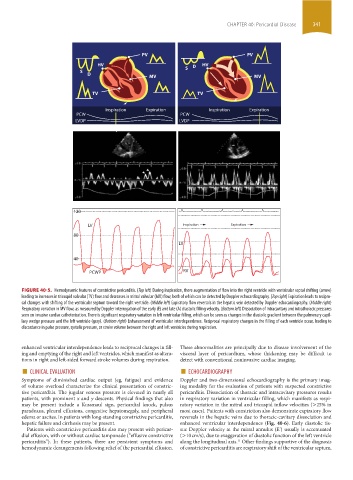
                    FIGURE 40-5.  Hemodynamic features of constrictive pericarditis. (Top left) During inspiration, there augmentation of flow into the right ventricle with ventricular septal shifting (arrow)
                    leading to increases in tricuspid valvular (TV) flow and decreases in mitral valvular (MV) flow, both of which can be detected by Doppler echocardiography. (Top right) Expiration leads to recipro-
                    cal changes with shifting of the ventricular septum toward the right ventricle. (Middle left) Expiratory flow reversals in the hepatic vein detected by Doppler echocardiography. (Middle right)
                    Respiratory variation in MV flow, as measured by Doppler interrogation of the early (E) and late (A) diastolic filling velocity. (Bottom left) Dissociation of intracavitary and intrathoracic pressures
                    seen on invasive cardiac catheterization. There is significant respiratory variation in left ventricular filling, which can be seen as changes in the diastolic gradient between the pulmonary capil-
                    lary wedge pressure and the left ventricle (gray). (Bottom right) Enhancement of ventricular interdependence. Reciprocal respiratory changes in the filling of each ventricle occur, leading to
                    discordance in pulse pressure, systolic pressure, or stroke volume between the right and left ventricles during respiration.


                    enhanced ventricular interdependence leads to reciprocal changes in fill-  These abnormalities are principally due to disease involvement of the
                    ing and emptying of the right and left ventricles, which manifest as altera-  visceral layer of pericardium, whose thickening may be difficult to
                    tions in right and left-sided forward stroke volumes during respiration.  detect with conventional noninvasive cardiac imaging.
                        ■  CLINICAL EVALUATION                                ■  ECHOCARDIOGRAPHY


                    Symptoms of diminished cardiac output (eg, fatigue) and evidence   Doppler and two-dimensional echocardiography is the primary imag-
                    of volume overload characterize the clinical presentation of constric-  ing modality for the evaluation of patients with suspected constrictive
                    tive pericarditis. The jugular venous pressure is elevated in nearly all   pericarditis. Dissociation of thoracic and intracavitary pressures results
                    patients, with prominent x and y descents. Physical findings that also   in respiratory variation in ventricular filling, which manifests as respi-
                    may be present include a Kussmaul sign, pericardial knock, pulsus   ratory variation in the mitral and tricuspid inflow velocities (>25% in
                    paradoxus, pleural effusions, congestive hepatomegaly, and peripheral   most cases). Patients with constriction also demonstrate expiratory flow
                    edema or ascites. In patients with long-standing constrictive pericarditis,   reversals in the hepatic veins due to thoracic-cavitary dissociation and
                    hepatic failure and cirrhosis may be present.         enhanced  ventricular  interdependence  (Fig. 40-6).  Early  diastolic  tis-
                     Patients with constrictive pericarditis also may present with pericar-  sue Doppler velocity at the mitral annulus (E’) usually is accentuated
                    dial effusion, with or without cardiac tamponade (“effusive constrictive   (>10 cm/s), due to exaggeration of diastolic function of the left ventricle
                    pericarditis”).  In  these  patients,  there  are  persistent  symptoms  and   along the longitudinal axis.  Other findings supportive of the diagnosis
                                                                                             11
                    hemodynamic derangements following relief of the pericardial effusion.    of constrictive pericarditis are respiratory shift of the ventricular  septum,


            section03.indd   341                                                                                       1/23/2015   2:07:44 PM

