


Page 472 - Hall et al (2015) Principles of Critical Care-McGraw-Hill
P. 472
342     PART 3: Cardiovascular Disorders


                                 80                                     80
                                  FA
                                                                        LV
                                              *


                                 40                                     40


                                                                          a   v
                                  RA        a     v                        x
                                              x
                                                                        RA     y

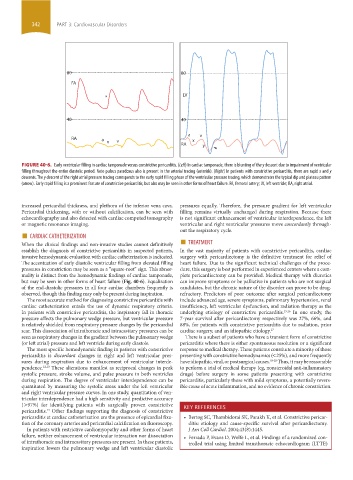
                 FIGURE 40-6.  Early ventricular filling in cardiac tamponade versus constrictive pericarditis. (Left) In cardiac tamponade, there is blunting of the y descent due to impairment of ventricular
                 filling throughout the entire diastolic period. Note pulsus paradoxus also is present in the arterial tracing (asterisk). (Right) In patients with constrictive pericarditis, there are rapid x and y
                 descents. The y descent of the right atrial pressure tracing corresponds to the early rapid filling phase of the ventricular pressure tracing, which demonstrates the typical dip and plateau pattern
                 (arrow). Early rapid filling is a prominent feature of constrictive pericarditis, but also may be seen in other forms of heart failure. FA, femoral artery; LV, left ventricle; RA, right atrial.


                 increased pericardial thickness, and plethora of the inferior vena cava.   pressures equally. Therefore, the pressure gradient for left ventricular
                 Pericardial thickening, with or without calcification, can be seen with   filling remains virtually unchanged during respiration. Because there
                 echocardiography and also detected with cardiac computed tomography   is not significant enhancement of ventricular interdependence, the left
                 or magnetic resonance imaging.                        ventricular and right ventricular pressures move concordantly through-
                     ■
                                                                       out the respiratory cycle.
                                                                       ■
                 When the clinical findings and non-invasive studies cannot definitively    TREATMENT
                    CARDIAC CATHETERIZATION
                 establish the diagnosis of constrictive pericarditis in suspected patients,   In the vast majority of patients with constrictive pericarditis, cardiac
                 invasive hemodynamic evaluation with cardiac catheterization is indicated.   surgery with pericardiectomy is the definitive treatment for relief of
                 The accentuation of early diastolic ventricular filling from elevated filling   heart failure. Due to the significant technical challenges of the proce-
                 pressures in constriction may be seen as a “square-root” sign. This abnor-  dure, this surgery is best performed in experienced centers where a com-
                 mality is distinct from the hemodynamic findings of cardiac tamponade,   plete pericardiectomy can be provided. Medical therapy with diuretics
                 but may be seen in other forms of heart failure (Fig. 40-6). Equalization   can improve symptoms or be palliative in patients who are not surgical
                 of the end-diastolic pressures in all four cardiac chambers frequently is   candidates, but the chronic nature of the disorder can prove to be drug-
                 observed, though this finding may only be  present during inspiration.  refractory. Predictors of poor outcome after surgical pericardiectomy
                   The most accurate method for diagnosing constrictive pericarditis with   include advanced age, severe symptoms, pulmonary hypertension, renal
                 cardiac catheterization entails the use of dynamic respiratory criteria.   insufficiency, left ventricular dysfunction, and radiation therapy as the
                 In patients with constrictive pericarditis, the inspiratory fall in thoracic   underlying  etiology  of  constrictive  pericarditis. 15,16   In  one  study,  the
                 pressure affects the pulmonary wedge pressure, but ventricular pressure   7-year survival after pericardiectomy respectively was 27%, 66%, and
                 is relatively shielded from respiratory pressure changes by the pericardial   88%, for patients with constrictive pericarditis due to radiation, prior
                 scar. This dissociation of intrathoracic and intracavitary pressures can be   cardiac surgery, and an idiopathic etiology. 17
                 seen as respiratory changes in the gradient between the pulmonary wedge   There is a subset of patients who have a transient form of constrictive
                 (or left atrial) pressure and left ventricle during early diastole.  pericarditis where there is either spontaneous resolution or a significant
                   The most specific hemodynamic finding in patients with constrictive   response to medical therapy. These patients constitute a minority of those
                 pericarditis is  discordant changes  in right and  left ventricular  pres-  presenting with constrictive hemodynamics (<25%), and more frequently
                 sures during respiration due to enhancement of ventricular interde-  have idiopathic, viral, or postsurgical causes. 18-20  Thus, it may be reasonable
                 pendence. 12,13  These alterations manifest as reciprocal changes in peak   to perform a trial of medical therapy (eg, nonsteroidal anti-inflammatory
                 systolic pressure, stroke volume, and pulse pressure in both ventricles   drugs) before surgery in some patients presenting with constrictive
                 during respiration. The degree of ventricular interdependence can be   pericarditis, particularly those with mild symptoms, a potentially revers-
                 quantitated by measuring the systolic areas under the left ventricular   ible cause of acute inflammation, and no evidence of chronic constriction.
                 and right ventricular pressure curves. In one study, quantitation of ven-
                 tricular interdependence had a high sensitivity and predictive accuracy
                 (>97%)  for  identifying  patients  with  surgically  proven  constrictive   KEY REFERENCES
                 pericarditis.  Other findings supporting the diagnosis of constrictive
                          14
                 pericarditis at cardiac catheterization are the presence of epicardial fixa-    • Bertog SC, Thambidorai SK, Parakh K, et al. Constrictive pericar-
                 tion of the coronary arteries and pericardial calcification on fluoroscopy.  ditis: etiology and cause-specific survival after pericardiectomy.
                   In patients with restrictive cardiomyopathy and other forms of heart   J Am Coll Cardiol. 2004;43(8):1445.
                 failure, neither enhancement of ventricular interaction nor dissociation     • Ferrada P, Evans D, Wolfe L, et al. Findings of a randomized con-
                 of intrathoracic and intracavitary pressures are present. In these patients,   trolled trial using limited transthoracic echocardiogram (LTTE)
                 inspiration lowers the pulmonary wedge and left ventricular diastolic


            section03.indd   342                                                                                       1/23/2015   2:07:45 PM

