


Page 598 - Hall et al (2015) Principles of Critical Care-McGraw-Hill
P. 598
418     PART 4: Pulmonary Disorders


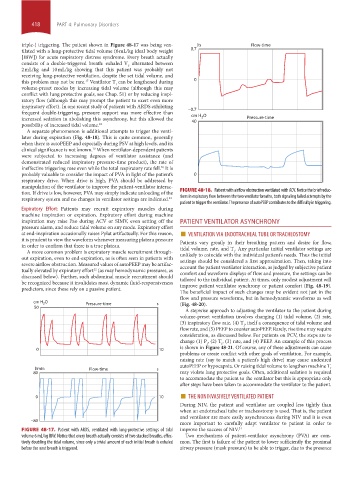
                 triple-) triggering. The patient shown in Figure 48-17 was being ven-  l/s    Flow-time
                 tilated with a lung-protective tidal volume (6 mL/kg ideal body weight   0.7
                 [IBW]) for acute respiratory distress syndrome. Every breath actually
                 consists of a double-triggered breath: exhaled V  alternated between
                                                     T
                 2 mL/kg and 10 mL/kg showing that this patient was probably not
                 receiving lung-protective ventilation, despite the set tidal volume, and
                                       17
                 this problem may not be rare.  Ventilator T  can be lengthened during   0
                                                 I
                 volume-preset modes by increasing tidal volume (although this may
                 conflict with lung protective goals, see Chap. 51) or by reducing inspi-
                 ratory flow (although this may prompt the patient to exert even more
                 inspiratory effort). In one recent study of patients with ARDS exhibiting
                 frequent double-triggering, pressure support was more effective than   −0.7
                                                                              2
                 increased sedation in abolishing this asynchrony, but this allowed the   cm H O  Pressure-time
                                                                           40
                 possibility of increased tidal volume. 18
                   A separate phenomenon is additional attempts to trigger the venti-
                 lator during expiration (Fig. 48-18). This is quite common, generally
                 when there is autoPEEP and especially during PSV at high levels, and its
                 clinical significance is not known.  When ventilator-dependent patients
                                         19
                 were subjected to increasing degrees of ventilator assistance (and
                 demonstrated reduced inspiratory pressure-time product), the rate of
                   ineffective triggering rose even while the total respiratory rate fell.  It is
                                                                 20
                 probably valuable to consider the impact of PVA in light of the patient’s   0
                 respiratory drive. When drive is high, PVA should be addressed by
                 manipulation of the ventilator to improve the patient-ventilator interac-
                 tion. If drive is low, however, PVA may simply indicate unloading of the   FIGURE 48-18.  Patient with airflow obstruction ventilated with ACV. Notice the brief reduc-
                 respiratory system and no changes in ventilator settings are indicated. 21  tions in expiratory flow between the two ventilator breaths, both signaling failed attempts by the
                                                                       patient to trigger the ventilator. The presence of autoPEEP contributes to the difficulty in triggering.
                 Expiratory Effort:  Patients may recruit expiratory muscles during
                 machine inspiration or expiration. Expiratory effort during machine
                 inspiration may raise Pao during ACV or SIMV, even setting off the  PATIENT VENTILATOR ASYNCHRONY
                 pressure alarm, and reduce tidal volume on any mode. Expiratory effort
                 at end-inspiration occasionally raises Pplat artifactually. For this reason,     ■  VENTILATION VIA ENDOTRACHEAL TUBE OR TRACHEOSTOMY
                 it is prudent to view the waveform whenever measuring plateau pressure   Patients vary greatly in their breathing pattern and desire for flow,
                 in order to confirm that there is a true plateau.     tidal volume, rate, and T . Any particular initial ventilator settings are
                   A more common problem is expiratory muscle recruitment through-  unlikely to coincide with the individual patient’s needs. Thus the initial
                                                                                          I
                 out expiration, even to end-expiration, as is often seen in patients with   settings should be considered a first approximation. Then, taking into
                 severe airflow obstruction. Measured values of autoPEEP may be artifac-  account the patient ventilator interaction, as judged by subjective patient
                                          22
                 tually elevated by expiratory effort  (as may hemodynamic pressures, as   comfort and waveform displays of flow and pressure, the settings can be
                 discussed below). Further, such abdominal muscle recruitment should   tailored to the individual patient. At times, only modest adjustment will
                 be recognized because it invalidates most dynamic fluid-responsiveness   improve patient ventilator synchrony or patient comfort (Fig. 48-19).
                 predictors, since these rely on a passive patient.
                                                                       The beneficial impact of such changes may be evident not just in the
                                                                       flow and pressure waveforms, but in hemodynamic waveforms as well
                     cm H 2 O          Pressure-time           s       (Fig. 48-20).
                     50
                                                                         A stepwise approach to adjusting the ventilator to the patient during
                                                                       volume-preset ventilation involves changing (1) tidal volume, (2) rate,
                                                                       (3) inspiratory flow rate, (4) T , itself a consequence of tidal volume and
                                                                                             I
                                                                       flow rate, and (5) PEEP to counter autoPEEP. Rarely, rise time may require
                                                                       consideration, as discussed below. For patients on PCV, the steps are to
                                                                       change (1) P , (2) T , (3) rate, and (4) PEEP. An example of this process
                                                                                I
                                                                                     I
                      0                                         10     is shown in Figure 48-21. Of course, any of these adjustments can cause
                                                                       problems or create conflict with other goals of ventilation. For example,
                                                                       raising rate (say to match a patient’s high drive) may cause undesired
                                                                       autoPEEP or hypocapnia. Or raising tidal volume to lengthen machine T
                      l/min             Flow-time              s                                                          I
                     80                                                may violate lung protective goals. Often, additional sedation is required
                                                                       to accommodate the patient to the ventilator but this is appropriate only
                                                                       after steps have been taken to accommodate the ventilator to the patient.
                                                                           ■
                      0                                         10        THE NONINVASIVELY VENTILATED PATIENT
                                                                       During NIV, the patient and ventilator are coupled less tightly than
                                                                       when an endotracheal tube or tracheostomy is used. That is, the patient
                                                                       and ventilator are more easily asynchronous during NIV and it is even
                    −80
                                                                       more important to carefully adapt ventilator to patient in order to
                 FIGURE 48-17.  Patient with ARDS, ventilated with lung-protective settings of tidal   improve the success of NIV. 21
                   volume 6 mL/kg IBW. Notice that every breath actually consists of two stacked breaths, effec-  Two mechanisms of patient-ventilator asynchrony (PVA) are com-
                 tively doubling the tidal volume, since only a trivial amount of each initial breath is exhaled   mon. The first is failure of the patient to lower sufficiently the proximal
                 before the next breath is triggered.                  airway pressure (mask pressure) to be able to trigger, due to the presence


            section04.indd   418                                                                                       1/23/2015   2:19:11 PM

