


Page 599 - Hall et al (2015) Principles of Critical Care-McGraw-Hill
P. 599
CHAPTER 48: Ventilator Waveforms: Clinical Interpretation  419


                                 DEC 14 2000            Waveform monitoring     Patient id 0000000000000
                                   60


                                P aw
                               cm H 2 O
                                                 2            4            6            8           10
                                  −20
                                   60
                                 .
                                 V
                                LPM              2            4            6            8           10
                                                                                                   HPL   LETV  02
                                   60                                                               LIP  FMV   AIR

                                 DEC 14 2000            Waveform monitoring     Patient id 0000000000000
                                   60


                                P aw
                               cm H 2 O

                                                 2            4            6            8           10
                                  −20
                                   60

                                 .
                                 V
                                LPM              2            4            6            8           10


                                   60
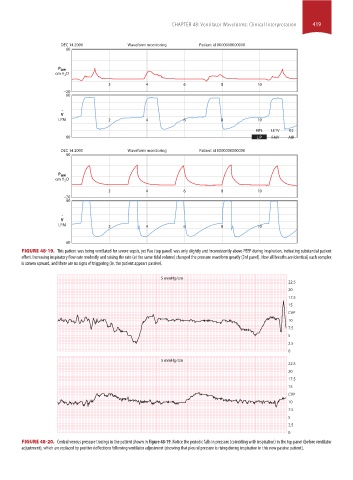
                    FIGURE 48-19.  This patient was being ventilated for severe sepsis, yet Pao (top panel) was only slightly and inconsistently above PEEP during inspiration, indicating substantial patient
                    effort. Increasing inspiratory flow rate modestly and raising the rate (at the same tidal volume) changed the pressure waveform greatly (3rd panel). Now all breaths are identical, each complex
                    is convex upward, and there are no signs of triggering (ie, the patient appears passive).

                                                                   5 mmHg/cm
                                                                                                              22.5
                                                                                                              20
                                                                                                              17.5
                                                                                                              15
                                                                                                              CVP
                                                                                                              10
                                                                                                              7.5
                                                                                                              5
                                                                                                              2.5
                                                                                                              0
                                                                   5 mmHg/cm
                                                                                                              22.5
                                                                                                              20
                                                                                                              17.5
                                                                                                              15
                                                                                                              CVP
                                                                                                              10
                                                                                                              7.5
                                                                                                              5
                                                                                                              2.5
                                                                                                              0
                    FIGURE 48-20.  Central venous pressure tracings in the patient shown in Figure 48-19. Notice the periodic falls in pressure (coinciding with inspiration) in the top panel (before ventilator
                    adjustment), which are replaced by positive deflections following ventilator adjustment (showing that pleural pressure is rising during inspiration in this now passive patient).


            section04.indd   419                                                                                       1/23/2015   2:19:12 PM

