


Page 601 - Hall et al (2015) Principles of Critical Care-McGraw-Hill
P. 601
CHAPTER 48: Ventilator Waveforms: Clinical Interpretation  421


                        ml              Volume-pressure         cm H O    smaller tidal volume or less PEEP. In a small patient study, adjusting
                                                                   2
                     500                                                  the ventilator according to the stress index reduced overdistention and
                                                                          measures of lung inflammation when compared with ARDSnet strategy-
                                                                          guided ventilation. 25
                                                                           There are problems with using VP curves or the stress index to guide
                                                                          ventilator management in patients with ALI and ARDS. First, these
                                                                          methods depend on a passive patient. Second, the presence of an LIP
                                                                          (or stress index <1) may not correlate with recruitment and derecruit-
                                                                          ment.  Most importantly, these approaches have not been shown to
                                                                              26
                                                                          improve meaningful outcomes, despite the theoretical elegance.
                                                                          VENTILATOR WAVEFORMS
                                                                          AND HEMODYNAMIC INTERPRETATION

                                                                          Respiratory muscle activity greatly affects intrathoracic pressure, which
                                                                    40    alters measured hemodynamic values. By convention, hemodynamic
                                                                          values such as Pra and Ppw are measured at end-expiration since the
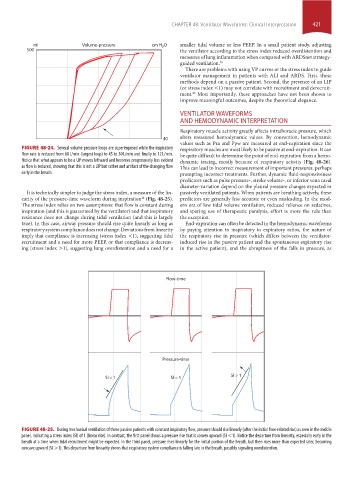
                    FIGURE 48-24.  Several volume pressure loops are superimposed while the inspiratory   respiratory muscles are most likely to be passive at end-expiration. It can
                    flow rate is reduced from 60 L/min (largest loop) to 45 to 30 L/min and finally to 12 L/min.   be quite difficult to determine the point of end-expiration from a hemo-
                    Notice that what appears to be a LIP moves leftward and becomes progressively less evident   dynamic tracing, mostly because of respiratory activity (Fig.  48-26).
                    as flow is reduced, showing that this is not a LIP but rather and artifact of the changing flow   This can lead to incorrect measurement of important pressures, perhaps
                    early in the breath.                                  prompting incorrect treatments. Further, dynamic fluid-responsiveness
                                                                          predictors such as pulse pressure-, stroke volume-, or inferior vena caval
                                                                          diameter-variation depend on the pleural pressure changes expected in
                     It is technically simpler to judge the stress index, a measure of the lin-  passively ventilated patients. When patients are breathing actively, these
                    earity of the pressure-time waveform during inspiration  (Fig. 48-25).   predictors are generally less accurate or even misleading. In the mod-
                                                            24
                    The stress index relies on two assumptions: that flow is constant during   ern era of low tidal volume ventilation, reduced reliance on sedatives,
                    inspiration (and this is guaranteed by the ventilator) and that inspiratory   and sparing use of therapeutic paralysis, effort is more the rule than
                    resistance does not change during tidal ventilation (and this is largely   the exception.
                    true). In this case, airway pressure should rise quite linearly as long as   End-expiration can often be detected in the hemodynamic waveforms
                    respiratory system compliance does not change. Deviations from linearity    by paying attention to inspiratory to expiratory ratios, the nature of
                    imply that compliance is increasing (stress index <1), suggesting tidal   the respiratory rise in pressure (which differs between the ventilator-
                    recruitment and a need for more PEEP, or that compliance is decreas-  induced rise in the passive patient and the spontaneous expiratory rise
                    ing (stress index >1), suggesting lung overdistention and a need for a   in the active patient), and the abruptness of the falls in pressure, as


                                                                     Flow-time


                                                                    Pressure-time


                                                SI < 1                SI = 1               SI > 1


                    FIGURE 48-25.  During mechanical ventilation of these passive patients with constant inspiratory flow, pressure should rise linearly (after the initial flow-related rise) as seen in the middle
                    panel, indicating a stress index (SI) of 1 (linear rise). In contrast, the first panel shows a pressure rise that is convex upward (SI <1). Notice the departure from linearity, especially early in the
                    breath at a time when tidal recruitment might be expected. In the third panel, pressure rises linearly for the initial portion of the breath, but then rises more than expected later, becoming
                    concave upward (SI >1). This departure from linearity shows that respiratory system compliance is falling late in the breath, possibly signaling overdistention.


            section04.indd   421                                                                                       1/23/2015   2:19:14 PM

