


Page 615 - Hall et al (2015) Principles of Critical Care-McGraw-Hill
P. 615
CHAPTER 50: Novel Modes of Mechanical Ventilation  435


                    risk for VILI increases as end inspiratory transpulmonary pressures        .                         .
                    exceed 30 to 35 cm H O, as tidal volumes exceed 8 to 10 mL/kg (ideal       V                         V
                                    2
                    body  weight),  and as  regions  of  repetitive  alveolar  opening-closing
                    develop. 2-12  Other ventilatory  pattern  factors  may also  be  involved in
                    the development of VILI. These include frequency of stretch  and the   Flow
                                                                13
                    acceleration/velocity of stretch. 14
                     Importantly, VILI is associated with cytokine release  and bacterial      V                         V
                                                            4-6
                    translocation.  These are often implicated as important contributors        T                         T
                              15
                    to the systemic inflammatory response with multiorgan dysfunction
                    that results in VILI associated mortality. The incidence of VILI has   Volume
                    been reported to be as high as 24% of patients who are receiving
                    mechanical ventilation for reasons other than ALI/ARDS although
                    estimates widely vary. 5,7,16                                             P AW                       P AW
                     Another conceptual source of injury during mechanical ventilatory
                    support is oxygen toxicity. Oxygen concentrations approaching 100%
                    are known to cause oxidant injuries in airways and lung  parenchyma.    Pressure
                                                                      17
                    A “safe” oxygen concentration or duration of exposure is not clear in   2  4  6    2        4        6
                    sick humans, however, since most of the data supporting the concept
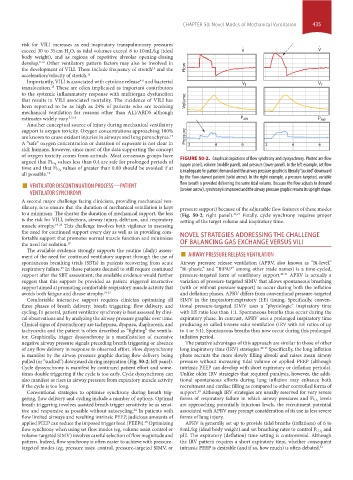
                    of oxygen toxicity comes from animals. Most consensus groups have
                                values less than 0.4 are safe for prolonged periods of   FIGURE 50-2.  Graphical depictions of flow synchrony and dyssynchrony. Plotted are flow
                    argued that Fi O 2                                    (upper panel), volume (middle panel), and pressure (lower panel). In the left example, set flow
                                  values of greater than 0.80 should be avoided if at
                    time and that Fi O 2                                  is inadequate for patient demand and the airway pressure graphic is literally “sucked” downward
                    all possible. 18                                      by the flow-starved patient (solid arrow). In the right example, a pressure-targeted, variable
                        ■  VENTILATOR DISCONTINUATION PROCESS—PATIENT     flow breath is provided delivering the same tidal volume. Because the flow adjusts to demand
                      VENTILATOR SYNCHRONY                                (broken arrow), synchrony is improved and the airway pressure graphic retains its upright shape.
                    A second major challenge facing clinicians, providing mechanical ven-
                    tilatory, is to ensure that the duration of mechanical ventilation is kept   pressure support) because of the adjustable flow features of these modes
                    to a minimum. The shorter the duration of mechanical support, the less   (Fig. 50-2;  right  panel). 26,27  Finally, cycle synchrony  requires  proper
                    is the risk for VILI, infections, airway injury, delirium, and respiratory     setting of the target volume and inspiratory time.
                    muscle atrophy. 19-23  This challenge involves both vigilance in assessing
                    the need for continued support every day as well as in providing com-
                    fortable support that promotes normal muscle function and minimizes   NOVEL STRATEGIES ADDRESSING THE CHALLENGE
                    the need for sedation. 19                             OF BALANCING GAS EXCHANGE VERSUS VILI
                    ment of the need for continued ventilatory support through the use of   ■  AIRWAY PRESSURE RELEASE VENTILATION
                     The available evidence strongly supports the routine (daily) assess-
                    spontaneous breathing trials (SBTs) in patients recovering from acute   Airway pressure release ventilation (APRV, also known as “Bi-level,”
                    respiratory failure.  In those patients deemed to still require continued   “Bi-phasic,” and “BiPAP” among other trade names) is a time-cycled,
                                 19
                    support after the SBT assessment, the available evidence would further   pressure-targeted  form  of  ventilatory  support. 28-31   APRV  is  actually a
                    suggest that this support be provided as patient triggered interactive   variation of pressure-targeted SIMV that allows spontaneous breathing
                    support aimed at promoting comfortable respiratory muscle activity that   (with or without pressure support) to occur during both the inflation
                    avoids both fatigue and disuse atrophy. 19-23         and deflation phases. APRV differs from conventional pressure-targeted
                     Comfortable interactive support requires clinician optimizing all   SIMV in the inspiratory:expiratory (I:E) timing. Specifically, conven-
                    three phases of breath delivery: breath triggering, flow delivery, and   tional pressure-targeted SIMV uses a “physiologic” inspiratory time
                    cycling. In general, patient ventilator synchrony is best assessed by clini-  with I:E ratio less than 1:1. Spontaneous breaths thus occur during the
                    cal observations and by analyzing the airway pressure graphic over time.   expiratory phase. In contrast, APRV uses a prolonged inspiratory time
                    Clinical signs of dyssynchrony are tachypnea, dyspnea, diaphoresis, and   producing so called inverse ratio ventilation (IRV with I:E ratios of up
                    tachycardia and the patient is often described as “fighting” the ventila-  to 4 or 5:1). Spontaneous breaths thus now occur during this prolonged
                    tor. Graphically, trigger dyssynchrony is a manifestation of excessive   inflation period.
                    negative airway pressure signals preceding breath triggering or absence   The putative advantages of this approach are similar to those of other
                    of any flow delivery in response to observed effort. Flow dyssynchrony   long inspiratory time (IRV) strategies. 28-33  Specifically, the long inflation
                    is manifest by the airway pressure graphic during flow delivery being   phase recruits the more slowly filling alveoli and raises mean airway
                    pulled (or “sucked”) downward during inspiration (Fig. 50-2; left panel).   pressure without increasing tidal volume or applied PEEP (although
                    Cycle dyssynchrony is manifest by continued patient effort and some-  intrinsic PEEP can develop with short expiratory or deflation periods).
                    times double triggering if the cycle is too early. Cycle dyssynchrony can   Unlike older IRV strategies that required paralysis, however, the addi-
                    also manifest as rises in airway pressure from expiratory muscle activity   tional spontaneous efforts during lung inflation may enhance both
                    if the cycle is too long.                             recruitment and cardiac filling as compared to other controlled forms of
                     Conventional  strategies  to  optimize  synchrony  during  breath  trig-  support.  Although IRV strategies are usually reserved for very severe
                                                                                28
                    gering, flow delivery and cycling include a number of options. Optimal   forms of respiratory failure in which airway pressures and Fi O 2  levels
                    breath triggering involves assisted breath trigger sensitivity be as sensi-  are approaching potentially injurious levels, the recruitment potential
                    tive and responsive as possible without autocycling.  In patients with   associated with APRV may prompt consideration of its use in less severe
                                                          24
                    flow limited airways and resulting intrinsic PEEP, judicious amounts of   forms of lung injury.
                    applied PEEP can reduce the imposed trigger load (PEEPi).  Optimizing   APRV is generally set up to provide tidal breaths (inflations) of 6 to
                                                              25
                    flow synchrony when using set flow modes (eg, volume assist control or   8 mL/kg (ideal body weight) and set breathing rates to control P CO 2  and
                    volume-targeted SIMV) involves careful selection of flow magnitude and   pH. The expiratory (deflation) time setting is controversial. Although
                    pattern. Indeed, flow synchrony is often easier to achieve with pressure-  the IRV pattern requires a short expiratory time, whether consequent
                    targeted modes (eg, pressure assist control,  pressure-targeted SIMV, or   intrinsic PEEP is desirable (and if so, how much) is often debated. 31


            section04.indd   435                                                                                       1/23/2015   2:19:23 PM

