


Page 639 - Hall et al (2015) Principles of Critical Care-McGraw-Hill
P. 639
458     PART 4: Pulmonary Disorders


                 APPROACH TO TREATMENT OF PATIENTS                       TABLE 52-5     Treatable Precipitating Causes of Acute Lung Injury (ALI) and
                 WITH ALI AND ARDS                                                 Acute Respiratory Distress Syndrome (ARDS)
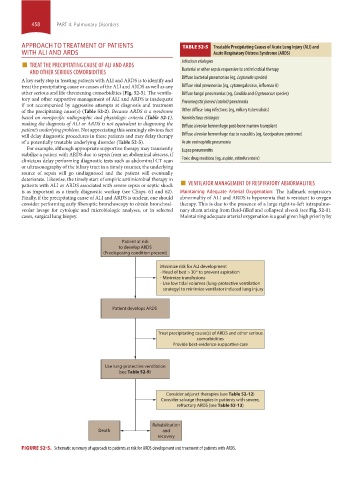
                     ■  TREAT THE PRECIPITATING CAUSE OF ALI AND ARDS    Infectious etiologies

                    AND OTHER SERIOUS COMORBIDITIES                     Bacterial or other sepsis responsive to antimicrobial therapy
                 A key early step in treating patients with ALI and ARDS is to identify and   Diffuse bacterial pneumonias (eg, Legionella species)
                 treat the precipitating cause or causes of the ALI and ARDS as well as any   Diffuse viral pneumonias (eg, cytomegalovirus, influenza A)
                 other serious and life-threatening comorbidities (Fig. 52-5). The ventila-  Diffuse fungal pneumonias (eg, Candida and Cryptococcus species)
                 tory and other supportive management of ALI and ARDS is inadequate   Pneumocystis jiroveci (carinii) pneumonia
                 if not accompanied by aggressive attempts at diagnosis and treatment
                 of the precipitating cause(s) (Table 52-2). Because ARDS is a syndrome     Other diffuse lung infections (eg, miliary tuberculosis)
                 based on nonspecific radiographic and physiologic criteria (Table 52-1),   Noninfectious etiologies
                 making the diagnosis of ALI or ARDS is not equivalent to diagnosing the   Diffuse alveolar hemorrhage post-bone marrow transplant
                 patient’s underlying problem. Not appreciating this seemingly obvious fact
                 will delay diagnostic procedures in these patients and may delay therapy   Diffuse alveolar hemorrhage due to vasculitis (eg, Goodpasture syndrome)
                 of a potentially treatable underlying disorder (Table 52-5).  Acute eosinophilic pneumonia
                   For example, although appropriate supportive therapy may transiently   Lupus pneumonitis
                 stabilize a patient with ARDS due to sepsis from an abdominal abscess, if
                 clinicians delay performing diagnostic tests such as abdominal CT scan   Toxic drug reactions (eg, aspirin, nitrofurantoin)
                 or ultrasonography of the biliary tract in a timely manner, the underlying
                 source  of sepsis  will  go  undiagnosed  and  the  patient  will eventually
                 patients with ALI or ARDS associated with severe sepsis or septic shock   ■  VENTILATOR MANAGEMENT OF RESPIRATORY ABNORMALITIES
                 deteriorate. Likewise, the timely start of empiric antimicrobial therapy in
                 is as important as a timely diagnostic workup (see Chaps. 61 and 62).   Maintaining Adequate Arterial Oxygenation:  The  hallmark  respiratory
                 Finally, if the precipitating cause of ALI and ARDS is unclear, one should   abnormality of ALI and ARDS is hypoxemia that is resistant to oxygen
                 consider performing early fiberoptic bronchoscopy to obtain bronchoal-  therapy. This is due to the presence of a large right-to-left intrapulmo-
                 veolar lavage for cytologic and microbiologic analyses, or in selected   nary shunt arising from fluid-filled and collapsed alveoli (see Fig. 52-1).
                 cases, surgical lung biopsy.                          Maintaining adequate arterial oxygenation is a goal given high priority by


                                                   Patient at risk
                                                  to develop ARDS
                                             (Predisposing condition present)

                                                                Minimize risk for ALI development
                                                                - Head of bed > 30° to prevent aspiration
                                                                - Minimize transfusions
                                                                - Use low tidal volumes (lung-protective ventilation
                                                                   strategy) to minimize ventilator induced lung injury


                                                Patient develops ARDS


                                                                Treat precipitating cause(s) of ARDS and other serious
                                                                             comorbidities
                                                                     Provide best-evidence supportive care


                                              Use lung-protective ventilation
                                                  (see Table 52-9)


                                                                  Consider adjunct therapies (see Table 52-12)
                                                                 Consider salvage therapies in patients with severe,
                                                                      refractory ARDS (see Table 52-13)


                                                              Rehabilitation
                                           Death                 and
                                                                recovery
                 FIGURE 52-5.  Schematic summary of approach to patients at risk for ARDS development and treatment of patients with ARDS.


            section04.indd   458                                                                                       1/23/2015   2:19:41 PM

