


Page 641 - Hall et al (2015) Principles of Critical Care-McGraw-Hill
P. 641
460     PART 4: Pulmonary Disorders


                                                                       lung injury, but that high inflation pressure in the absence of large-tidal-
                       Basic research              Clinical research
                     (Animals and in vitro)      (CT scans correlated with  volume excursion was not. Surprisingly, PEEP had the effect of limiting
                   High-tidal-volume ventilation  respiratory mechanics)  the injury that occurred in animals ventilated with large tidal volumes
                   causes acute lung injury     Lung is non homogeneous  and high pressures. The application of PEEP not only preserved gas
                   PEEP exerts a protective effect  Compartment of aerated alveoli  exchange, but also prevented the morphologic progression of the lesion
                   on ventilator-induced lung   (the “baby lung”) is subject to  caused by this pattern of ventilation. These observations have been veri-
                   injury                       overdistension
                                                                       fied in larger animals 259-262  (see Chap. 51 for more details).
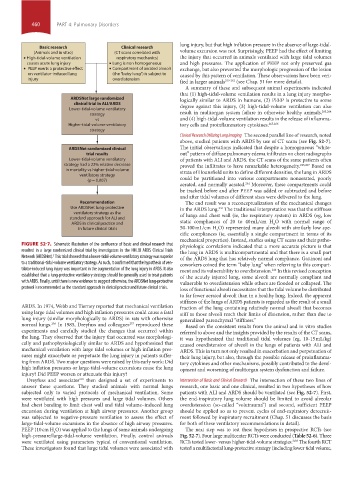
                                                                         A summary of these and subsequent animal experiments indicated
                                                                       that (1) high-tidal-volume ventilation results in a lung injury morpho-
                                  ARDSNet large randomized             logically similar to ARDS in humans, (2) PEEP is protective to some
                                   clinical trial in ALI/ARDS          degree against this injury, (3) high-tidal-volume ventilation can also
                                 Lower-tidal-volume ventilatory                                                         263,264
                                        strategy                       result in multiorgan system failure in otherwise healthy animals,
                                          vs                           and (4) high-tidal-volume ventilation results in the release of inflamma-
                                 Higher-tidal-volume ventilatory       tory cells and proinflammatory cytokines. 265,266
                                        strategy
                                                                       Clinical Research Utilizing Lung Imaging  The second parallel line of research, noted
                                                                       above, studied patients with ARDS by use of CT scans (see Fig. 52-7).
                                 ARDSNet randomized clinical           The initial observations indicated that despite a homogeneous “white-
                                       trial results                   out” pattern of diffuse pulmonary edema infiltrates on chest radiographs
                                 Lower-tidal-volume ventilatory        of patients with ALI and ARDS, the CT scans of the same patients often
                                strategy had a 22% relative decrease   proved the infiltrates to have remarkable heterogeneity. 245,267  Based on
                                in mortality vs higher-tidal-volume    strata of Hounsfield units to define different densities, the lung in ARDS
                                     ventilatory strategy              could be partitioned into various compartments: nonaerated, poorly
                                        (p = 0.007)
                                                                       aerated, and normally aerated.  Moreover, these compartments could
                                                                                             244
                                                                       be tracked before and after PEEP was added or subtracted and before
                                                                       and after tidal volumes of different sizes were delivered to the lung.
                                     Recommendation                      The end result was a reconceptualization of the mechanical changes
                                  Use ARDSNet lung-protective          in the ARDS lung.  The traditional interpretation was that the stiffness
                                                                                    244
                                   ventilatory strategy as the         of lungs and chest wall (ie, the respiratory system) in ARDS (eg, low
                                  standard approach for ALI and        static compliances of 20 to 40 mL/cm H O with normal range of
                                  ARDS in clinical practice and                                        2
                                     in future clinical trials         50-100 mL/cm H O) represented many alveoli with similarly low spe-
                                                                                    2
                                                                       cific compliances (ie, essentially a single compartment in terms of its
                                                                       mechanical properties). Instead, studies using CT scans and their patho-
                 FIGURE 52-7.  Schematic illustration of the confluence of basic and clinical research that   physiologic correlations indicated that a more accurate picture is that
                 resulted in a large randomized clinical trial by investigators in the NHLBI ARDS Clinical Trials   the lung in ARDS is multicompartmental and that there is a small part
                 Network (ARDSNet).  This trial showed that a lower-tidal-volume ventilatory strategy was superior   of the ARDS lung that has relatively normal compliance. Gattinoni and
                            3
                 to a traditional-tidal-volume ventilatory strategy. As such, it confirmed that the hypothesis of ven-  coworkers coined the term “baby lung” when referring to this compart-
                 tilator-induced lung injury was important in the augmentation of the lung injury in ARDS. It also   ment and its vulnerability to overdistension.  In this revised conception
                                                                                                       244
                 established that a lung-protective ventilatory strategy should be generally used to treat patients   of the acutely injured lung, some alveoli are normally compliant and
                 with ARDS. Finally, until there is new evidence to suggest otherwise, the ARDSNet lung-protective   vulnerable to overdistension while others are flooded or collapsed. The
                 protocol is recommended as the standard approach in clinical practice and future clinical trials.  loss of functional alveoli necessitates that the tidal volume be distributed
                                                                       to far fewer aerated alveoli than in a healthy lung. Indeed, the apparent
                                                                       stiffness of the lungs of ARDS patients is regarded as the result of a small
                 ARDS. In 1974, Webb and Tierney reported that mechanical ventilation   fraction of the lung containing relatively normal alveoli that becomes
                 using large tidal volumes and high inflation pressures could cause a fatal   stiff as those alveoli reach their limits of distension, rather than due to
                 lung injury (similar morphologically to ARDS) in rats with otherwise   generalized parenchymal “stiffness.”
                 normal lungs.  In 1985, Dreyfuss and colleagues  reproduced these   Based on the consistent results from the animal and in vitro studies
                                                      257
                           256
                 experiments and carefully studied the changes that occurred within   referred to above and the insights provided by the results of the CT scans,
                 the lung. They observed that the injury that occurred was morphologi-  it was hypothesized that traditional tidal volumes (eg, 10-15 mL/kg)
                 cally and pathophysiologically similar to ARDS and hypothesized that   caused overdistension of alveoli in the lungs of patients with ALI and
                 mechanical ventilation with large tidal volumes or high inflation pres-  ARDS. This in turn not only resulted in exacerbation and perpetuation of
                 sures might exacerbate or perpetuate the lung injury in patients suffer-  their lung injury, but also, through the possible release of proinflamma-
                 ing from ARDS. Two major questions were raised by this early work: Did   tory cytokines and other mechanisms, possibly contributed to the devel-
                 high inflation pressures or large-tidal-volume excursions cause the lung   opment and worsening of multiorgan system dysfunction and failure.
                 injury? Did PEEP worsen or attenuate this injury?
                   Dreyfuss and associates  then designed a set of experiments to   Intersection of Basic and Clinical Research  The intersection of these two lines of
                                     258
                 answer these questions. They studied animals with normal lungs    research, one basic and one clinical, resulted in two hypotheses of how
                 subjected only to varied protocols of mechanical ventilation. Some   patients with ALI and ARDS should be ventilated (see Fig. 52-7). First,
                 were ventilated with high pressures and large tidal volumes. Others   the end-inspiratory lung volume should be limited to avoid alveolar
                 had chest banding to limit chest wall and tidal volume–induced lung   overdistension (so-called “volutrauma”) and second, sufficient PEEP
                 excursion during ventilation at high airway pressures. Another group   should be applied so as to prevent cycles of end-expiratory derecruit-
                 was subjected to negative-pressure ventilation to assess the effect of   ment followed by inspiratory recruitment (Chap. 51 discusses the basis
                 large-tidal-volume excursions in the absence of high airway pressures.   for both of these ventilatory recommendations in detail).
                 PEEP (10 cm H O) was applied to the lungs of some animals undergoing   The next step was to test these hypotheses in prospective RCTs (see
                            2
                 high-pressure/large-tidal-volume  ventilation.  Finally,  control  animals   Fig. 52-7). Four large multicenter RCTs were conducted (Table 52-6). Three
                 were ventilated using parameters typical of conventional ventilation.   RCTs tested lower- versus higher-tidal-volume strategies. 3,8,9  The fourth RCT
                 These investigators found that large tidal volumes were associated with   tested a multifactorial lung-protective strategy (including lower tidal volume,


            section04.indd   460                                                                                       1/23/2015   2:19:43 PM

