


Page 642 - Hall et al (2015) Principles of Critical Care-McGraw-Hill
P. 642
CHAPTER 52: Acute Lung Injury and the Acute Respiratory Distress Syndrome  461


                      TABLE 52-6    Phase III Randomized Controlled Clinical Trials Using Lung-Protective Strategies
                                                                               Mortality in Lower-Tidal-  Mortality in Higher- Tidal-
                    Authors      Year Published (Years of Enrollment)  Number of Subjects Enrolled  Volume Group  volume Group  p-Value
                                                                                                    a
                                                                                  a
                    Amato et al 7  1998 (1990-1995)              53            38%  (45%) b      71%  (71%) b       <0.0001 (0.37)
                    Brochard et al 8  1998 (1994-1996)          116            46.5% c           37.9% c            0.39
                    Stewart et al 9  1998 (1995-1996)           120            50.0% d           47% d              0.72
                    ARDSNet 3,e  2000 (1996-1999)               861            31.0% f           39.8% f            0.007
                    a Mortality at 28 days.
                    b As of hospital discharge.
                    c Mortality at 60 days.
                    d Mortality at hospital discharge (up to ~100 days in hospital).
                    e NHLBI Acute Respiratory Distress Syndrome Clinical Trials Network.
                    f Mortality before discharge to home without assisted ventilation or as of 180 days, whichever occurred first.

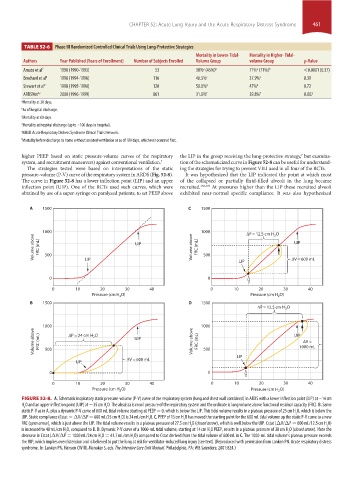
                    higher PEEP based on static pressure-volume curves of the respiratory    the LIP in the group receiving the lung-protective strategy,  but examina-
                                                                                                                   7
                    system, and recruitment maneuvers) against conventional ventilation. 7  tion of the schematicized curve in Figure 52-8 can be useful for understand-
                     The strategies tested  were  based  on  interpretations  of  the  static   ing the strategies for trying to prevent VILI used in all four of the RCTs.
                      pressure-volume (P-V) curve of the respiratory system in ARDS (Fig. 52-8).   It was hypothesized that the LIP indicated the point at which most
                    The curve in Figure 52-8 has a lower inflection point (LIP) and an upper   of the collapsed or partially fluid-filled alveoli in the lung became
                    inflection point (UIP). One of  the RCTs used such curves, which  were   recruited. 268,269  At pressures higher than the LIP these recruited alveoli
                    obtained by use of a super-syringe on paralyzed patients, to set PEEP above   exhibited near-normal specific compliance. It was also hypothesized

                      A    1500                                             C    1500


                           1000                                                  1000            P = 12.5 cm H 2 O
                        Volume above  FRC (mL)  500  LIP  UIP                 Volume above  FRC (mL)  500  LIP   V = 600 mL
                                                                                                                UIP


                             0                                                     0

                              0       10      20       30      40                   0       10      20       30      40
                                            Pressure (cm H 2 O)                                   Pressure (cm H 2 O)
                      B    1500                                              D   1500
                                                                                                     P = 12.5 cm H 2 O


                           1000                                                  1000
                        Volume above  FRC (mL)  500   P = 24 cm H 2 O  UIP    Volume above  FRC (mL)  500       UIP 1000 mL

                                                                                                                    V =

                                                        V = 600 mL                           LIP
                                      LIP
                             0                                                     0

                              0       10      20       30      40                   0       10      20       30      40
                                            Pressure (cm H 2 O)                                   Pressure (cm H 2 O)
                    FIGURE 52-8.  A. Schematic inspiratory static pressure-volume (P-V) curve of the respiratory system (lung and chest wall combined) in ARDS with a lower inflection point (LIP) at ~14 cm
                    H O and an upper inflection point (UIP) at ∼35 cm H O. The abscissa is recoil pressure of the respiratory system and the ordinate is lung volume above functional residual capacity (FRC). B. Same
                                                2
                    2
                    static P-V as in A, plus a dynamic P-V curve of 600 mL tidal volume starting at PEEP = 0, which is below the LIP. This tidal volume results in a plateau pressure of 25 cm H O, which is below the
                                                                                                                 2
                    UIP. Static compliance (Cstat = ΔV/ΔP = 600 mL/25 cm H O) is 24 mL/cm H O. C. PEEP of 15 cm H O has moved the starting point for the 600 mL tidal volume up the static P-V curve to a new
                                                               2
                                                                           2
                                                     2
                    FRC (open arrow), which is just above the LIP. The tidal volume results in a plateau pressure of 27.5 cm H O (closed arrow), which is well below the UIP. Cstat (ΔV/ΔP = 600 mL/12.5 cm H O)
                                                                                                                            2
                                                                             2
                    is increased to 48 mL/cm H O, compared to B. D. Dynamic P-V curve of a 1000-mL tidal volume, starting at 14 cm H O PEEP, results in a plateau pressure of 38 cm H O (closed arrow). Note the
                                                                                                              2
                                   2
                                                                                    2
                    decrease in Cstat (ΔV/ΔP = 1000 mL/24 cm H O = 41.7 mL/cm H O) compared to Cstat derived from the tidal volume of 600 mL in C. The 1000-mL tidal volume’s plateau pressure exceeds
                                                          2
                                               2
                    the UIP, which implies overdistension and is believed to put the lung at risk for ventilator-induced lung injury (see text). (Reproduced with permission from Lanken PN. Acute respiratory distress
                    syndrome. In: Lanken PN, Hanson CW III, Manaker S, eds. The Intensive Care Unit Manual. Philadelphia, PA: WB Saunders; 2001:824.)
            section04.indd   461                                                                                       1/23/2015   2:19:45 PM

