


Page 854 - Hall et al (2015) Principles of Critical Care-McGraw-Hill
P. 854
CHAPTER 65: Pneumonia   585


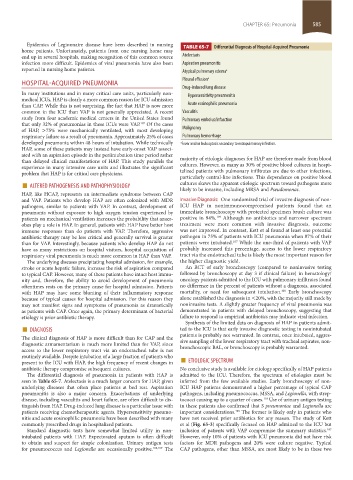
                     Epidemics of Legionnaire disease have been described in nursing     TABLE 65-7    Differential Diagnosis of Hospital-Acquired Pneumonia
                    home patients. Unfortunately, patients from one nursing home may
                    end up in several hospitals, making recognition of this common source   Atelectasis
                    infection more difficult. Epidemics of viral pneumonia have also been   Aspiration pneumonitis
                    reported in nursing home patients.                    Atypical pulmonary edema a

                                                                          Pleural effusion a
                    HOSPITAL-ACQUIRED PNEUMONIA
                                                                          Drug-induced lung disease
                    In many institutions and in many critical care units, particularly non-    Hypersensitivity pneumonitis
                    medical ICUs, HAP is clearly a more common reason for ICU admission
                    than CAP. While this is not surprising, the fact that HAP is now more     Acute eosinophilic pneumonia
                    common in the ICU than VAP is not generally appreciated. A recent   Vasculitis
                    study from four academic medical centers in the United States found   Pulmonary embolus/infarction
                    that only 32% of pneumonias in these ICUs were VAP.  Of the cases
                                                            107
                    of HAP,  >75% were mechanically ventilated, with most developing   Malignancy
                    respiratory failure as a result of pneumonia. Approximately 25% of cases   Pulmonary hemorrhage
                    developed pneumonia within 48 hours of intubation. While technically   a Fever and/or leukocytosis secondary to extrapulmonary infection.
                    HAP, some of these patients may instead have early-onset VAP associ-
                    ated with an aspiration episode in the periintubation time period rather
                    than delayed clinical manifestations of HAP. This study parallels the   majority of etiologic diagnoses for HAP are therefore made from blood
                    experience in many intensive care units and illustrates the significant   cultures. However, as many as 30% of positive blood cultures in hospi-
                    problem that HAP is for critical care physicians.     talized patients with pulmonary infiltrates are due to other infections,
                                                                          particularly central-line infections. This dependence on positive blood
                        ■  ALTERED PATHOGENESIS AND PATHOPHYSIOLOGY       cultures skews the apparent etiologic spectrum toward pathogens more
                    HAP, like HCAP, represents an intermediate syndrome between CAP   likely to be invasive, including MRSA and Pseudomonas.
                    and VAP. Patients who develop HAP are often colonized with MDR   Invasive Diagnosis:  One randomized trial of invasive diagnosis of non-
                    pathogens, similar to patients with VAP. In contrast, development of   ICU HAP in nonimmunocompromised patients found that an
                    pneumonia without exposure to high oxygen tension experienced by   immediate bronchoscopy with protected specimen brush culture was
                                                                                      109
                    patients on mechanical ventilation increases the probability that anaer-  positive in 94%.  Although no antibiotics and narrower spectrum
                    obes play a role in HAP. In general, patients with HAP have better host   treatment were more common with invasive diagnosis, outcome
                    immune responses than do patients with VAP. Therefore, aggressive   was not improved. In contrast, Kett et al found at least one potential
                    antibiotic therapy may be less critical and generally survival is greater   pathogen in 75% of patients with ICU pneumonia when 87% of their
                                                                                            107
                    than for VAP. Interestingly, because patients who develop HAP do not   patients were intubated.  While the one-third of patients with VAP
                    have as many restrictions on hospital visitors, hospital acquisition of   probably increased this percentage, access to the lower respiratory
                    respiratory viral pneumonia is much more common in HAP than VAP.  tract via the endotracheal tube is likely the most important reason for
                     The underlying diseases precipitating hospital admission, for example,     the higher diagnostic yield.
                    stroke or acute hepatic failure, increase the risk of aspiration compared   An RCT of early bronchoscopy (compared to noninvasive testing
                    to typical CAP. However, many of these patients have intact host immu-  followed by bronchoscopy at day 3 if clinical failure) in hematology/
                    nity and, therefore, the ability to avoid development of pneumonia   oncology patients admitted to the ICU with pulmonary infiltrates found
                    oftentimes rests on the primary cause for hospital admission. Patients   no difference in the percent of patients without a diagnosis, associated
                                                                                                            108
                    with HAP may have some blunting of their inflammatory response   mortality,  or  need  for  subsequent  intubation.   Early  bronchoscopy
                    because of typical causes for hospital admission. For this reason they   alone established the diagnosis in <20%, with the majority still made by
                    may not  manifest  signs  and symptoms of  pneumonia  as  dramatically   noninvasive tests. A slightly greater frequency of viral pneumonia was
                    as patients with CAP. Once again, the primary determinant of bacterial   demonstrated in patients with delayed bronchoscopy, suggesting that
                    etiology is prior antibiotic therapy.                 failure to respond to empirical antibiotics may indicate viral infection.
                        ■  DIAGNOSIS                                      ted to the ICU is that early invasive diagnostic testing in nonintubated
                                                                           Synthesis of the limited data on diagnosis of HAP in patients admit-

                    The clinical diagnosis of HAP is more difficult than for CAP and the   patients is probably not warranted. In contrast, once intubated, aggres-
                                                                          sive sampling of the lower respiratory tract with tracheal aspirates, non-
                    diagnostic armamentarium is much more limited than for VAP, since
                    access to the lower respiratory tract via an endotracheal tube is not   bronchoscopic BAL, or bronchoscopy is probably warranted.
                    present to the ICU with HAP, the high frequency of recent changes in   ■  ETIOLOGIC SPECTRUM
                    routinely available. Despite intubation of a large fraction of patients who
                    antibiotic therapy compromise subsequent cultures.    No conclusive study is available for etiology specifically of HAP patients
                     The differential diagnosis of pneumonia in patients with HAP is   admitted  to  the ICU. Therefore,  the  spectrum  of  etiologies  must  be
                    seen in Table 65-7. Atelectasis is a much larger concern for HAP, given   inferred  from  the  few  available  studies.  Early  bronchoscopy  of  non-
                    underlying diseases that often place patients at bed rest. Aspiration   ICU HAP patients demonstrated a higher percentage of typical CAP
                    pneumonitis is also a major concern. Exacerbations of underlying   pathogens, including pneumococcus, MSSA, and Legionella, with strep-
                    disease, including vasculitis and heart failure, are often difficult to dis-  tococci causing up to a quarter of cases.  Use of urinary antigen testing
                                                                                                      110
                    tinguish from HAP. Drug-induced lung disease is a particular issue with   in these patients also confirmed that S pneumoniae and Legionella are
                    patients receiving chemotherapeutic agents. Hypersensitivity pneumo-  important considerations.  The former is likely only in patients who
                                                                                            109
                    nitis and acute eosinophilic pneumonia have been described with many   have  not  received  prior  antibiotics  for  any  reason.  The  study  of  Kett
                    commonly prescribed drugs in hospitalized patients.   et al (Fig. 65-3) specifically focused on HAP admitted to the ICU but
                     Standard diagnostic tests have somewhat limited utility in non-  inclusion of patients with VAP compromise the summary statistics.
                                                                                                                            107
                    intubated patients with HAP. Expectorated sputum is often difficult   However, only 10% of patients with ICU pneumonia did not have risk
                    to  obtain and suspect  for simple colonization. Urinary antigen tests   factors  for  MDR  pathogens  and  20%  were  culture  negative.  Typical
                    for pneumococcus  and  Legionella are occasionally positive. 108,109  The   CAP pathogens, other than MSSA, are most likely to be in these two


            section05_c61-73.indd   585                                                                                1/23/2015   12:47:56 PM

