


Page 861 - Hall et al (2015) Principles of Critical Care-McGraw-Hill
P. 861
592     PART 5: Infectious Disorders


                 that for patients in the ICU with a new onset of fever but without severe   Device-related infections due to  Candida species should have the
                 sepsis or evidence of bloodstream infection, percutaneous and blood   device removed and be treated with a 14-day course of an azole such as
                 cultures  from  a  nontunneled  central  line  should  be  obtained  without   fluconazole, amphotericin B or a lipid formulation of amphotericin B,
                 routine catheter removal but if the patient has unexplained sepsis or ery-  or an echinocandin as appropriate based on susceptibility.  In the sus-
                                                                                                                 53
                 thema overlying the catheter insertion site or purulence at the catheter   ceptible patient population most often found in the ICU, a thorough
                 insertion site, the catheter should be removed and cultured. For patients   evaluation  for  metastatic  candidal  infection,  including  careful  fundo-
                 with unexplained fever, if blood culture results are positive, the central   scopic examination, is necessary. The finding of persistently positive
                 catheter should be exchanged over a guide wire, and if the subsequent   blood cultures after catheter removal and initiation of antifungal therapy
                 catheter tip culture has significant growth, then the catheter should be   or the finding of metastatic candidal lesions would necessitate more pro-
                 removed and a new catheter placed in a new site.      longed therapy. An option for the management of uncomplicated bacte-
                   Device-related bacteremia that is suspected to arise from cuffed central   remia due to coagulase-negative staphylococci in the setting of a cuffed
                 long-term indwelling catheters or totally implanted devices does not neces-  long-term central catheter or implantable port, without removal of the
                 sarily require removal of the device. 53,55  If there is obvious local purulence,   device, is the use of systemic antimicrobials and the antibiotic-lock
                 a tunnel infection or tunnel-associated cellulitis, port-associated abscess,   technique, with careful monitoring for evidence of relapse.
                 septic thrombophlebitis, endocarditis, persistent bacteremia, metastatic
                 infection, or bacteremia due to S aureus or Candida species removal of   PREVENTIVE STRATEGIES
                 the device is required with surgical dissection as appropriate. Retention
                 of a cuffed long-term central catheter with catheter-related  S aureus   Attention to detail in all aspects of the placement and care of intravascular
                 bacteremia has been associated with a higher relapse rate of bacteremia   devices is necessary to minimize the risks of device-related infection. This
                 and higher sepsis-related mortality.  In the setting of bacteremia due to   attention to detail is particularly important in the ICU, where the use of
                                          56
                 other microorganisms and in the absence of complications, a course of   lines is intensive and patients, by nature of their underlying illnesses, are
                 parenteral antimicrobial therapy with or without antibiotic-lock therapy,   at high risk of device-related infections. This attention to detail with a
                 based on the susceptibility of the identified microbe, without removal of   focus on quality improvement was demonstrated in a large multicentre
                 the cuffed central catheter or implantable device may be sufficient in as   trial involving 375,757 catheter-days in 108 ICUs in a state-wide study in
                 many as two-thirds of cases.  Following treatment, these patients should   the United States.  An infection control bundle consisting of five anti-
                                     53
                                                                                    57
                 be monitored carefully for recurrences of bacteremic infection.  septic techniques highly recommended by the US Centers for Disease
                   Definitive antimicrobial therapy for device-associated bacteremia   Control  and Prevention (CDC)  guidelines  (emphasis on appropriate
                                                                                                      51
                 depends on appropriate identification and susceptibility testing of the   hand hygiene, use of maximum sterile barrier precautions during insertion
                 infecting microorganism.  Empirical therapy prior to the identification   of the CVC, use of chlorhexidine for skin antisepsis prior to placement, use
                                   53
                 and susceptibility results will be influenced by local microbiologic patterns   of the subclavian vein as the preferred insertion site, and the removal of
                 of line-related infection and susceptibilities. However, a combination of   unnecessary CVCs) resulted in a highly significant decrease in the mean
                 an intravenous antistaphylococcal penicillin (vancomycin if methicillin-  rate of CLABSIs from 7.7/1000 catheter-days to 1.4 infections at 16 to 18
                 resistant S aureus is prevalent) and an aminoglycoside or a third-generation   months follow-up, with the reduction persisting after implementation. 57
                 cephalosporin will provide adequate empiric coverage for most gram-   The processes to which preventive strategies may be applied may be
                 positive and gram-negative microorganisms. Any device-related bactere-  divided conveniently into the catheter itself, catheter insertion, catheter
                 mic infections caused by S aureus should be managed by device removal   site care, catheter care, and the delivery system (Table 66-4). Major pre-
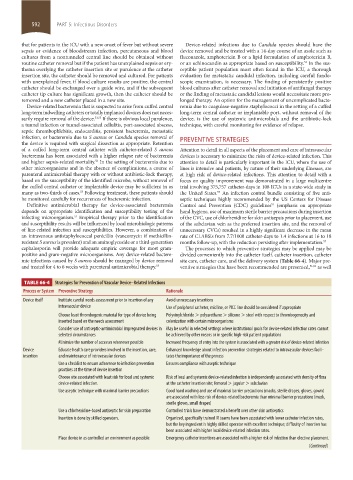
                 and treated for 4 to 6 weeks with parenteral antimicrobial therapy. 53  ventive strategies that have been recommended are presented, 31,51  as well

                   TABLE 66-4    Strategies for Prevention of Vascular Device–Related Infections
                  Process or System Preventive Strategy            Rationale
                  Device itself  Institute careful needs assessment prior to insertion of any    Avoid unnecessary insertions
                              intravascular device                 Use of peripheral catheter, midline, or PICC line should be considered if appropriate
                              Choose least thrombogenic material for type of device being   Polyvinylchloride > polyurethane > silicone > steel with respect to thrombogenecity and
                              inserted based on the needs assessment  colonization with certain microorganisms
                              Consider use of antiseptic-antimicrobial impregnated devices in  May be useful in selected settings where institutional goals for device-related infection rates cannot
                              selected circumstances               be achieved by other means or in specific high-risk patient populations
                              Minimize the number of accesses whenever possible  Increased frequency of entry into the system is associated with a greater risk of device-related infection
                  Device      Educate health care providers involved in the insertion, care,   Enhanced knowledge about infection prevention strategies related to intravascular devices facili-
                  insertion   and maintenance of intravascular devices  tates the importance of the process
                              Use a checklist to ensure adherence to infection prevention   Ensures compliance with aseptic technique
                              practices at the time of device insertion
                              Choose site associated with least risk for local and systemic    Risk of local and systemic device-related infection is independently associated with density of flora
                              device-related infection.            at the catheter insertion site; femoral > jugular > subclavian
                              Use aseptic technique with maximal barrier precautions  Good hand washing and use of maximal barrier precautions (masks, sterile drapes, gloves, gown)
                                                                   are associated with less risk of device-related bacteremia than minimal barrier precautions (mask,
                                                                   sterile gloves, small drapes)
                              Use a chlorhexidine-based antiseptic for skin preparation  Controlled trials have demonstrated a benefit over other skin antiseptics
                              Insertion is done by skilled operators.  Organized, specifically trained IV teams have been associated with lower catheter infection rates,
                                                                   but the key ingredient is highly skilled operator with excellent technique; difficulty of insertion has
                                                                   been  associated with higher local device-related infection rates.
                              Place device in as controlled an environment as possible  Emergency catheter insertions are associated with a higher risk of infection than elective placement.
                                                                                                                   (Continued)


            section05_c61-73.indd   592                                                                                1/23/2015   12:48:00 PM

