


Page 856 - Hall et al (2015) Principles of Critical Care-McGraw-Hill
P. 856
CHAPTER 65: Pneumonia   587


                    Specific Therapy:  Once the etiologic diagnosis is known, specific   An important distinction in prevention is that strategies to decrease
                    antibiotic choices become much more straightforward. Some pneu-  pneumonia may be slightly different than strategies to decrease the risk
                    monias require treatment with antibiotics outside the usual spectrum   of pneumonia due to MDR pathogens. Clearly the most important issue
                    of empirical agents, including trimethoprim/sulfamethoxazole for   for the latter is minimization of antibiotic exposure. Emergence of resis-
                    Stenotrophomonas maltophilia, ampicillin/sulbactam for Acinetobacter   tance is most dependent on duration of therapy. Therefore, appropriate
                    sp, or colistin for KPC-carrying Enterobacteriaceae. However, specific   discontinuation of prophylactic perioperative and other antibiotics is
                    treatment for several pathogens remains controversial.  very important. In addition, use of broad-spectrum antibiotics and
                     Recommended treatment for MRSA pneumonia is either linezolid   combination antibiotic therapy also increase the risk.
                                                94
                    or glycopeptides, usually vancomycin.  Subgroup analysis of FDA-
                    registration trials  and a head-to-head comparison suggest that clinical
                                111
                    outcome is improved with linezolid compared to vancomycin, even with
                    high dose adjusted therapy.  This difference is probably less important   KEY REFERENCES
                                       112
                    in patients with HAP who never required ICU admission than in ICU     • Azoulay E, Alberti C, Bornstain C, et al. Improved survival in
                    pneumonias, particularly those with VAP. 111             cancer patients requiring mechanical ventilatory support: impact
                     The need for combination therapy for Pseudomonas once the isolate   of noninvasive mechanical ventilatory support.  Crit Care Med.
                    is known to be sensitive to a β-lactam also remains unclear. No large   2001;29(3):519-525.
                    RCT has been performed and smaller ones do not demonstrate a benefit.
                    However, the clinical outcome for Pseudomonas pneumonia remains so     • Blot S, Koulenti D, Dimopoulos G, et al. Prevalence, risk factors,
                    poor that adjunctive therapy seems warranted.            and mortality for ventilator-associated pneumonia in middle-
                                                                             aged, old, and very old critically ill patients.  Crit Care Med.
                    Optimized Pharmacokinetics/Pharmacodynamics:  Because HAP is a   2014;42(3):601-609.
                    potentially life-threatening illness, antibiotic dosing should be     • Bouadma L, Luyt CE, Tubach F, et al. Use of procalcitonin to
                    optimized for maximal effect. This usually involves using the high-  reduce patients’ exposure to antibiotics in intensive care units
                    est recommended dose. Beta lactams should be given as prolonged   (PRORATA trial): a multicentre randomised controlled trial.
                    infusions in order to maximize their time above the minimal inhibi-  Lancet. 2010;375(9713):463-474.
                    tory concentration. The aminoglycosides should be given as a single
                    daily dose to maximize the area under the inhibitory curve and take     • Chastre J, Wolff M, Fagon JY, et al. Comparison of 8 vs 15 days of
                    advantage of their post-antibiotic effects. Vancomycin dosing is   antibiotic therapy for ventilator-associated pneumonia in adults: a
                    much more controversial. Dosing adjusted to achieve vancomycin   randomized trial. JAMA. 2003;290(19):2588-2598.
                    trough levels in the 15 to 20 µg/mL range has been associated with     • Fine MJ, Auble TE, Yealy DM, et al. A prediction rule to identify
                    increased nephrotoxicity and no clear-cut improvement in clinical   low-risk patients with community-acquired pneumonia. N Engl J
                    response. 112                                            Med. 1997;336(4):243-250.
                     HAP is unlikely to need a longer duration of therapy than VAP.      • Halm  EA,  Fine  MJ,  Kapoor  WN,  Singer  DE,  Marrie  TJ,  Siu  AL.
                                                                      113
                    Therefore, 7 to 8 days is adequate in the majority of cases. For   Instability  on  hospital  discharge  and  the  risk  of  adverse  out-
                    Pseudomonas, the requirement for duration longer than 8 days probably   comes in patients with pneumonia. Arch Intern Med. 2002;162(11):
                    represents ineffective treatment—alternative therapy, rather than pro-  1278-1284.
                    longing use of the same antibiotics, may lead to better outcomes. Once
                    again, appropriate de-escalation based on culture results is critical to     • Kett D, Cano E, Quartin A, et al. Implementation of guidelines for
                                                                             management of possible multidrug-resistant pneumonia in inten-
                    avoid toxicity and decrease the selective pressure for antibiotic-resistant
                    strains. 107,113                                         sive care: an observational, multicentre cohort study. Lancet Infect
                                                                             Dis. 2011;11(3):181-189.
                        ■  PREVENTION                                         • Maclaren R, Reynolds PM, Allen RR. Histamine-2 receptor
                    Prevention of HAP  has  received  significantly  less  attention  recently     antagonists vs proton pump inhibitors on gastrointestinal tract
                    than prevention of VAP. Since many of the strategies for VAP prevention   hemorrhage and infectious complications in the intensive care
                                                                             unit. JAMA Intern Med. 2014;174(4):564-574.
                    are predicated on the presence of an endotracheal tube, most are inap-
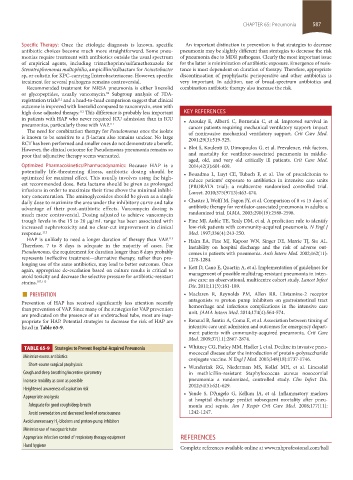
                    propriate for HAP. Potential strategies to decrease the risk of HAP are     • Renaud B, Santin A, Coma E, et al. Association between timing of
                    listed in Table 65-9.                                    intensive care unit admission and outcomes for emergency depart-
                                                                             ment patients with community-acquired pneumonia.  Crit Care
                                                                             Med. 2009;37(11):2867-2874.
                      TABLE 65-9    Strategies to Prevent Hospital-Acquired Pneumonia    • Whitney CG, Farley MM, Hadler J, et al. Decline in invasive pneu-
                                                                             mococcal disease after the introduction of protein-polysaccharide
                    Minimize excess antibiotics
                                                                             conjugate vaccine. N Engl J Med. 2003;348(18):1737-1746.
                      Short-course surgical prophylaxis                       • Wunderink RG, Niederman MS, Kollef  MH, et  al. Linezolid
                    Cough and deep breathing/incentive spirometry            in methicillin-resistant Staphylococcus aureus nosocomial
                    Increase mobility as soon as possible                    pneumonia: a randomized, controlled study.  Clin Infect Dis.
                                                                             2012;54(5):621-629.
                    Heightened awareness of aspiration risk
                                                                              • Yende S, D’Angelo G, Kellum JA, et al. Inflammatory markers
                    Appropriate analgesia
                                                                             at hospital discharge predict subsequent mortality after pneu-
                      Adequate for good cough/deep breath                    monia and sepsis.  Am J Respir Crit Care Med. 2008;177(11):
                      Avoid oversedation and decreased level of consciousness  1242-1247.
                    Avoid unnecessary H -blockers and proton-pump inhibitors
                                2
                    Minimize use of nasogastric tube
                    Appropriate infection control of respiratory therapy equipment  REFERENCES
                    Hand hygiene
                                                                          Complete references available online at www.mhprofessional.com/hall


            section05_c61-73.indd   587                                                                                1/23/2015   12:47:57 PM

