


Page 859 - Hall et al (2015) Principles of Critical Care-McGraw-Hill
P. 859
590     PART 5: Infectious Disorders


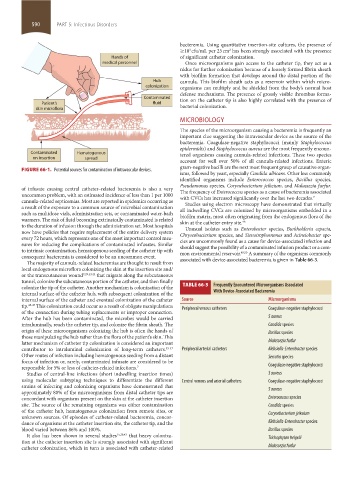
                                                                       bacteremia.  Using  quantitative  insertion-site  cultures,  the  presence  of
                                                                       ≥10  cfu/mL per 25 cm  has been strongly associated with the presence
                                                                          3
                                                                                        2
                                                Hands of               of significant catheter colonization.
                                             medical personnel           Once microorganisms gain access to the catheter tip, they act as a
                                                                       nidus for further colonization because of a loosely formed fibrin sheath
                                                                       with biofilm formation that develops around the distal portion of the
                                                              Hub      cannula. This biofilm sheath acts as a reservoir within which micro-
                                                           colonization  organisms can multiply and be shielded from the body’s normal host
                                                                       defense mechanisms. The presence of grossly visible thrombus forma-
                                                           Contaminated  tion on the catheter tip is also highly correlated with the presence of
                        Patient’s                             fluid    bacterial colonization.
                      skin microflora
                                                                       MICROBIOLOGY

                                                                       The species of the microorganism causing a bacteremia is frequently an
                                                                       important clue suggesting the intravascular device as the source of the
                                                                       bacteremia. Coagulase-negative staphylococci (mainly  Staphylococcus
                                                                       epidermidis) and Staphylococcus aureus are the most frequently encoun-
                    Contaminated    Hematogenous                       tered organisms causing cannula-related infections. These two species
                     on insertion      spread
                                                                       account for well over 50% of all cannula-related infections. Enteric
                                                                       gram-negative bacilli are the next most frequent group of causative organ-
                 FIGURE 66-1.  Potential sources for contamination of intravascular devices.
                                                                       isms, followed by yeast, especially Candida albicans. Other less commonly
                                                                       identified organisms include  Enterococcus species,  Bacillus species,
                                                                       Pseudomonas species, Corynebacterium jeikeium, and Malassezia furfur.
                 of infusate  causing central catheter–related  bacteremia is  also a very   The frequency of Enterococcus species as a cause of bacteremia associated
                 uncommon problem, with an estimated incidence of less than 1 per 1000   with CVCs has increased significantly over the last two decades. 7
                 cannula-related septicemias. Most are reported in epidemics occurring as   Studies using electron microscopy have demonstrated that virtually
                 a result of the exposure to a common source of microbial contamination   all indwelling CVCs are colonized by microorganisms embedded in a
                 such as multidose vials, administration sets, or contaminated water-bath   biofilm matrix, most often originating from the endogenous flora of the
                 warmers. The risk of fluid becoming extrinsically contaminated is related   skin at the catheter entry site. 48
                 to the duration of infusion through the administration set. Most hospitals   Unusual isolates such as  Enterobacter species,  Burkholderia cepacia,
                 now have policies that require replacement of the entire delivery system   Chryseobacterium species, and Stenotrophomonas and Acinetobacter spe-
                 every 72 hours, which represents one of the most important control mea-  cies are uncommonly found as a cause for device-associated infection and
                 sures for reducing the complications of contaminated infusates. Similar   should suggest the possibility of a contaminated infusion product or a com-
                 to intrinsic contamination, hematogenous seeding of the catheter tip with   mon environmental reservoir. 49,50  A summary of the organisms commonly
                 consequent bacteremia is considered to be an uncommon event.  associated with device-associated bacteremia is given in Table 66-3.
                   The majority of cannula-related bacteremias are thought to result from
                 local endogenous microflora colonizing the skin at the insertion site and/
                 or the transcutaneous wound 7,29,43,44  that migrate along the subcutaneous
                 tunnel, colonize the subcutaneous portion of the catheter, and then finally
                 colonize the tip of the catheter. Another mechanism is colonization of the     TABLE 66-3     Frequently Encountered Microorganisms Associated
                 internal surface of the catheter hub, with subsequent colonization of the   With  Device-Associated Bacteremia
                 internal surface of the catheter and eventual colonization of the catheter   Source  Microorganisms
                 tip. 45-47  This colonization could occur as a result of obligate manipulations   Peripheral venous catheters  Coagulase-negative staphylococci
                 of the connection during tubing replacements or improper connection.
                 After the hub has been contaminated, the microbes would be carried                  S aureus
                 intraluminally, reach the catheter tip, and colonize the fibrin sheath. The         Candida species
                 origin of these microorganisms colonizing the hub is often the hands of             Bacillus species
                 those manipulating the hub rather than the flora of the patient’s skin. This
                 latter mechanism of catheter tip colonization is considered an important            Malassezia furfur
                 contributor to intraluminal colonization of long-term catheters. 45-47    Peripheral arterial catheters  Klebsiella-Enterobacter species
                 Other routes of infection including hematogenous seeding from a distant             Serratia species
                 focus of infection or, rarely, contaminated infusate are considered to be
                 responsible for 5% or less of catheter-related infections. 7                        Coagulase-negative staphylococci
                   Studies of central-line infections (short indwelling insertion times)             S aureus
                 using molecular subtyping techniques to differentiate the different   Central venous and arterial catheters  Coagulase-negative staphylococci
                 strains of infecting and colonizing organisms have demonstrated that                S aureus
                 approximately 80% of the microorganisms from distal catheter tips are
                 concordant with organisms present on the skin at the catheter insertion             Enterococcus species
                 site. The source of the remaining organisms was either contamination                Candida species
                 of the catheter hub, hematogenous colonization from remote sites, or                Corynebacterium jeikeium
                 unknown sources. Of episodes of catheter-related bacteremia, concor-
                 dance of organisms at the catheter insertion site, the catheter tip, and the        Klebsiella-Enterobacter species
                 blood varied between 86% and 100%.                                                  Bacillus species
                   It also has been shown in several studies 15,20,43  that heavy coloniza-          Trichophyton beigelii
                 tion at the catheter insertion site is strongly associated with significant
                 catheter colonization, which in turn is associated with catheter-related            Malassezia furfur


            section05_c61-73.indd   590                                                                                1/23/2015   12:47:59 PM

