


Page 857 - Hall et al (2015) Principles of Critical Care-McGraw-Hill
P. 857
588     PART 5: Infectious Disorders


                   CHAPTER   Infectious Complications                  including local site infection, bacteremia, clinical sepsis without bacte-
                                                                       remia, line fracture and extravasation of fluids or drugs, obstruction by
                    66       of Intravascular Access                   medication, thrombosis, thrombophlebitis, and septic thrombophlebitis.
                                                                       Infectious complications are the most frequent and among the most
                             Devices Used in Critical Care             serious of these complications. The magnitude of CVC-related infec-
                                                                       tious complications can be appreciated when one realizes there are an
                             John Conly                                estimated 15 million days of exposure to CVCs in patients in ICUs in
                                                                       the United States each year with 80,000 cases of central line–associated
                                                                       blood stream infections (CLABSI) annually.  Catheter-related infections
                                                                                                       1
                  KEY POINTS                                           are associated with significant morbidity and mortality with attributable
                     • Intravascular access device–associated infections may be either   length of stay extended between 7 and 19.1 days and attributable mortal-
                    local or bacteremic, and the risk of developing an infection varies   ity reported as high as 24.6% to 35%. 1-4
                    with the patient population, the type of device, the microbe, and
                    the patient-microbe-device interaction.            EPIDEMIOLOGY
                     • The status of all indwelling vascular access devices should be   The risk of developing device-related infection (either local or bacteremic)
                    reviewed daily by the critical care team, with attention to the dura-  varies between ICUs and countries depending on the patient population,
                    tion of placement, appearance of the exit site, and continued clini-  the type of device and its intended use, the microorganisms involved, and
                    cal indication for the intravascular device.       the patient-microbe-device interaction. The annual National Healthcare
                     • Central venous catheters account for over 90% of all intravascular   Safety Network in the US reports stratify CLABSIs per ICU type and
                    device–related bacteremias.                        representative  incidence-density  rates  are  shown  from  its  most  recent
                                                                                          5
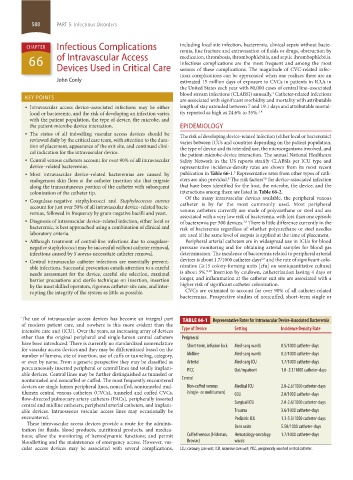
                     • Most intravascular device–related bacteremias are caused by   publication in Table 66-1.  Representative rates from other types of cath-
                                                                                                    7,8
                                                                                        6
                    endogenous skin flora at the catheter insertion site that migrate   eters are also provided.  The risk factors  for device-associated infection
                    along the transcutaneous portion of the catheter with subsequent   that have been identified for the host, the microbe, the device, and the
                    colonization of the catheter tip.                  interactions among them are listed in Table 66-2.
                     • Coagulase-negative staphylococci and  Staphylococcus aureus   Of the many intravascular devices available, the peripheral venous
                    account for just over 50% of all intravascular device–related bacte-  catheter is by far the most commonly used. Most peripheral
                                                                       venous catheters currently are made of polyurethane or steel and are
                    remias,  followed in frequency by gram-negative bacilli and yeast.  associated with a very low risk of bacteremia, with less than one episode
                     • Diagnosis of intravascular device–related infection, either local or   of bacteremia per 500 devices.  There is little difference currently in the
                                                                                             7,8
                      bacteremic, is best approached using a combination of clinical and   risk of bacteremia regardless of whether polyurethane or steel needles
                    laboratory criteria.                               are used if the same level of asepsis is applied at the time of placement.
                     • Although treatment of central-line infections due to coagulase-   Peripheral arterial catheters are in widespread use in ICUs for blood
                    negative staphylococci may be successful without catheter removal,   pressure monitoring and for obtaining arterial samples for blood gas
                    infections caused by S aureus necessitate catheter removal.  determination. The incidence of bacteremia related to peripheral arterial
                                                                                                   6,9
                     • Central intravascular catheter infections are essentially prevent-  devices is about 1.7/1000 catheter-days  and the rate of significant colo-
                    able infections. Successful prevention entails attention to a careful   nization (≥15 colony-forming units [cfu] on semiquantitative culture)
                                                                                9,10
                    needs assessment for the device, careful site selection, maximal   is about 5%.  Insertion by cutdown, catheterization lasting 4 days or
                    barrier precautions and sterile technique on insertion, insertion   longer, and inflammation at the catheter exit site are associated with a
                    by the most skilled operators, rigorous catheter-site care, and inter-  higher risk of significant catheter colonization.
                    rupting the integrity of the system as little as possible.  CVCs are estimated to account for over 90% of all catheter-related
                                                                       bacteremias. Prospective studies of noncuffed, short-term single or


                 The use of intravascular access devices has become an integral part     TABLE 66-1    Representative Rates for Intravascular Device-Associated Bacteremia
                 of modern patient care, and nowhere is this more evident than the
                 intensive care unit (ICU). Over the years, an increasing array of devices   Type of Device  Setting  Incidence Density Rate
                 other than the original peripheral and single-lumen central catheters   Peripheral
                 have been introduced. There is currently no standardized nomenclature     Short-term, infusion lock  Med-surg wards  0.5/1000 catheter-days
                 for vascular access devices and they may be differentiated based on the
                 number of lumens, site of insertion, use of cuffs or tunneling, category,     Midline  Med-surg wards  0.2/1000 catheter-days
                 or even by name. From a generic perspective they may be classified as     Arterial  Med-surg ICU  1.7/1000 catheter-days
                 percutaneously inserted peripheral or central lines and totally implant-    PICC  Out/inpatient  1.0 -2.1/1000 catheter-days
                 able devices. Central lines may be further distinguished as tunneled or
                 nontunneled and noncuffed or cuffed. The most frequently encountered   Central
                 devices are single lumen peripheral lines, noncuffed, nontunneled mul-     Non-cuffed venous    Medical ICU  2.0-2.6/1000 catheter-days
                 tilumen central venous catheters (CVCs), tunneled and cuffed CVCs,   (single- or multilumen)  CCU  2.0/1000 catheter-days
                 flow-directed pulmonary artery catheters (PACs), peripherally inserted
                 central and midline catheters, peripheral arterial catheters, and implant-  Surgical ICU  2.0-2.6/1000 catheter-days
                 able devices. Intraosseous vascular access lines may occasionally be     Trauma          3.6/1000 catheter-days
                 encountered.                                                             Pediatric ICU   1.3-3.3/1000 catheter-days
                   These intravascular access devices provide a route for the adminis-
                 tration for fluids, blood products, nutritional products, and medica-    Burn units      5.50/1000 catheter-days
                 tions; allow the monitoring of hemodynamic functions; and permit      Cuffed venous (Hickman,   Hematology-oncology   1.7/1000 catheter-days
                   bloodletting and the maintenance of emergency access. However, vas-  Broviac)  wards
                 cular access devices may be associated with several complications,   CCU, coronary care unit; ICU, intensive care unit; PICC, peripherally inserted central catheter.


            section05_c61-73.indd   588                                                                                1/23/2015   12:47:58 PM

