


Page 914 - Hall et al (2015) Principles of Critical Care-McGraw-Hill
P. 914
CHAPTER 70: Fungal Infections  645


                    easily defined and the end points for success are clear-cut. Candidemia   Several studies have shown that prompt treatment of candidemia signifi-
                    can be an isolated event, or it can be a herald for disseminated infection   cantly decreases the mortality rate, and delay for as long as 48 hours after
                    involving multiple organs. Candidemia can culminate with sepsis, but   the blood culture is performed is associated with increased mortality. 53,54
                    many patients, especially those with an indwelling central venous cath-  Mortality appears to be higher in patients with candidemia due to C
                    eter, may be merely febrile with no localizing signs. Conversely, patients   krusei, but this could reflect the fact that this species is seen more often
                    can have invasive candidiasis, but not be candidemic.  in patients who have hematological malignancies. 27,33  Mortality associ-
                        ■  INTRA-ABDOMINAL INFECTION                      ated with candidemia due to C parapsilosis is consistently lower than that
                                                                          found with other species.
                                                                                               In some studies, mortality rates for patients
                                                                                            23,51
                    Intra-abdominal infections with Candida species most often occur sec-  who have C glabrata fungemia have been noted to be higher than that
                    ondary to bowel perforation, anastomotic leaks after bowel surgery, and   seen with C albicans,  but in other studies, there was no difference or
                                                                                         27
                    acute necrotizing pancreatitis. 40,41  Peritonitis and/or abscess formation   the rates were lower. 23,29,55
                    can occur, and sepsis may ensue. C albicans is most often found, but
                    in some medical centers,  C glabrata predominates. The symptoms of  DIAGNOSIS
                    intra-abdominal infection due to Candida do not differ from those seen
                    with bacterial pathogens, and in fact, mixed bacterial-yeast infections   The diagnosis of invasive candidiasis requires clinical suspicion that
                    are the rule.                                         Candida infection could be present. The patient might be only mildly ill
                     The diagnosis is made when peritoneal fluid or abscess material   or may have sepsis. Many of the manifestations of invasive candidiasis
                    obtained by ultrasound or CT-guided aspiration or at the time of sur-  and candidemia do not differ from those seen with bacteremia and
                    gery yields Candida species. Growth of yeast from an indwelling drain   other serious bacterial infections, and patients, especially those with an
                    is not adequate for the diagnosis of intra-abdominal Candida infection   intra-abdominal process, can have polymicrobial infection with yeasts
                    because it usually reflects only colonization of the drain.  and bacteria.
                        ■  URINARY TRACT INFECTION                            ■  CLINICAL CLUES

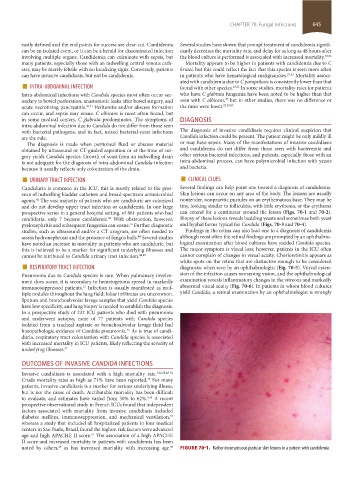
                    Candiduria is common in the ICU; this is mostly related to the pres-  Several findings can help point one toward a diagnosis of candidemia.
                    ence of indwelling bladder catheters and broad-spectrum antimicrobial   Skin lesions can occur on any area of the body. The lesions are usually
                    agents.  The vast majority of patients who are candiduric are colonized   nontender, nonpruritic pustules on an erythematous base. They may be
                         42
                    and do not develop upper tract infection or candidemia. In one large   tiny, looking similar to folliculitis, with little erythema, or the erythema
                    prospective series in a general hospital setting, of 861 patients who had   can extend for a centimeter around the lesion (Figs. 70-1 and 70-2).
                    candiduria, only 7 became candidemic.  With obstruction, however,   Biopsy of these lesions reveals budding yeasts and sometimes both yeast
                                                 43
                    pyelonephritis and subsequent fungemia can ensue.  Further diagnostic   and hyphal forms typical for Candida (Figs. 70-3 and 70-4).
                                                        16
                    studies, such as ultrasound and/or a CT urogram, are often needed to   Findings in the retina can also lead one to a diagnosis of candidemia
                    assess hydronephrosis and the presence of fungus balls.  Several studies   although most often the retinal findings are prompted by an ophthalmo-
                                                           44
                    have noted an increase in mortality in patients who are candiduric, but   logical examination after blood cultures have yielded Candida species.
                    this is believed to be a marker for significant underlying illnesses and   The major symptom is visual loss; however, patients in the ICU often
                    cannot be attributed to Candida urinary tract infection. 44,45  cannot complain of changes in visual acuity. Chorioretinitis appears as
                        ■  RESPIRATORY TRACT INFECTION                    white spots on the retina that are distinctive enough to be considered
                                                                          diagnostic when seen by an ophthalmologist (Fig. 70-5). Vitreal exten-
                    Pneumonia due to Candida species is rare. When pulmonary involve-  sion of the infection causes worsening vision, and the ophthalmological
                    ment does occur, it is secondary to hematogenous spread in markedly   examination reveals inflammatory changes in the vitreous and markedly
                    immunosuppressed patients.  Infection is usually manifested as mul-  abnormal visual acuity (Fig. 70-6). In patients in whom blood cultures
                                        17
                    tiple nodules throughout the lung field; lobar infiltrates are uncommon.   yield Candida, a retinal examination by an ophthalmologist is strongly
                    Sputum and bronchoalveolar lavage samples that yield Candida species
                    have low specificity, and lung biopsy is needed to establish the diagnosis.
                    In a prospective study of 232 ICU patients who died with pneumonia
                    and underwent autopsy, none of 77 patients with  Candida species
                    isolated  from  a  tracheal  aspirate  or  bronchoalveolar  lavage  fluid  had
                    histopathologic evidence of Candida pneumonia.  As is true of candi-
                                                       46
                    duria, respiratory tract colonization with Candida species is associated
                    with increased mortality in ICU patients, likely reflecting the severity of
                    underlying illnesses. 47

                    OUTCOMES OF INVASIVE CANDIDA INFECTIONS
                    Invasive candidiasis is associated with a high mortality rate. 3,22,23,48-52
                    Crude mortality rates as high as 71% have been reported.  For many
                                                              49
                    patients, invasive candidiasis is a marker for serious underlying illness,
                    but is not the cause of death. Attributable mortality has been difficult
                    to  evaluate,  and  estimates  have  varied  from  30%  to  62%.   A  recent
                                                              3,49
                    prospective observational study in French ICUs found that independent
                    factors associated with mortality from invasive candidiasis included
                    diabetes mellitus, immunosuppression, and mechanical ventilation,
                                                                      52
                    whereas a study that included all hospitalized patients in four medical
                    centers in Sao Paulo, Brazil, found the highest risk factors were advanced
                    age and high APACHE II score.  The association of a high APACHE
                                           51
                    II score and increased mortality in patients with candidemia has been
                    noted by others,  as has increased mortality with increasing age.    FIGURE 70-1.  Rather inconspicuous pustular skin lesions in a patient with candidemia.
                                23
                                                                      38


            section05_c61-73.indd   645                                                                                1/23/2015   12:48:27 PM

