


Page 913 - Hall et al (2015) Principles of Critical Care-McGraw-Hill
P. 913
644     PART 5: Infectious Disorders


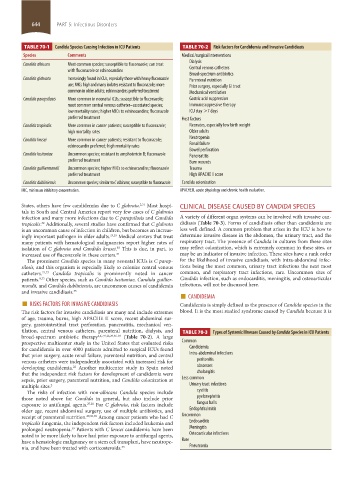
                   TABLE 70-1    Candida Species Causing Infection in ICU Patients    TABLE 70-2    Risk factors for Candidemia and Invasive Candidiasis
                  Species        Comments                               Medical/surgical Interventions
                                                                          Dialysis
                  Candida albicans  Most common species; susceptible to fluconazole; can treat   Central venous catheters
                                 with fluconazole or echinocandins
                                                                          Broad-spectrum antibiotics
                  Candida glabrata  Increasingly found in ICUs, especially those with heavy fluconazole   Parenteral nutrition
                                 use; MICs high and many isolates resistant to fluconazole; more   Prior surgery, especially GI tract
                                 common in older adults; echinocandins preferred treatment  Mechanical ventilation
                  Candida parapsilosis  More common in neonatal ICUs; susceptible to fluconazole;   Gastric acid suppression
                                 most common central venous catheter–associated species;   Immunosuppressive therapy
                                 low mortality rates; higher MICs to echinocandins; fluconazole   ICU stay >7 days
                                 preferred treatment                    Host factors
                  Candida tropicalis  More common in cancer patients; susceptible to fluconazole;   Neonates, especially low birth weight
                                 high mortality rates                     Older adults
                  Candida krusei  More common in cancer patients; resistant to fluconazole;    Neutropenia
                                 echinocandin preferred; high mortality rates  Renal failure
                                                                          Bowel perforation
                  Candida lusitaniae  Uncommon species; resistant to amphotericin B; fluconazole    Pancreatitis
                                 preferred treatment                      Burn wounds
                  Candida guilliermondii  Uncommon species; higher MICs to echinocandins; fluconazole   Trauma
                                 preferred treatment                      High APACHE II score
                  Candida dubliniensis  Uncommon species; similar to C albicans; susceptible to fluconazole  Candida colonization
                 MIC, minimum inhibitory concentration.                APACHE II, acute physiology and chronic health evaluation.


                 States, others have few candidemias due to C glabrata.  Most hospi-  CLINICAL DISEASE CAUSED BY CANDIDA SPECIES
                                                          2,31
                 tals in South and Central America report very few cases of C glabrata
                 infection and many more infections due to C parapsilosis and Candida     A variety of different organ systems can be involved with invasive can-
                        32
                 tropicalis.  Additionally, several studies have confirmed that C glabrata   didiasis (Table 70-3). Forms of candidiasis other than candidemia are
                 is an uncommon cause of infection in children, but becomes an increas-  less well defined. A common problem that arises in the ICU is how to
                 ingly important pathogen in older adults. 25,29  Medical centers that treat   determine invasive disease in the abdomen, the urinary tract, and the
                 many patients with hematological malignancies report higher rates of   respiratory tract. The presence of Candida in cultures from these sites
                 isolation of  C glabrata and Candida krusei.  This is due, in part, to   may reflect colonization, which is extremely common in these sites, or
                                                  33
                 increased use of fluconazole in these centers. 34     may be an indicator of invasive infection. These sites have a rank order
                   The prominent Candida species in many neonatal ICUs is C parap-  for the likelihood of invasive candidiasis, with intra-abdominal infec-
                 silosis, and this organism is especially likely to colonize central venous    tions being the most common, urinary tract infections the next most
                 catheters. 21,22   Candida tropicalis is prominently noted in cancer   common, and respiratory tract infections, rare. Uncommon sites of
                 patients.  Other species, such as Candida lusitaniae, Candida guillier-  Candida infection, such as endocarditis, meningitis, and osteoarticular
                       9,33
                 mondii, and Candida dubliniensis, are uncommon causes of candidemia   infections, will not be discussed here.
                 and invasive candidiasis. 35                              ■
                     ■  RISKS FACTORS FOR INVASIVE CANDIDIASIS         Candidemia is simply defined as the presence of Candida species in the
                                                                          CANDIDEMIA
                 The risk factors for invasive candidiasis are many and include extremes   blood. It is the most studied syndrome caused by Candida because it is
                 of age, trauma, burns, high APACHE II score, recent abdominal sur-
                 gery, gastrointestinal tract perforation, pancreatitis, mechanical ven-
                 tilation, central venous catheters, parenteral nutrition, dialysis, and     TABLE 70-3    Types of Systemic Illnesses Caused by Candida Species in ICU Patients
                 broad-spectrum antibiotic therapy 2,4,7,9,22,29,36-38  (Table 70-2). A large
                 prospective multicenter study in the United States that evaluated risks   Common
                 for candidemia in over 4000 patients admitted to surgical ICUs found   Candidemia
                 that prior surgery, acute renal failure, parenteral nutrition, and central   Intra-abdominal infections
                 venous catheters were independently associated with increased risk for   peritonitis
                 developing candidemia.  Another multicenter study in Spain noted   abscesses
                                   22
                 that the independent risk factors for development of candidemia were   cholangitis
                 sepsis, prior surgery, parenteral nutrition, and Candida colonization at   Less common
                 multiple sites. 2                                        Urinary tract infections
                   The risks of infection with non-albicans Candida species include   cystitis
                 those noted above for  Candida in general, but also include prior   pyelonephritis
                 exposure to antifungal agents. 27,28  For  C glabrata, risk factors include   fungus balls
                 older age, recent abdominal surgery, use of multiple antibiotics, and   Endophthalmitis
                 receipt of parenteral nutrition. 29,30,38  Among cancer patients who had C   Uncommon
                 tropicalis fungemia, the independent risk factors included leukemia and   Endocarditis
                 prolonged neutropenia.  Patients with C krusei candidemia have been   Meningitis
                                  39
                 noted to be more likely to have had prior exposure to antifungal agents,   Osteoarticular infections
                 have a hematologic malignancy or a stem cell transplant, have neutrope-  Rare
                 nia, and have been treated with corticosteroids. 33      Pneumonia


            section05_c61-73.indd   644                                                                                1/23/2015   12:48:26 PM

