


Page 916 - Hall et al (2015) Principles of Critical Care-McGraw-Hill
P. 916
CHAPTER 70: Fungal Infections  647


                    In most patients, candiduria represents colonization of the urinary tract,   specificity of 74%.  A prospective multicenter study compared the use-
                                                                                       68
                    and further studies are necessary to establish a diagnosis of  Candida   fulness of the Candida Score to the Candida Colonization Index to iden-
                    urinary tract infection.  On the other hand, culture of Candida species   tify ICU patients at greatest risk of invasive candidiasis and found that
                                    44
                    from normally sterile sites, characteristic skin lesions, and involved tis-  the Candida Score was more sensitive in predicting the development of
                    sues implies invasive infection.                      invasive candidiasis than the Candida Colonization Index. 69
                     It takes 1 to 3 days for yeasts to grow in blood culture bottles and for
                    the laboratory to notify the clinician of this event. In most laboratories,     ■  CLINICAL PREDICTION RULES
                    subculture onto solid media is required to determine the species of   The potential use of colonization indices and scores seems obvious, but
                    Candida,  adding  an  additional  few  days  until  a  final  identification  is   they are not utilized by many ICUs because it is quite costly to perform
                    reported. Several studies have shown increased mortality when anti-  repeated surveillance cultures from multiple different sites in all patients
                    fungal therapy is delayed more than 48 hours after blood is taken for   in an ICU when, for most units, the risk of developing invasive candi-
                    culture. 53,54  An increasing number of laboratories use a rapid specific   diasis is less than 5%. Because of this, others have proposed prediction
                    fluorescence-based assay, PNA-FISH, that can identify C albicans and    rules based solely on clinical risk factors. 70,71  One such rule identified
                    C glabrata within 1 to 2 hours of finding yeasts in a blood culture bottle. 58,59  several factors that, if present within a few days of ICU admission, were
                        ■  NONCULTURE TECHNIQUES                          highly predictive of invasive candidiasis. These factors included systemic
                                                                          antibiotic therapy, presence of a central venous catheter, parenteral
                    Many years have been spent trying to develop an antigen assay for the   nutrition, dialysis, major surgery, pancreatitis, corticosteroids, and other
                    diagnosis of invasive candidiasis. The most promising target is an assay   immunosuppressive agents.  Currently, none of these rules or indices is
                                                                                             70
                    for (1,3)-β-D-glucan, a component of the cell wall of fungi. 60-63  This   widely used, and the benefit appears to be greatest for those units that
                    assay is not specific for Candida because the antigen is present in the cell   have high rates of candidiasis. 71
                    wall of many fungi. However, it could be used as an indirect test for the
                    possibility of candidiasis in appropriate high-risk hosts, such as those   STRATEGIES TO PREVENT INVASIVE CANDIDIASIS
                    in the ICU. In one multicenter study in the United States and another
                    single center in Japan (using a different assay), approximately 80% of   Several strategies have been developed to reduce the risk of develop-
                    patients with documented invasive candidiasis had a positive test, and   ment of invasive candidiasis in patients in the ICU setting. These strate-
                                                                                                                            73
                    the sensitivity was 70% to 85%. 62,63  However, a study conducted specifi-  gies include prophylaxis, preemptive therapy, and empirical therapy
                    cally in ICU patients found a sensitivity of only 52%.  At this point, it   (Table 70-4).
                                                          61
                    is not clear that this assay will prove to be more useful than obtaining     ■
                    cultures of blood.                                      PROPHYLAXIS
                     PCR technology appears to hold promise for the diagnosis of invasive   Prophylaxis has been used for patients who are at risk for invasive candi-
                    candidiasis and for identification of the infecting Candida species, but   diasis, but who do not have documented colonization. 66,67  In some stud-
                    has yet to be developed as a commercially available, standardized assay.   ies, prophylaxis was given to most patients at the time of their admission
                    In some studies, but not in others, PCR facilitated earlier diagnosis. 64,65  to the ICU; other studies selectively used prophylaxis only for those
                                                                          patients felt to be at the highest risk for invasive candidiasis. 74-81  Two pla-
                    IDENTIFYING PATIENTS AT RISK                          cebo-controlled studies have shown that fluconazole, 100 mg or 400 mg
                    FOR INVASIVE CANDIDIASIS                              daily, given on admission to the ICU can prevent invasive candidiasis, but
                                                                          in both studies, there was no decrease in mortality. 74,77  In a small placebo-
                    Because of the difficulty in quickly establishing a diagnosis of invasive   controlled blinded trial that specifically targeted patients at high risk for
                    candidiasis, strategies to determine which patients are at greatest risk   Candida intra-abdominal infections, fluconazole prophylaxis was able
                    for invasive candidiasis have been developed with the intent of allowing   to prevent both intra-abdominal Candida colonization and infection. 78
                    therapy for invasive candidiasis to begin as early as possible in appropri-  In  an  attempt  to  obviate  the  issue  of  selection  of  fluconazole-
                    ate patients. 66,67  A number of prediction rules have been formulated to   resistant yeasts, such as C glabrata, the use of an echinocandin, caspo-
                    identify high-risk patients. The prediction rules are of two types: one   fungin, as prophylaxis in the ICU setting has been studied. A small
                    type uses the presence of Candida colonization as one component of the
                    rule and is more commonly used in European medical centers 36,68,69 ; the
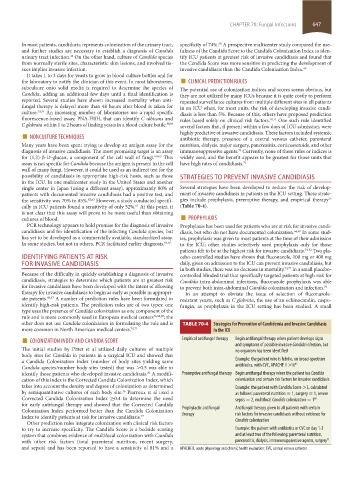
                    other does not use Candida colonization in formulating the rule and is     TABLE 70-4     Strategies for Prevention of Candidemia and Invasive Candidiasis
                    more common in North American medical centers. 70,71             in the ICU
                        ■  COLONIZATION INDEX AND CANDIDA SCORE           Empirical antifungal therapy  Begin antifungal therapy when patient develops signs

                    The initial studies by Pittet et al utilized daily cultures of multiple   and symptoms of possible invasive Candida infection, but
                                                                                            no organism has been identified
                    body sites for Candida in patients in a surgical ICU and showed that
                    a  Candida  Colonization  Index  (number  of  body  sites  yielding  same   Example: the patient who is febrile, on broad-spectrum
                                                                                                                 83
                    Candida species/number body sites tested) that was >0.5 was able to     antibiotics, with CVC, APACHE II >16
                    identify those patients who developed invasive candidiasis.  A modifi-  Preemptive antifungal therapy Begin antifungal therapy when the patient has Candida
                                                              36
                    cation of this index is the Corrected Candida Colonization Index, which   colonization and certain risk factors for invasive candidiasis
                    takes into account the density and degree of colonization as determined   Example: the patient with Candida Score >3, calculated
                    by semiquantitative cultures of each body site.  Piarroux et al used a   as follows: parenteral nutrition = 1, surgery = 1, severe
                                                      36
                    Corrected Candida Colonization Index  ≥0.4 to determine the need        sepsis = 2, multifocal Candida colonization = 1 69
                    for early antifungal therapy and showed that the Corrected Candida
                    Colonization Index performed better than the Candida Colonization   Prophylactic antifungal   Antifungal therapy given to all patients with certain
                    Index to identify patients at risk for invasive candidiasis. 72  therapy  risk factors for invasive candidiasis without evidence for
                     Other prediction rules integrate colonization with clinical risk factors   Candida colonization
                    to  try  to  increase  specificity.  The  Candida  Score  is  a  bedside  scoring   Example: the patient with antibiotics or CVC on day 1-3
                    system that combines evidence of multifocal colonization with Candida   and at least two of the following: parenteral nutrition,
                    with other risk factors (total parenteral nutrition, recent surgery,    pancreatitis, dialysis, immunosuppressive agents, surgery 71
                    and sepsis) and has been reported to have a sensitivity of 81% and a   APACHE II, acute physiology and chronic health evaluation; CVC, central venous catheter.


            section05_c61-73.indd   647                                                                                1/23/2015   12:48:32 PM

