


Page 917 - Hall et al (2015) Principles of Critical Care-McGraw-Hill
P. 917
648     PART 5: Infectious Disorders


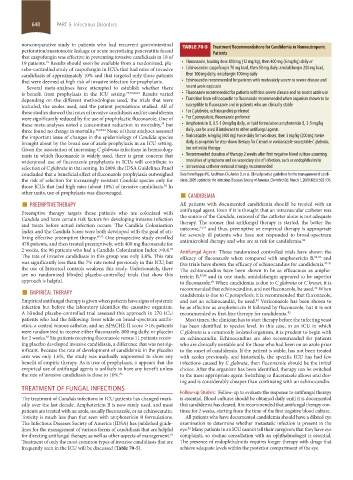
                 noncomparative study in patients who had recurrent gastrointestinal     TABLE 70-5     Treatment Recommendations for Candidemia in Nonneutropenic
                 perforation/ anastomotic leakage or acute necrotizing pancreatitis found   Patients
                 that caspofungin was effective in preventing invasive candidiasis in 18 of
                 19 patients.  Results should soon be available from a randomized, pla-  •  Fluconazole, loading dose 800 mg (12 mg/kg), then 400 mg (6 mg/kg) daily or
                          79
                 cebo-controlled study of caspofungin in ICUs that had rates of invasive   •  Echinocandin: caspofungin 70 mg load, then 50 mg daily; anidulafungin 200 mg load,
                 candidiasis of approximately 10% and that targeted only those patients   then 100 mg daily; micafungin 100 mg daily
                 that were deemed at high risk of invasive infection for prophylaxis.  •  Echinocandin recommended for patients with moderately severe to severe disease and
                   Several meta-analyses have attempted to establish whether there   recent azole exposure
                 is benefit from prophylaxis in the ICU setting. 75,76,80,81  Results varied   •  Fluconazole recommended for patients with less severe disease and no recent azole use
                 depending  on  the  different  methodologies  used,  the  trials  that  were   •  Transition from echinocandin to fluconazole recommended when organism shown to be
                 included, the azoles used, and the patient populations studied. All of     susceptible to fluconazole and in patients who are clinically stable
                 these studies showed that rates of invasive candidiasis and/or candidemia   •  For C glabrata, echinocandins preferred
                 were significantly reduced by the use of prophylactic fluconazole. One of   •  For C parapsilosis, fluconazole preferred
                 these meta-analyses noted a concomitant reduction in mortality,  but   •  Amphotericin B, 0.5-1.0 mg/kg daily, or lipid formulation amphotericin B, 3-5 mg/kg
                                                                 75
                 three found no change in mortality. 76,80,81  None of these analyses assessed   daily, can be used if intolerant to other antifungal agents
                 the important issue of changes in the epidemiology of Candida species   •  Voriconazole, 6 mg/kg (400 mg) twice daily for two doses, then 3 mg/kg (200 mg) twice
                 brought about by the broad use of azole prophylaxis in an ICU setting.   daily, is an option for step-down therapy for C krusei or voriconazole-susceptible C glabrata,
                 Given the association of increasing C glabrata infections in hematology   but not initial therapy
                 units in which fluconazole is widely used, there is great concern that   •  Recommended duration of therapy 2 weeks after first negative blood culture assuming
                 widespread use of fluconazole prophylaxis in ICUs will contribute to     resolution of symptoms and no secondary site of infection, such as endophthalmitis
                 selection of C glabrata in that setting. In 2009, the IDSA Guidelines Panel   •  Intravenous catheter removal strongly recommended
                 concluded that a beneficial effect of fluconazole prophylaxis outweighed   Data from Pappas PG, Kauffman CA, Andes D, et al. Clinical practice guidelines for the management of candi-
                 the risk of selection for increasingly resistant Candida species only for   diasis: 2009 update by the Infectious Diseases Society of America. Clin Infect Dis. March 1, 2009;48(5):503-535.
                 those ICUs that had high rates (about 10%) of invasive candidiasis.  In
                                                                  82
                 other units, use of prophylaxis was discouraged.          ■  CANDIDEMIA
                     ■  PREEMPTIVE THERAPY                             All patients with documented candidemia should be treated with an
                 Preemptive therapy  targets those  patients  who  are colonized with   antifungal agent. Even if it is thought that an intravascular catheter was
                 Candida and have certain risk factors for developing invasive infection   the source of the Candida, removal of the catheter alone is not adequate
                 and treats before actual infection occurs. The Candida Colonization   therapy. The sooner that antifungal therapy is started, the better the
                                                                              53,54
                 Index and the Candida Score were both developed with the goal of uti-  outcome,   and thus, preemptive or empirical therapy is appropriate
                 lizing effective preemptive therapy. 68,72  One prospective study enrolled   for severely ill patients who have not responded to broad-spectrum
                                                                                                                 82
                 478 patients, and then treated preemptively, with 400 mg fluconazole for   antimicrobial therapy and who are at risk for candidemia.
                 2 weeks, the 96 patients who had a Candida Colonization Index >0.4.    Antifungal Agent:  Three randomized controlled trials have shown the
                                                                    72
                 The rate of invasive candidiasis in this group was only 3.8%. This rate   efficacy of fluconazole when compared with amphotericin B, 84-86  and
                 was significantly less than the 7% rate noted previously in this ICU, but   five trials have shown the efficacy of echinocandins for candidemia. 87-91
                 the use of historical controls weakens this study. Unfortunately, there   The  echinocandins  have  been  shown  to  be  as  efficacious  as ampho-
                 are no randomized blinded placebo-controlled trials that show this   tericin B, 87,88  and in one study, anidulafungin appeared to be superior
                 approach is helpful.                                  to fluconazole.  When candidemia is due to C glabrata or C krusei, it is
                                                                                  89
                     ■  EMPIRICAL THERAPY                              recommended that echinocandins, and not fluconazole, be used.  When
                                                                                                                     82
                 Empirical antifungal therapy is given when patients have signs of systemic   candidemia is due to C parapsilosis, it is recommended that fluconazole,
                                                                       and not an echinocandin, be used.  Voriconazole has been shown to
                                                                                                 82
                 infection but before the laboratory identifies the causative organism.    be as effective as amphotericin B followed by fluconazole, but it is not
                 A blinded placebo-controlled trial assessed this approach in 270 ICU   recommended as first-line therapy for candidemia. 92
                 patients who had the following: fever while on broad-spectrum antibi-  Most times, the clinician has to start therapy before the infecting yeast
                 otics, a central venous catheter, and an APACHE II score >16; patients   has been identified to species level. In this case, in an ICU in which
                 were randomized to receive either fluconazole, 800 mg daily, or placebo   C glabrata is a commonly isolated organism, it is prudent to begin with
                 for 2 weeks.  Six patients receiving fluconazole versus 11 patients receiv-  an echinocandin. Echinocandins are also recommended for patients
                          83
                 ing placebo developed invasive candidiasis, a difference that was not sig-  who are clinically unstable and for those who had been on an azole prior
                 nificant. Because the rate of development of candidemia in the placebo   to the onset of candidemia. If the patient is stable, has not been treated
                 arm was only 1.6%, the study was markedly unpowered to show any   with azoles  previously, and historically, the specific ICU  has  had  few
                 benefit of empiric therapy. As is true of prophylaxis, it appears that the   infections caused by C glabrata, then fluconazole should be the initial
                 empirical use of antifungal agents is unlikely to have any benefit unless   choice. After the organism has been identified, therapy can be switched
                 the rate of invasive candidiasis is close to 10%. 82  to the most appropriate agent. Switching to fluconazole allows oral dos-
                                                                       ing and is considerably cheaper than continuing with an echinocandin.
                 TREATMENT OF FUNGAL INFECTIONS
                                                                       Follow-up Studies:  Follow-up to evaluate the response to antifungal therapy
                 The treatment of Candida infections in ICU patients has changed mark-  is essential. Blood cultures should be obtained daily until it is documented
                 edly over the last decade. Amphotericin B is now rarely used, and most   that candidemia has cleared. It is recommended that antifungal therapy con-
                 patients are treated with an azole, usually fluconazole, or an echinocandin.   tinue for 2 weeks, starting from the time of the first negative blood culture.
                 Toxicity is much less than that seen with amphotericin B formulations.   All patients who have documented candidemia should have a dilated eye
                 The Infectious Diseases Society of America (IDSA) has published guide-  examination to determine whether metastatic infection is present in the
                 lines for the management of various forms of candidiasis that are helpful   eye.  Many patients in an ICU cannot tell their caregivers that they have eye
                                                                          82
                 for directing antifungal therapy, as well as other aspects of management.    complaints, so routine consultation with an ophthalmologist is essential.
                                                                    82
                 Treatment of only the most common types of invasive candidiasis that are   The presence of endophthalmitis requires longer therapy with drugs that
                 frequently seen in the ICU will be discussed (Table 70-5).  achieve adequate levels within the posterior compartment of the eye.


            section05_c61-73.indd   648                                                                                1/23/2015   12:48:32 PM

