


Page 185 - Clinical Anatomy
P. 185
ECA3  7/18/06  6:45 PM  Page 170


                 170  The upper limb


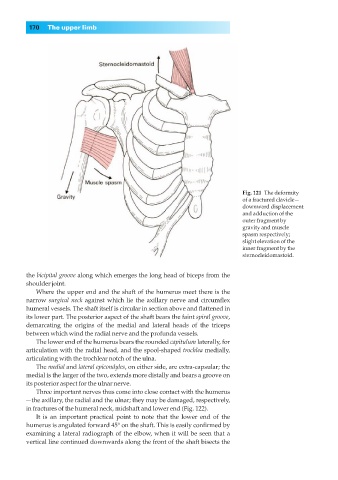
                                                                              Fig. 121◊The deformity
                                                                              of a fractured clavicle—
                                                                              downward displacement
                                                                              and adduction of the
                                                                              outer fragment by
                                                                              gravity and muscle
                                                                              spasm respectively;
                                                                              slight elevation of the
                                                                              inner fragment by the
                                                                              sternocleidomastoid.


                the bicipital groove along which emerges the long head of biceps from the
                shoulder joint.
                   Where the upper end and the shaft of the humerus meet there is the
                narrow surgical neck against which lie the axillary nerve and circumflex
                humeral vessels. The shaft itself is circular in section above and flattened in
                its lower part. The posterior aspect of the shaft bears the faint spiral groove,
                demarcating the origins of the medial and lateral heads of the triceps
                between which wind the radial nerve and the profunda vessels.
                   The lower end of the humerus bears the rounded capitulum laterally, for
                articulation with the radial head, and the spool-shaped trochlea medially,
                articulating with the trochlear notch of the ulna.
                   The medial and lateral epicondyles, on either side, are extra-capsular; the
                medial is the larger of the two, extends more distally and bears a groove on
                its posterior aspect for the ulnar nerve.
                   Three important nerves thus come into close contact with the humerus
                —the axillary, the radial and the ulnar; they may be damaged, respectively,
                in fractures of the humeral neck, midshaft and lower end (Fig. 122).
                   It is an important practical point to note that the lower end of the
                humerus is angulated forward 45° on the shaft. This is easily confirmed by
                examining a lateral radiograph of the elbow, when it will be seen that a
                vertical line continued downwards along the front of the shaft bisects the

