


Page 198 - Clinical Application of Mechanical Ventilation
P. 198
164    Chapter 6


                        TABLE 6-4 Procedure for Oral Intubation

                          1.  Assemble and test supplies (e.g., check light source and ET tube cuff for air leak).

                          2.  Lubricate the deflated cuff with a water-soluble lubricant.

                          3.  Inform or explain procedure to patient.
                          4.  Bag-mask ventilate and preoxygenate patient with 100% oxygen.

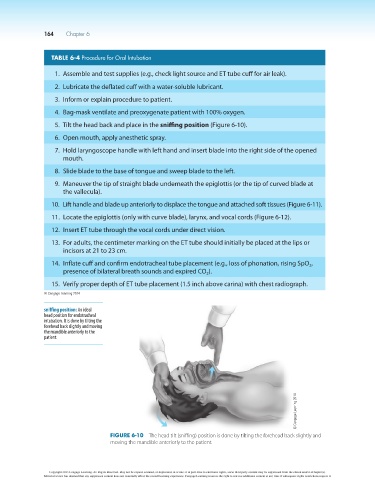
                          5.  Tilt the head back and place in the sniffing position (Figure 6-10).
                          6.  Open mouth, apply anesthetic spray.

                          7.   Hold laryngoscope handle with left hand and insert blade into the right side of the opened
                            mouth.
                          8.  Slide blade to the base of tongue and sweep blade to the left.

                          9.   Maneuver the tip of straight blade underneath the epiglottis (or the tip of curved blade at
                            the vallecula).

                        10.   Lift handle and blade up anteriorly to displace the tongue and attached soft tissues (Figure 6-11).

                        11.  Locate the epiglottis (only with curve blade), larynx, and vocal cords (Figure 6-12).
                        12.  Insert ET tube through the vocal cords under direct vision.

                        13.   For adults, the centimeter marking on the ET tube should initially be placed at the lips or
                            incisors at 21 to 23 cm.

                        14.   Inflate cuff and confirm endotracheal tube placement (e.g., loss of phonation, rising SpO ,
                                                                                                             2
                            presence of bilateral breath sounds and expired CO ).
                                                                           2
                        15.  Verify proper depth of ET tube placement (1.5 inch above carina) with chest radiograph.

                      © Cengage Learning 2014

                      sniffing position: An ideal
                      head position for endotracheal
                      intubation. It is done by tilting the
                      forehead back slightly and moving
                      the mandible anteriorly to the
                      patient.


                                                                                                        © Cengage Learning 2014


                                            Figure 6-10  The head tilt (sniffing) position is done by tilting the forehead back slightly and
                                            moving the mandible anteriorly to the patient.


                        Copyright 2013 Cengage Learning. All Rights Reserved. May not be copied, scanned, or duplicated, in whole or in part. Due to electronic rights, some third party content may be suppressed from the eBook and/or eChapter(s).
                      Editorial review has deemed that any suppressed content does not materially affect the overall learning experience. Cengage Learning reserves the right to remove additional content at any time if subsequent rights restrictions require it.

