


Page 203 - Clinical Application of Mechanical Ventilation
P. 203
Airway Management in Mechanical Ventilation  169


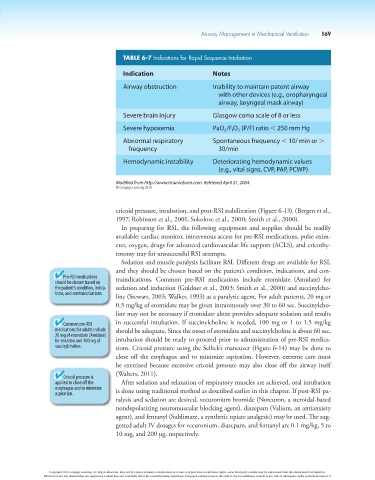
                                                TABLE 6-7 Indications for Rapid Sequence Intubation

                                                Indication                   Notes

                                                Airway obstruction           Inability to maintain patent airway
                                                                               with other devices (e.g., oropharyngeal
                                                                               airway, laryngeal mask airway)

                                                Severe brain injury          Glasgow coma scale of 8 or less

                                                Severe hypoxemia             PaO /F O  (P/F) ratio , 250 mm Hg
                                                                                     2
                                                                                 2
                                                                                   I
                                                Abnormal respiratory         Spontaneous frequency , 10/ min or .
                                                  frequency                    30/min
                                                Hemodynamic instability      Deteriorating hemodynamic values
                                                                               (e.g., vital signs, CVP, PAP, PCWP)

                                             Modified from http://www.traumaburn.com. Retrieved April 21, 2004.
                                             © Cengage Learning 2014


                                             cricoid pressure, intubation, and post-RSI stabilization (Figure 6-13). (Bergen et al.,
                                             1997; Robinson et al., 2001; Sokolove et al., 2000; Smith et al., 2000).
                                               In preparing for RSI, the following equipment and supplies should be readily
                                             available: cardiac monitor, intravenous access for pre-RSI medications, pulse oxim-
                                             eter, oxygen, drugs for advanced cardiovascular life support (ACLS), and cricothy-
                                             rotomy tray for unsuccessful RSI attempts.
                                               Sedation and muscle paralysis facilitate RSI. Different drugs are available for RSI,
                                             and they should be chosen based on the patient’s condition, indications, and con-
                            Pre-RSI medications   traindications.  Common  pre-RSI  medications  include  etomidate  (Amidate)  for
                          should be chosen based on
                          the patient’s condition, indica-  sedation and induction (Guldner et al., 2003; Smith et al., 2000) and succinylcho-
                          tions, and contraindications.
                                             line (Stewart, 2003; Walker, 1993) as a paralytic agent. For adult patients, 20 mg or
                                             0.3 mg/kg of etomidate may be given intravenously over 30 to 60 sec. Succinylcho-
                                             line may not be necessary if etomidate alone provides adequate sedation and results

                            Common pre-RSI   in successful intubation. If succinylcholine is needed, 100 mg or 1 to 1.5 mg/kg
                          medications for adults include   should be adequate. Since the onset of etomidate and succinylcholine is about 60 sec,
                          20 mg of etomidate (Amidate)
                          for sedation and 100 mg of   intubation should be ready to proceed prior to administration of pre-RSI medica-
                          succinylcholine.   tions. Cricoid pressure using the Sellick’s maneuver (Figure 6-14) may be done to
                                             close off the esophagus and to minimize aspiration. However, extreme care must
                                             be exercised because excessive cricoid pressure may also close off the airway itself
                                             (Walters, 2011).
                            Cricoid pressure is
                          applied to close off the   After sedation and relaxation of respiratory muscles are achieved, oral intubation
                          esophagus and to minimize   is done using traditional method as described earlier in this chapter. If post-RSI pa-
                          aspiration.
                                             ralysis and sedation are desired, vecuronium bromide (Norcuron, a steroidal-based
                                             nondepolarizing neuromuscular blocking agent), diazepam (Valium, an antianxiety
                                             agent), and fentanyl (Sublimaze, a synthetic opiate analgesic) may be used. The sug-
                                             gested adult IV dosages for vecuronium, diazepam, and fentanyl are 0.1 mg/kg, 5 to
                                             10 mg, and 200 μg, respectively.


                        Copyright 2013 Cengage Learning. All Rights Reserved. May not be copied, scanned, or duplicated, in whole or in part. Due to electronic rights, some third party content may be suppressed from the eBook and/or eChapter(s).
                      Editorial review has deemed that any suppressed content does not materially affect the overall learning experience. Cengage Learning reserves the right to remove additional content at any time if subsequent rights restrictions require it.

