


Page 208 - Clinical Application of Mechanical Ventilation
P. 208
174    Chapter 6


                                            Secretions must be removed by way of ET suctioning. However, frequent and
                                            inappropriate ET suctioning can cause mucosal damage and increase the inci-
                                            dence of suction-induced hypoxemia and arrhythmias. Therefore, ET suctioning
                                            should not be done on a preset sechedule; it should be done only when indicated.
                                             The size of a suction catheter should be large enough for removal of secretions.
                                            However,  an  oversized  suction  catheter  may  impede  airflow  through  the  ET
                                            tube. As a rule of thumb, the outside diameter of the suction catheter should
                                            not exceed 50% of the inside diameter of the ET tube (Wilkins et al., 2003).
                          The appropriate suction   For  example,  a  size  12  Fr  suction  catheter  should  be  used  to  suction  a  size
                        catheter size in French (Fr)
                        may be estimated by multiply-  8 ET tube. The equation is (8 mm 3 3)/2. The 3 in the equation is the factor
                        ing the ET tube size by 3, and   to convert mm to Fr. The 2 in the equation is to obtain 50% of the ET tube
                        then dividing by 2. The equa-
                        tion is Fr 5 (mm 3 3) / 2.  diameter. If the calculate size is not available, the next larger suction catheter
                                            may be used.
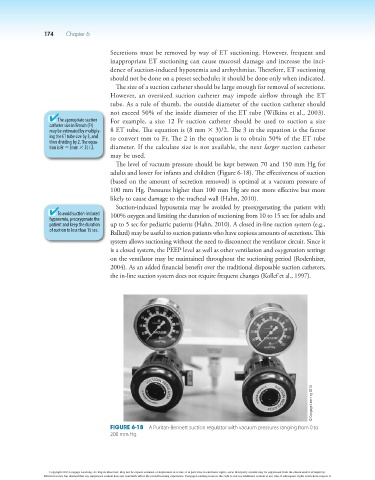
                                             The level of vacuum pressure should be kept between 70 and 150 mm Hg for
                                            adults and lower for infants and children (Figure 6-18). The effectiveness of suction
                                            (based on the amount of secretion removed) is optimal at a vacuum pressure of
                                            100 mm Hg. Pressures higher than 100 mm Hg are not more effective but more
                                            likely to cause damage to the tracheal wall (Hahn, 2010).
                                             Suction-induced  hypoxemia  may  be  avoided  by  preoxygenating  the  patient  with
                          To avoid suction-induced   100% oxygen and limiting the duration of suctioning from 10 to 15 sec for adults and
                        hypoxemia, preoxygenate the
                        patient and keep the duration   up to 5 sec for pediatric patients (Hahn, 2010). A closed in-line suction system (e.g.,
                        of suction to less than 15 sec.  Ballard) may be useful to suction patients who have copious amounts of secretions. This
                                            system allows suctioning without the need to disconnect the ventilator circuit. Since it
                                            is a closed system, the PEEP level as well as other ventilation and oxygenation settings
                                            on the ventilator may be maintained throughout the suctioning period (Rodenhizer,
                                            2004). As an added financial benefit over the traditional disposable suction catheters,
                                            the in-line suction system does not require frequent changes (Kollef et al., 1997).


                                                                                                             © Cengage Learning 2014


                                            Figure 6-18  A Puritan-Bennett suction regulator with vacuum pressures ranging from 0 to
                                            200 mm Hg.


                        Copyright 2013 Cengage Learning. All Rights Reserved. May not be copied, scanned, or duplicated, in whole or in part. Due to electronic rights, some third party content may be suppressed from the eBook and/or eChapter(s).
                      Editorial review has deemed that any suppressed content does not materially affect the overall learning experience. Cengage Learning reserves the right to remove additional content at any time if subsequent rights restrictions require it.

