


Page 318 - Clinical Application of Mechanical Ventilation
P. 318
284    Chapter 10


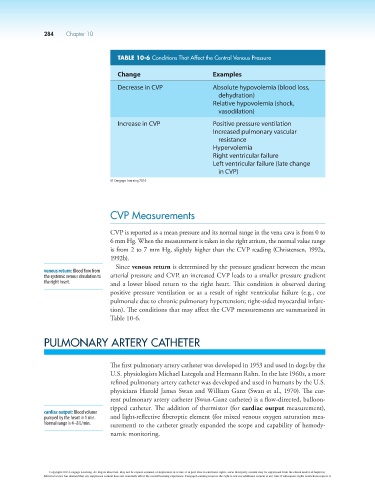
                                              TABLE 10-6 Conditions That Affect the Central Venous Pressure

                                              Change                         Examples

                                              Decrease in CVP                Absolute hypovolemia (blood loss,
                                                                               dehydration)
                                                                             Relative hypovolemia (shock,
                                                                               vasodilation)
                                              Increase in CVP                Positive pressure ventilation
                                                                             Increased pulmonary vascular
                                                                               resistance
                                                                             Hypervolemia
                                                                             Right ventricular failure
                                                                             Left ventricular failure (late change
                                                                               in CVP)
                                            © Cengage Learning 2014


                                            CVP Measurements


                                            CVP is reported as a mean pressure and its normal range in the vena cava is from 0 to
                                            6 mm Hg. When the measurement is taken in the right atrium, the normal value range
                                            is from 2 to 7 mm Hg, slightly higher than the CVP reading (Christensen, 1992a,
                                            1992b).
                                             Since venous return is determined by the pressure gradient between the mean
                      venous return: Blood flow from
                      the systemic venous circulation to   arterial pressure and CVP, an increased CVP leads to a smaller pressure gradient
                      the right heart.      and a lower blood return to the right heart. This condition is observed during
                                            positive  pressure  ventilation  or  as  a  result  of  right  ventricular  failure  (e.g.,  cor
                                            pulmonale due to chronic pulmonary hypertension; right-sided myocardial infarc-
                                            tion). The conditions that may affect the CVP measurements are summarized in
                                            Table 10-6.


                      PULMONARY ARTERY CATHETER


                                            The first pulmonary artery catheter was developed in 1953 and used in dogs by the
                                            U.S. physiologists Michael Lategola and Hermann Rahn. In the late 1960s, a more
                                            refined pulmonary artery catheter was developed and used in humans by the U.S.
                                            physicians Harold James Swan and William Ganz (Swan et al., 1970). The cur-
                                            rent pulmonary artery catheter (Swan-Ganz catheter) is a flow-directed, balloon-
                                            tipped catheter. The addition of thermistor (for cardiac output measurement),
                      cardiac output: Blood volume
                      pumped by the heart in 1 min.   and light-reflective fiberoptic element (for mixed venous oxygen saturation mea-
                      Normal range is 4–8 L/min.  surement) to the catheter greatly expanded the scope and capability of hemody-
                                            namic monitoring.


                        Copyright 2013 Cengage Learning. All Rights Reserved. May not be copied, scanned, or duplicated, in whole or in part. Due to electronic rights, some third party content may be suppressed from the eBook and/or eChapter(s).
                      Editorial review has deemed that any suppressed content does not materially affect the overall learning experience. Cengage Learning reserves the right to remove additional content at any time if subsequent rights restrictions require it.

