


Page 351 - Clinical Application of Mechanical Ventilation
P. 351
Ventilator Waveform Analysis  317


                                             patient’s lungs, allowing clinicians to measure lung pressure or, more importantly,
                                             alveolar pressure (P ALV ). Since there is no flow, the corresponding pressure created
                                             by resistance to flow dissipates immediately. Pressure drops to the peak alveolar
                        peak alveolar pressure (P ALV ):
                                                          ), plateau pressure (P
                        Pressure obtained by performing   pressure (P ALV     PLAT ) level, which can be measured because
                        an end-inspiratory pause, also   of the open communication in the ventilator circuit between the alveoli and the
                        called plateau pressure.
                                             manometer at the ventilator. All lung pressures, not just peak P ALV , are monitored
                                             during this pause in flow. However, P ALV  is used in the graphics and text for em-
                        plateau pressure (P PLAT ): Pres-  phasis throughout this chapter. The extremely thin type 1 pneumocytes (0.5 to 2
                        sure obtained by performing an   angstroms) lining alveoli are more sensitive to pressure and trauma than the progres-
                        end-inspiratory pause, also called
                        peak alveolar pressure.  sively thicker airways. P ALV  is a major concern and reason for performing the pause-
                                             pressure measurement during ventilator management. Once peak P ALV  is known,
                                             circuit and airway resistance can be determined [Resistance 5 (PIP 2 peak P ALV )/
                                             Flow], provided that a constant flow pattern is present to cause a consistent flow-
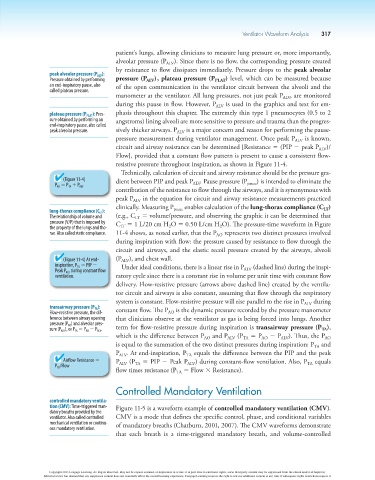
                                             resistive pressure throughout inspiration, as shown in Figure 11-4.
                                               Technically, calculation of circuit and airway resistance should be the pressure gra-
                            (Figure 11-4)    dient between PIP and peak P  . Pause pressure (P  ) is intended to eliminate the
                          P AO  5 P TA  1 P ALV                        ALV              pause
                                             contribution of the resistance to flow through the airways, and it is synonymous with
                                             peak P ALV  in the equation for circuit and airway resistance measurements practiced
                                             clinically. Measuring P   enables calculation of the lung-thorax compliance (C )
                        lung-thorax compliance (C LT ):         pause                                            LT
                        The relationship of volume and   (e.g., C  5 volume/pressure, and observing the graphic it can be determined that
                                                    LT
                        pressure (V/P) that is imposed by   C  5 1 L/20 cm H O 5 0.50 L/cm H O). The pressure-time waveform in Figure
                        the property of the lungs and tho-  LT  2              2
                        rax. Also called static compliance.  11-4 shows, as noted earlier, that the P  represents two distinct pressures involved
                                                                              AO
                                             during inspiration with flow: the pressure caused by resistance to flow through the
                                             circuit and airways, and the elastic recoil pressure created by the airways, alveoli
                            (Figure 11-4) At end-  (P ALV ), and chest wall.
                          inspiration, P TA  5 PIP 2   Under ideal conditions, there is a linear rise in P   (dashed line) during the inspi-
                          Peak P ALV  during constant flow                             ALV
                          ventilation.       ratory cycle since there is a constant rise in volume per unit time with constant flow
                                             delivery. Flow-resistive pressure (arrows above dashed line) created by the ventila-
                                             tor circuit and airways is also constant, assuming that flow through the respiratory
                                             system is constant. Flow-resistive pressure will rise parallel to the rise in P ALV  during
                        transairway pressure (P TA ):   constant flow. The P  is the dynamic pressure recorded by the pressure manometer
                        Flow-resistive pressure, the dif-     AO
                        ference between airway opening   that clinicians observe at the ventilator as gas is being forced into lungs. Another
                        pressure (P AO ) and alveolar pres-
                        sure (P ALV ), or P TA  5 P AO  2 P ALV .  term for flow-resistive pressure during inspiration is transairway pressure (P ),
                                                                                                                 TA
                                             which is the difference between P  and P ALV  (P  5 P  2 P ALV ). Thus, the P
                                                                          AO
                                                                                                                  AO
                                                                                       TA
                                                                                             AO
                                             is equal to the summation of the two distinct pressures during inspiration: P  and
                                                                                                              TA
                                             P ALV . At end-inspiration, P  equals the difference between the PIP and the peak
                                                                    TA
                            Airflow Resistance 5   P   (P  5 PIP 2 Peak P  ) during constant-flow ventilation. Also, P  equals
                          P TA /Flow           ALV  TA               ALV                                    TA
                                             flow times resistance (P  5 Flow 3 Resistance).
                                                                 TA
                                             Controlled Mandatory Ventilation
                        controlled mandatory ventila-
                        tion (CMV): Time-triggered man-  Figure 11-5 is a waveform example of controlled mandatory ventilation (CMV).
                        datory breaths provided by the
                        ventilator. Also called controlled   CMV is a mode that defines the specific control, phase, and conditional variables
                        mechanical ventilation or continu-  of mandatory breaths (Chatburn, 2001, 2007). The CMV waveforms demonstrate
                        ous mandatory ventilation.
                                             that  each  breath  is  a  time-triggered  mandatory  breath,  and  volume-controlled


                        Copyright 2013 Cengage Learning. All Rights Reserved. May not be copied, scanned, or duplicated, in whole or in part. Due to electronic rights, some third party content may be suppressed from the eBook and/or eChapter(s).
                      Editorial review has deemed that any suppressed content does not materially affect the overall learning experience. Cengage Learning reserves the right to remove additional content at any time if subsequent rights restrictions require it.

