


Page 350 - Clinical Application of Mechanical Ventilation
P. 350
316    Chapter 11


                                            side of the waveform (y-axis) is 60 L/min or 1 L/s (60 L/min * 1 min/60s 5 1 L/s).
                      tidal volume (V T ): Volume
                      delivered by ventilator during   Flow is constant for 1 second, therefore, the width of the rectangle (x-axis) is 1 second
                      mandatory breaths.    and, since length times width equals area, 1 L/s * 1s 5 1 liter tidal volume (V )
                                                                                                                T
                                            delivered. Also, constant flow means there is a constant delivery of volume per unit
                                            time. For example, if 0.25s is used as the unit of time, a 0.25 liter of gas is delivered
                          Constant Peak Flow 3   every 0.25s (Volume 5 1 L/s * 0.25s 5 0.25 L).
                        I Time 5 Tidal Volume
                                             Since patients exhale what they inhale, it can be stated that area b enclosed under
                                            the expiratory flow wave equals area a under the CFW. If the volume enclosed by
                                            area b during mechanical ventilation is less than area a, then there must either be
                                            a leak in the circuit, some gas has not been expired, or has been trapped in the
                                            patient’s lungs momentarily. The pressure pattern shows a constant rise in lung pres-
                                            sure during the constant flow period as discussed earlier in Figure 11-2.
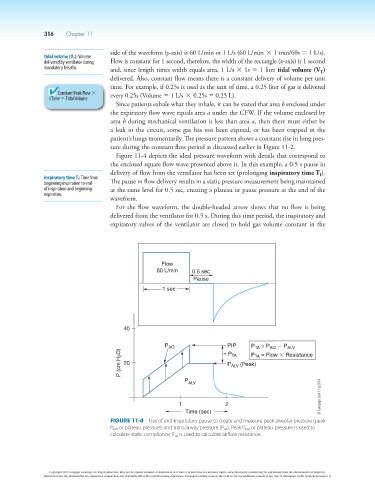
                                             Figure 11-4 depicts the ideal pressure waveform with details that correspond to
                                            the enclosed square flow wave presented above it. In this example, a 0.5 s pause in
                                            delivery of flow from the ventilator has been set (prolonging inspiratory time T ).
                                                                                                                I
                      inspiratory time T I : Time from
                      beginning inspiration to end   The pause in flow delivery results in a static pressure measurement being maintained
                      of inspiration and beginning   at the same level for 0.5 sec, creating a plateau or pause pressure at the end of the
                      expiration.
                                            waveform.
                                             For the flow waveform, the double-headed arrow shows that no flow is being
                                            delivered from the ventilator for 0.5  s. During this time period, the inspiratory and
                                            expiratory valves of the ventilator are closed to hold gas volume constant in the


                                                            Flow
                                                           60 L/min   0.5 sec
                                                                       Pause
                                                             1 sec


                                                40


                                                             P AO               = P       P  = P AO  2 P ALV
                                                                                  PIP
                                                                                           TA
                                               P (cm H 2 O)  20                   P ALV  (Peak) TA
                                                                                          P  = Flow 3 Resistance
                                                                                   TA
                                                                    P
                                                                                                                © Cengage Learning 2014
                                                                     ALV

                                                                  1              2
                                                                    Time (sec)
                                            Figure 11-4  Use of end-inspiratory pause to create and measure peak alveolar pressure (peak
                                            P ALV  or plateau pressure) and transairway pressure (P TA ). Peak P ALV  or plateau pressure is used to
                                            calculate static compliance; P TA  is used to calculate airflow resistance.


                        Copyright 2013 Cengage Learning. All Rights Reserved. May not be copied, scanned, or duplicated, in whole or in part. Due to electronic rights, some third party content may be suppressed from the eBook and/or eChapter(s).
                      Editorial review has deemed that any suppressed content does not materially affect the overall learning experience. Cengage Learning reserves the right to remove additional content at any time if subsequent rights restrictions require it.

