


Page 353 - Clinical Application of Mechanical Ventilation
P. 353
Ventilator Waveform Analysis  319


                                            60
                                           V (L/min)  50


                                                         1         2         3          4         5         6

                                           230
                                          P (cm H 2 O)  40


                                                                                                                    © Cengage Learning 2014


                                           22
                                                         1         2         3          4         5         6
                                                                            Time (sec)
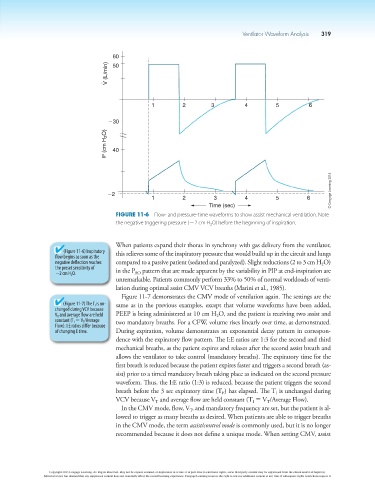
                                             Figure 11-6  Flow- and pressure-time waveforms to show assist mechanical ventilation. Note
                                             the negative triggering pressure (22 cm H 2 O) before the beginning of inspiration.


                                             When patients expand their thorax in synchrony with gas delivery from the ventilator,
                            (Figure 11-6) Inspiratory   this relieves some of the inspiratory pressure that would build up in the circuit and lungs
                          flow begins as soon as the
                          negative deflection reaches   compared to a passive patient (sedated and paralyzed). Slight reductions (2 to 3 cm H O)
                                                                                                                 2
                          the preset sensitivity of   in the P  pattern that are made apparent by the variability in PIP at end-inspiration are
                          22 cm H 2 O.              AO
                                             unremarkable. Patients commonly perform 33% to 50% of normal workloads of venti-
                                             lation during optimal assist CMV VCV breaths (Marini et al., 1985).
                                               Figure 11-7 demonstrates the CMV mode of ventilation again. The settings are the
                            (Figure 11-7) The T I  is un-  same as in the previous examples, except that volume waveforms have been added,
                          changed during VCV because
                          V T  and average flow are held   PEEP is being administered at 10 cm H O, and the patient is receiving two assist and
                                                                              2
                          constant (T I  5 V T /Average   two mandatory breaths. For a CFW, volume rises linearly over time, as demonstrated.
                          Flow). I:E ratios differ because
                          of changing E time.  During expiration, volume demonstrates an exponential decay pattern in correspon-
                                             dence with the expiratory flow pattern. The I:E ratios are 1:3 for the second and third
                                             mechanical breaths, as the patient expires and relaxes after the second assist breath and
                                             allows the ventilator to take control (mandatory breaths). The expiratory time for the
                                             first breath is reduced because the patient expires faster and triggers a second breath (as-
                                             sist) prior to a timed mandatory breath taking place as indicated on the second pressure
                                             waveform. Thus, the I:E ratio (1:3) is reduced, because the patient triggers the second
                                             breath before the 3 sec expiratory time (T ) has elapsed. The T  is unchanged during
                                                                                                  I
                                                                                E
                                             VCV because V  and average flow are held constant (T  5 V /Average Flow).
                                                                                               T
                                                                                          I
                                                          T
                                               In the CMV mode, flow, V , and mandatory frequency are set, but the patient is al-
                                                                      T
                                             lowed to trigger as many breaths as desired. When patients are able to trigger breaths
                                             in the CMV mode, the term assist/control mode is commonly used, but it is no longer
                                             recommended because it does not define a unique mode. When setting CMV, assist


                        Copyright 2013 Cengage Learning. All Rights Reserved. May not be copied, scanned, or duplicated, in whole or in part. Due to electronic rights, some third party content may be suppressed from the eBook and/or eChapter(s).
                      Editorial review has deemed that any suppressed content does not materially affect the overall learning experience. Cengage Learning reserves the right to remove additional content at any time if subsequent rights restrictions require it.

