


Page 372 - Clinical Application of Mechanical Ventilation
P. 372
338    Chapter 11


                                           V (L/min)  120


                                                         2         4       6        8       10       12       14


                                          P (cm H 2 O)  2120


                                              40
                                                                                                                  © Cengage Learning 2014


                                                          2       4        6        8        10       12      14
                                                                            Time (sec)
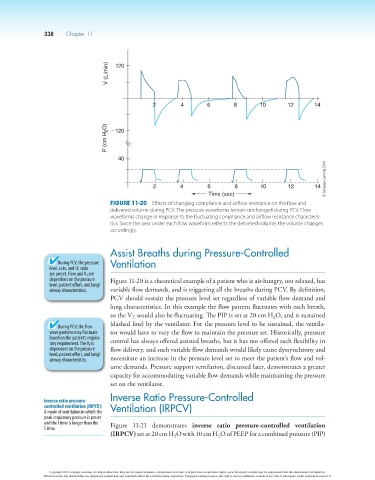
                                            Figure 11-20  Effects of changing compliance and airflow resistance on the flow and
                                            delivered volume during PCV. The pressure waveforms remain unchanged during PCV. Flow
                                            waveforms change in response to the fluctuating compliance and airflow resistance characteris-
                                            tics. Since the area under each flow waveform reflects the delivered volume, the volume changes
                                            accordingly.


                                            Assist Breaths during Pressure-Controlled

                          During PCV, the pressure   Ventilation
                        level, rate, and I:E ratio
                        are preset. Flow and V T  are
                        dependent on the pressure   Figure 11-20 is a theoretical example of a patient who is air-hungry, not relaxed, has
                        level, patient effort, and lung/
                        airway characteristics.  variable flow demands, and is triggering all the breaths during PCV. By definition,
                                            PCV should sustain the pressure level set regardless of variable flow demand and
                                            lung characteristics. In this example the flow pattern fluctuates with each breath,
                                            so the V  would also be fluctuating. The PIP is set at 20 cm H O, and is sustained
                                                                                                 2
                                                   T
                                            (dashed line) by the ventilator. For the pressure level to be sustained, the ventila-
                          During PCV, the flow
                        wave patterns may fluctuate   tor would have to vary the flow to maintain the pressure set. Historically, pressure
                        based on the patient’s respira-  control has always offered assisted breaths, but it has not offered such flexibility in
                        tory requirement. The V T  is
                        dependent on the pressure   flow delivery, and such variable flow demands would likely cause dyssynchrony and
                        level, patient effort, and lung/
                        airway characteristics.  necessitate an increase in the pressure level set to meet the patient’s flow and vol-
                                            ume demands. Pressure support ventilation, discussed later, demonstrates a greater
                                            capacity for accommodating variable flow demands while maintaining the pressure
                                            set on the ventilator.
                                            Inverse Ratio Pressure-Controlled
                      inverse ratio pressure-
                      controlled ventilation (IRPCV):   Ventilation (IRPCV)
                      A mode of ventilation in which the
                      peak inspiratory pressure is preset
                      and the I time is longer than the   Figure  11-21  demonstrates  inverse  ratio  pressure-controlled  ventilation
                      E time.
                                            (IRPCV) set at 20 cm H O with 10 cm H O of PEEP for a combined pressure (PIP)
                                                                               2
                                                                2


                        Copyright 2013 Cengage Learning. All Rights Reserved. May not be copied, scanned, or duplicated, in whole or in part. Due to electronic rights, some third party content may be suppressed from the eBook and/or eChapter(s).
                      Editorial review has deemed that any suppressed content does not materially affect the overall learning experience. Cengage Learning reserves the right to remove additional content at any time if subsequent rights restrictions require it.

