


Page 377 - Clinical Application of Mechanical Ventilation
P. 377
Ventilator Waveform Analysis  343


                                              V (L/min)  100


                                                           2        4        6        8       10       12       14

                                              260
                                             P (cm H 2 O)


                                                40      a            b          c           d            e
                                                                                                                    © Cengage Learning 2014


                                               22
                                                           2        4        6        8       10       12       14
                                                                              Time (sec)
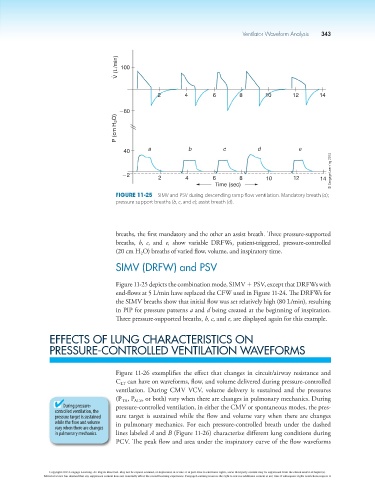
                                             Figure 11-25  SIMV and PSV during descending ramp flow ventilation. Mandatory breath (a);
                                             pressure support breaths (b, c, and e); assist breath (d).


                                             breaths, the first mandatory and the other an assist breath. Three pressure-supported
                                             breaths,  b,  c,  and  e,  show  variable  DRFWs,  patient-triggered,  pressure-controlled
                                             (20 cm H O) breaths of varied flow, volume, and inspiratory time.
                                                     2
                                             SIMV (DRFW) and PSV


                                             Figure 11-25 depicts the combination mode, SIMV 1 PSV, except that DRFWs with
                                             end-flows at 5 L/min have replaced the CFW used in Figure 11-24. The DRFWs for
                                             the SIMV breaths show that initial flow was set relatively high (80 L/min), resulting
                                             in PIP for pressure patterns a and d being created at the beginning of inspiration.
                                             Three pressure-supported breaths, b, c, and e, are displayed again for this example.


                        EFFECTS OF LUNG CHARACTERISTICS ON
                        PRESSURE-CONTROLLED VENTILATION WAVEFORMS


                                             Figure 11-26 exemplifies the effect that changes in circuit/airway resistance and
                                             C  can have on waveforms, flow, and volume delivered during pressure-controlled
                                               LT
                                             ventilation.  During  CMV  VCV,  volume  delivery  is  sustained  and  the  pressures
                                             (P , P ALV , or both) vary when there are changes in pulmonary mechanics. During
                                               TA
                            During pressure-  pressure-controlled ventilation, in either the CMV or spontaneous modes, the pres-
                          controlled ventilation, the
                          pressure target is sustained   sure target is sustained while the flow and volume vary when there are changes
                          while the flow and volume   in  pulmonary  mechanics.  For  each  pressure-controlled  breath  under  the  dashed
                          vary when there are changes
                          in pulmonary mechanics.  lines labeled A and B (Figure 11-26) characterize different lung conditions during
                                             PCV. The peak flow and area under the inspiratory curve of the flow waveforms


                        Copyright 2013 Cengage Learning. All Rights Reserved. May not be copied, scanned, or duplicated, in whole or in part. Due to electronic rights, some third party content may be suppressed from the eBook and/or eChapter(s).
                      Editorial review has deemed that any suppressed content does not materially affect the overall learning experience. Cengage Learning reserves the right to remove additional content at any time if subsequent rights restrictions require it.

