


Page 373 - Clinical Application of Mechanical Ventilation
P. 373
Ventilator Waveform Analysis  339


                                                         I     E
                                              V (L/min)  50  2:1  x
                                                        I:E


                                                           2          4         6         8         10        12
                                                                     y

                                              250

                                              P (cm H 2 O)  40


                                                                                                                    © Cengage Learning 2014


                                                            2         4         6         8         10        12
                                                                               Time (sec)
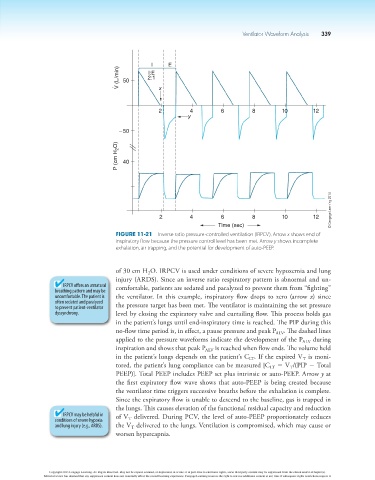
                                             Figure 11-21  Inverse ratio pressure-controlled ventilation (IRPCV). Arrow x shows end of
                                             inspiratory flow because the pressure control level has been met. Arrow y shows incomplete
                                             exhalation, air trapping, and the potential for development of auto-PEEP.


                                             of 30 cm H O. IRPCV is used under conditions of severe hypoxemia and lung
                                                        2
                                             injury (ARDS). Since an inverse ratio respiratory pattern is abnormal and un-
                            IRPCV offers an unnatural   comfortable, patients are sedated and paralyzed to prevent them from “fighting”
                          breathing pattern and may be
                          uncomfortable. The patient is   the ventilator. In this example, inspiratory flow drops to zero (arrow x) since
                          often sedated and paralyzed
                          to prevent patient-ventilator   the pressure target has been met. The ventilator is maintaining the set pressure
                          dyssynchrony.      level by closing the expiratory valve and curtailing flow. This process holds gas
                                             in the patient’s lungs until end-inspiratory time is reached. The PIP during this
                                             no-flow time period is, in effect, a pause pressure and peak P ALV . The dashed lines
                                             applied to the pressure waveforms indicate the development of the P ALV  during
                                             inspiration and shows that peak P ALV  is reached when flow ends. The volume held
                                             in the patient’s lungs depends on the patient’s C . If the expired V  is moni-
                                                                                         LT
                                                                                                          T
                                             tored, the patient’s lung compliance can be measured [C  5 V /(PIP 2 Total
                                                                                                      T
                                                                                                LT
                                             PEEP)]. Total PEEP includes PEEP set plus intrinsic or auto-PEEP. Arrow y at
                                             the  first  expiratory  flow  wave  shows  that  auto-PEEP  is  being  created  because
                                             the ventilator time triggers successive breaths before the exhalation is complete.
                                             Since the expiratory flow is unable to descend to the baseline, gas is trapped in
                                             the lungs. This causes elevation of the functional residual capacity and reduction
                            IRPCV may be helpful in   of V  delivered. During PCV, the level of auto-PEEP proportionately reduces
                          conditions of severe hypoxia   T
                          and lung injury (e.g., ARDS).  the V  delivered to the lungs. Ventilation is compromised, which may cause or
                                                  T
                                             worsen hypercapnia.


                        Copyright 2013 Cengage Learning. All Rights Reserved. May not be copied, scanned, or duplicated, in whole or in part. Due to electronic rights, some third party content may be suppressed from the eBook and/or eChapter(s).
                      Editorial review has deemed that any suppressed content does not materially affect the overall learning experience. Cengage Learning reserves the right to remove additional content at any time if subsequent rights restrictions require it.

